
Estimate preparative HPLC injections, mobile phase to prepare, solvent split, runtime, and solvent cost from your loading and method values.
Table of contents
How to use our Preparative HPLC Loading, Solvent Use and Cost Calculator
- Enter the requested Target purified amount and a realistic Expected recovery from a similar purification or planning estimate.
- Enter the target-compound concentration, planned injection volume, and method-supported Usable target load per injection.
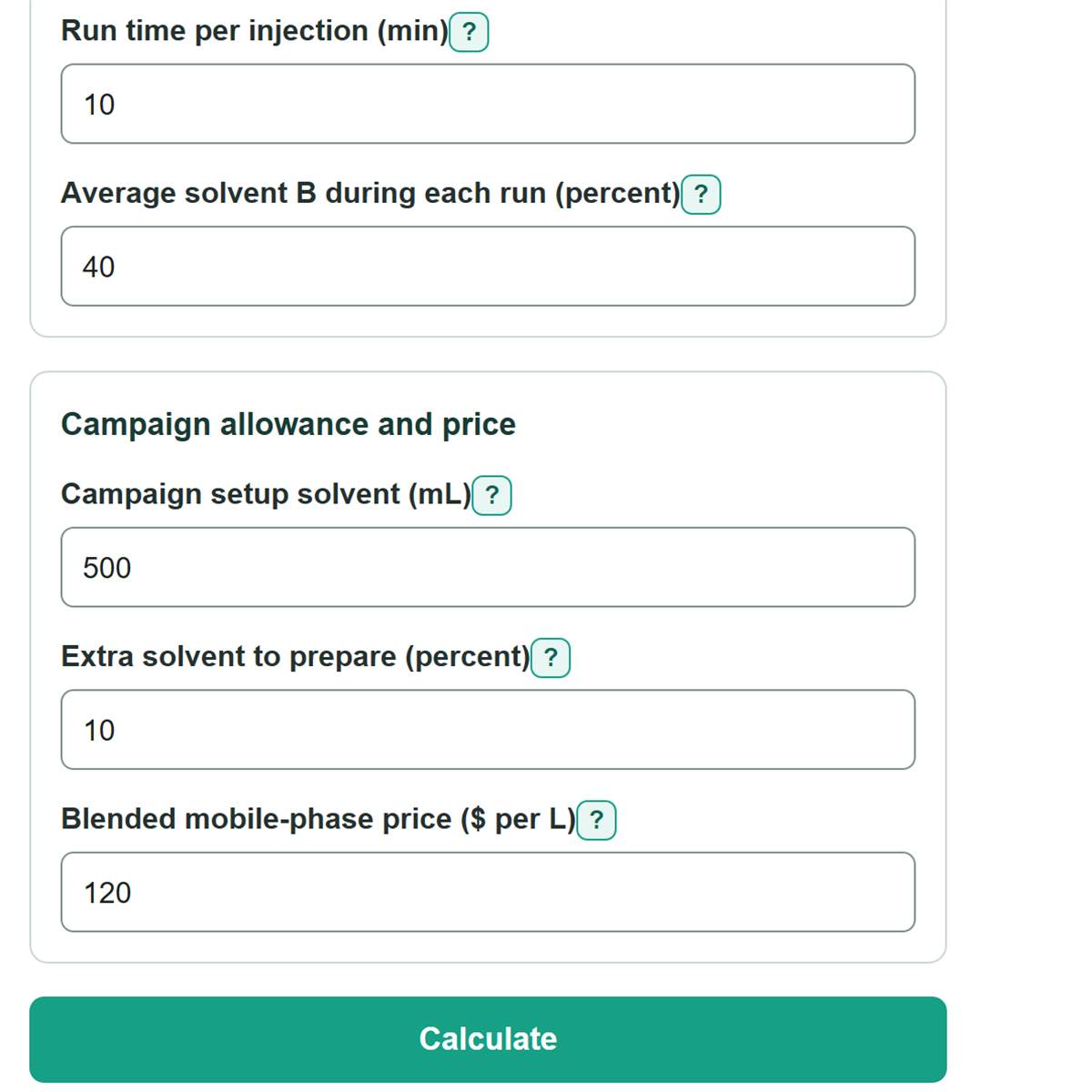
- Copy the flow rate, run time, and flow-weighted average solvent B percentage from the HPLC method.
- Add one-time Campaign setup solvent, any Extra solvent to prepare, and your blended mobile-phase price, then select Calculate.
- Sanity-check that planned target mass per injection does not exceed the working load and that the mobile-phase volume includes enough setup and buffer solvent for the campaign.
Definitions
Expected recovery: The percentage of loaded target compound expected to be isolated after the purification.
Target compound concentration: Milligrams of the target compound in each mL of prepared sample, not total crude solids.
Usable target load per injection: The target mass that can be injected while preserving the separation needed for the campaign.
Average solvent B: The average share of mobile phase made from solvent B across one run. A changing gradient needs an average across its segments.
Campaign setup solvent: One-time mobile phase for tasks such as priming, flushing, and column equilibration.
Blended mobile-phase price: Your estimated cost for one liter of the prepared A/B mobile-phase mixture.
Common mistakes and quick fixes
Mistake: Entering total crude solids as Target compound concentration when the sample is not pure.
Fix: Enter the concentration of the target compound only, using assay or purity-adjusted sample-preparation data.
Mistake: Treating Usable target load per injection as a universal column capacity.
Fix: Use a working load supported by a loading study, validated method, or comparable successful run.
Mistake: Entering Injection volume in mL even though the label uses uL.
Fix: Convert mL to uL before entry: 0.5 mL is 500 uL.
Mistake: Using only the repeated run volume and leaving Campaign setup solvent at zero without checking equilibration or flushing needs.
Fix: Add the one-time volume your lab expects for priming, flushing, and equilibration.
Mistake: Entering the starting or ending gradient composition as Average solvent B during each run.
Fix: Enter a flow-weighted average B percentage for the whole run.
Mistake: Reading Estimated solvent cost as the full purification cost.
Fix: Treat it as mobile-phase cost only; budget labor, instrument time, waste, fraction handling, and column wear separately.
Limitations & Key Assumptions / Boundary Conditions
- The calculation assumes the entered flow rate and run time describe the full repeated injection cycle. Methods with multiple flow segments need a time-weighted flow calculation outside this tool.
- The usable load is a user-entered working limit, not a predicted column capacity. The result does not verify resolution, pressure, retention, or peak shape.
- Sample solvent strength and injection volume can affect chromatography even when the planned target mass per injection is within the entered limit.
- Solvent A and B volumes use one average solvent B percentage. They are planning estimates and do not replace integrating a detailed gradient program.
- Mobile phase to prepare includes the entered setup allowance and percentage buffer. Add other lab-specific solvent uses if they are not included in those entries.
- Estimated solvent cost uses only the entered blended price and calculated mobile-phase volume. It excludes instrument time, labor, waste disposal, fraction handling, and column wear.
Methodology
Calculation steps
The calculator first finds the target mass delivered by concentration and injection volume, then uses the lower of that amount and the entered working load.
planned target mass per injection = min(target compound concentration x injection volume / 1000, usable target load per injection)
It divides the requested isolated amount by expected recovery, then rounds injection count up because each remaining fraction still needs a full run.
target mass that must be loaded = target purified amount / (expected recovery / 100)
planned injections = ceil(target mass that must be loaded / planned target mass per injection)
The repeated injection solvent is flow rate times run time times planned injections. One-time setup solvent is added once, and the extra-solvent percentage is applied to the combined amount.
mobile phase to prepare = (flow rate x run time per injection x planned injections + campaign setup solvent) x (1 + extra solvent to prepare / 100) / 1000
Solvent B is the entered percentage of total prepared mobile phase. Solvent A is the remainder. Estimated solvent cost equals total prepared liters times blended mobile-phase price.
estimated solvent cost = mobile phase to prepare x blended mobile-phase price
Worked example
With 100 mg requested, 80% expected recovery, 20 mg/mL target concentration, 500 uL injection volume, and an 8 mg usable load, concentration would deliver 10 mg per injection but the working load caps the plan at 8 mg. The campaign needs 125 mg loaded and 16 injections. At 20 mL/min for 10 minutes, plus 500 mL setup and 10% extra solvent, mobile phase to prepare is 4.07 L. At 40% B, this is 2.442 L solvent A and 1.628 L solvent B. At $120 per L, estimated solvent cost is $488.40.