
Enter plant flow, dose, chemical strength, and usable tank volume to calculate sodium hypochlorite feed rate, daily chlorine use, and tank life.
Advanced options
Table of contents
How to use our Sodium Hypochlorite Feed Rate and Tank Life Calculator
- Choose the unit shown for Plant flow, then enter the continuous treated-water flow from your meter, SCADA screen, log, or design basis.
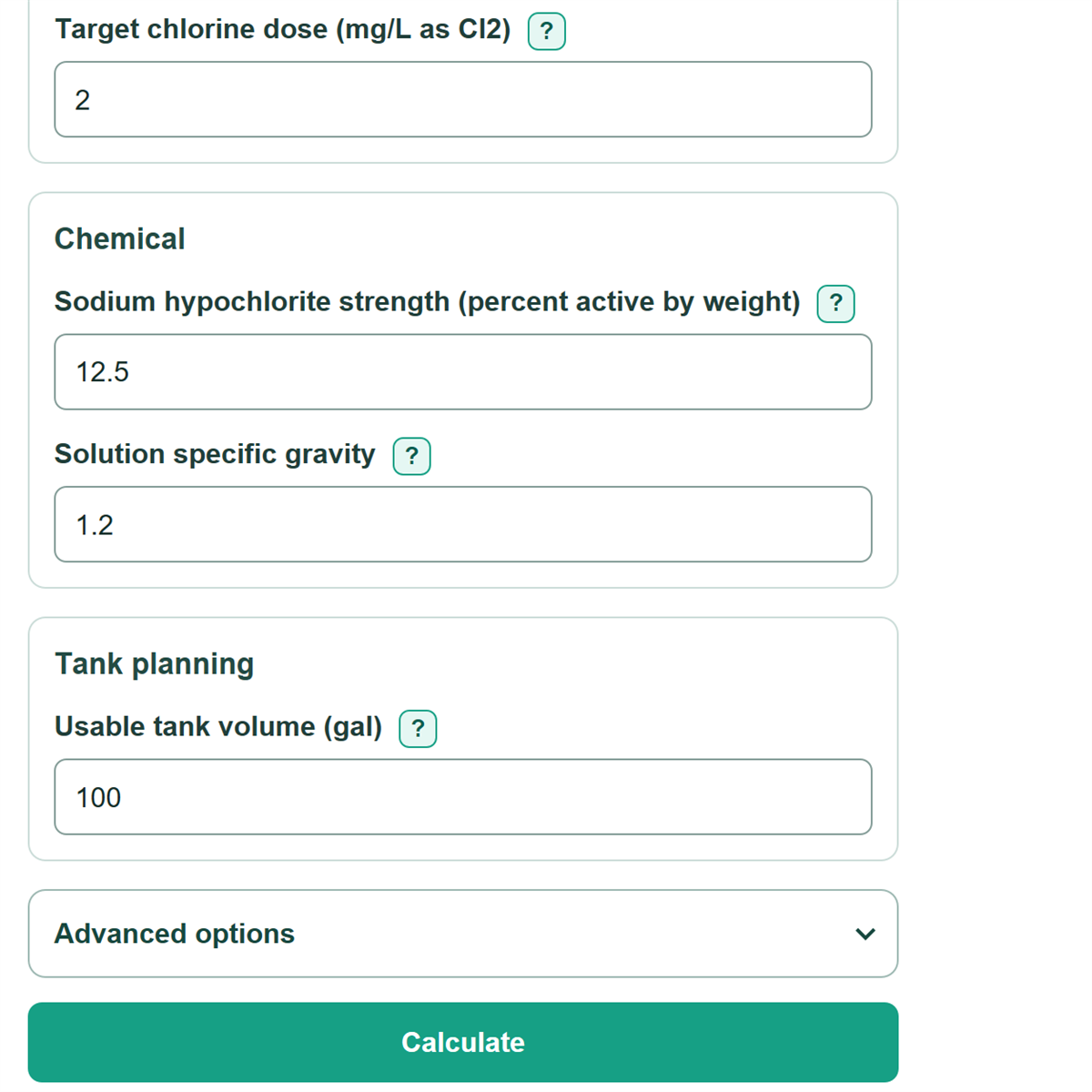
- Enter the approved Target chlorine dose, plus the current Sodium hypochlorite strength and Solution specific gravity from supplier records or testing.
- Enter Usable tank volume, which is the chemical available before your refill point rather than the tank's full nameplate size.
- Open Advanced options only if needed. Add Verified pump capacity from an operating-pressure calibration and an approved Extra feed margin.
- Check that the required feed rate is below 100 percent of verified pump capacity and that the usable tank life matches your refill plan before using the result as a starting setpoint.
Definitions
Target chlorine dose: The applied chlorine dose in mg/L as Cl2. It can include chlorine demand plus the desired residual when your approved operating target is set that way.
Active chlorine: The chlorine-equivalent ingredient used for dose calculations, reported here as pounds per day as Cl2.
Sodium hypochlorite strength: The percent active by weight in the delivered liquid chemical. Enter 12.5 for 12.5 percent, not 0.125.
Solution specific gravity: The solution density compared with water. It has no unit and helps convert percent-by-weight strength into pounds of active chlorine per gallon.
Calculated available chlorine: The pounds of active chlorine as Cl2 supplied by one gallon of the entered sodium hypochlorite solution.
Usable tank volume: The gallons available before the refill point, excluding any reserve or volume that cannot be pumped out.
Verified pump capacity: Pump output in gal/day measured or confirmed at the actual operating pressure. It is used to calculate the required pump setting.
Common mistakes and quick fixes
Mistake: Entering a desired chlorine residual as Target chlorine dose.
Fix: Enter the approved applied dose, including chlorine demand when your operating procedure requires it.
Mistake: Typing 0.125 into Sodium hypochlorite strength for a 12.5 percent product.
Fix: Enter 12.5 because this field uses percent active by weight.
Mistake: Using nominal tank capacity for Usable tank volume.
Fix: Enter only the gallons available above the refill point or unusable reserve.
Mistake: Using a nameplate rating for Verified pump capacity.
Fix: Check Plant flow unit and then recalculate. Use a calibration result at the actual operating pressure, or leave the optional field blank.
Mistake: Leaving an old label value in Sodium hypochlorite strength after chemical storage.
Fix: Replace it with current delivery paperwork, a certificate of analysis, or a verified strength test before setting the pump.
Mistake: Entering a negative Extra feed margin to lower the dose.
Fix: Use 0 for no added margin. Change Target chlorine dose only through the approved operating process.
Limitations & Key Assumptions / Boundary Conditions
- This is a continuous, steady-flow planning calculation. Flow and dose can change during the day, changing actual chemical use and tank life.
- Use a current sodium hypochlorite strength and specific gravity. Stored hypochlorite can lose strength, so an old label value can make the calculated liquid feed rate too low.
- The target chlorine dose must come from an approved operating target. This calculation does not determine chlorine demand, residual, CT, disinfection compliance, or water quality.
- Usable tank life ends at the entered refill threshold. Site reserve requirements, delivery timing, transfer limits, and pump downtime can require an earlier refill.
- A pump setting is only a screening result. Verify pump output with a calibration at operating pressure and follow site procedures before changing chemical feed.
Methodology
Calculation method
The calculator first changes the entered plant flow to gallons per day. It then applies any extra feed margin to the target dose and calculates active chlorine demand.
flow_gpd = plant_flow, plant_flow * 1440, or plant_flow * 1000000
The first form is for GPD, the second is for GPM, and the third is for MGD.
adjusted_dose_mg_l = target_dose_mg_l * (1 + feed_margin_percent / 100)
active_chlorine_lb_day = flow_gpd * adjusted_dose_mg_l * 0.00000834
Next, percent active by weight and specific gravity are converted into the active chlorine supplied by each gallon of solution.
available_chlorine_lb_gal = specific_gravity * 8.34 * strength_percent / 100
solution_use_gpd = active_chlorine_lb_day / available_chlorine_lb_gal
tank_life_days = usable_tank_volume_gal / solution_use_gpd
feed_rate_gal_hour = solution_use_gpd / 24
If a verified pump capacity is entered, the calculator also uses the following check. A result above 100 percent means the entered pump capacity is below the calculated requirement.
pump_percent = solution_use_gpd / pump_capacity_gpd * 100
Worked example
For 1.0 MGD, a 2.0 mg/L as Cl2 dose, 12.5 percent strength, and specific gravity of 1.20, active chlorine use is 16.68 lb/day. The calculated available chlorine is 1.251 lb/gal, so the required solution feed rate is 13.33 gal/day. A usable volume of 100 gal lasts 7.5 days.
Calculation choices
The 8.34 factor is the water-treatment pounds-per-day conversion used with flow in MGD and dose in mg/L. The calculator keeps full precision during calculations and rounds only the displayed results. A blank extra feed margin is treated as 0. A blank verified pump capacity omits the pump-setting result.