
Calculate the certificate-corrected solid mass needed to prepare a molar solution at your chosen final volume.
Solid material
Advanced options
Equipment limits
Suggested stock and dilution plan
Calculation details
Table of contents
How to use our Standard Solution Preparation Calculator
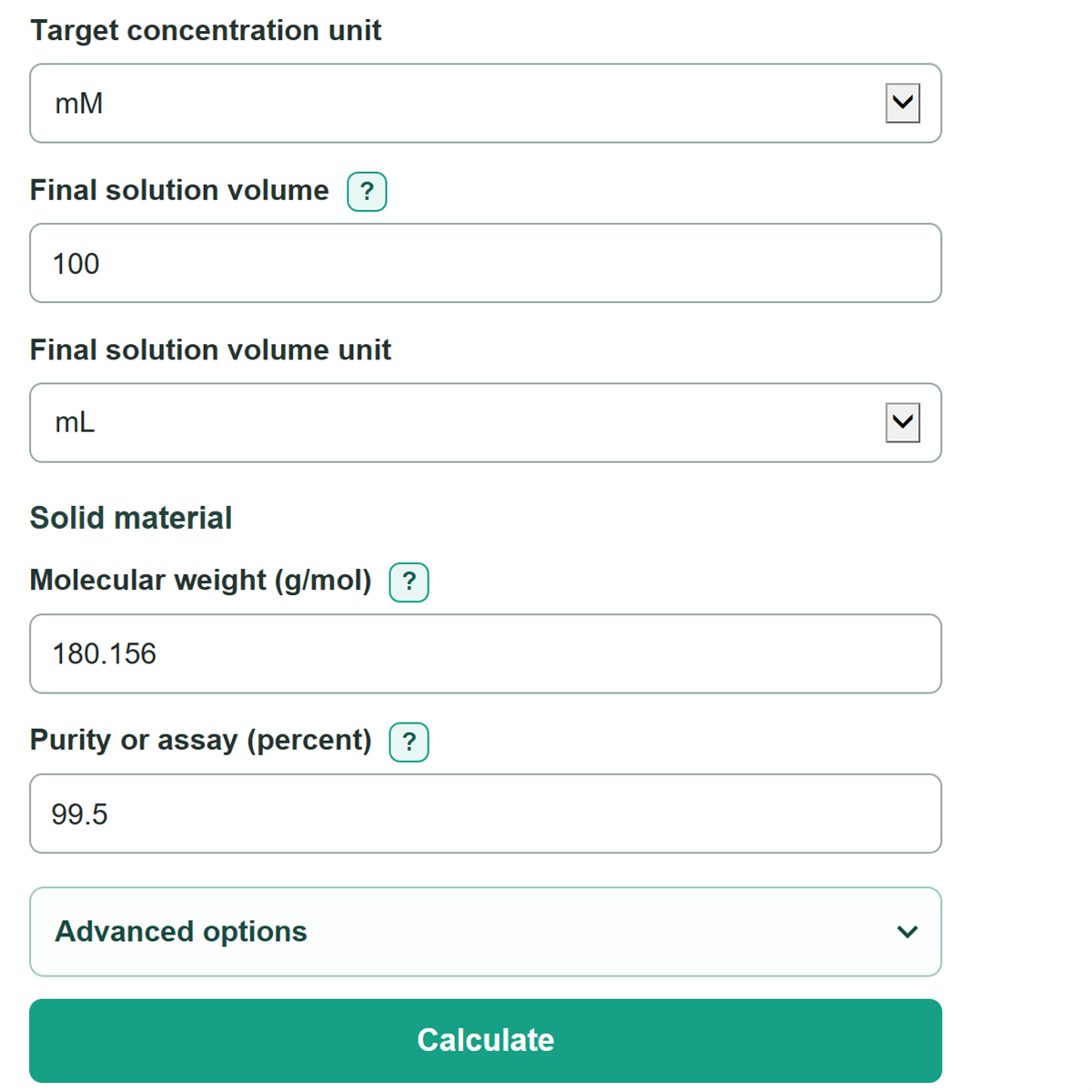
- Enter the target concentration and choose its printed unit: M, mM, uM, or nM.
- Enter the completed Final solution volume and its unit, not the amount of solvent added at the start.
- Copy Molecular weight (g/mol) and Purity or assay (percent) from the exact material form and lot certificate.
- Click Calculate, then weigh the displayed corrected mass, dissolve it, and bring the solution to the stated final volume.
- For a very small weigh-out, enter both optional equipment limits and check that the suggested stock mass and stock aliquot fit your approved balance and transfer method.
Definitions
Molar concentration: Amount of dissolved substance per liter of completed solution. One M is one mole per liter; mM, uM, and nM are smaller units. [1]
Final solution volume: The total completed volume after the solid dissolves and the solution is brought to its final mark.
Molecular weight (g/mol): The mass of one mole of the exact chemical form being weighed, including any salt or hydrate.
Purity or assay (percent): The percent of the weighed material counted as the intended substance for this mass correction. A value of 99.5 percent is used as 0.995.
Theoretical pure-solute mass: Mass needed if the material were 100 percent pure.
Corrected solid mass to weigh: The theoretical pure-solute mass adjusted upward for the entered purity or assay percent.
Stock aliquot: A measured volume of a stronger stock solution that is transferred and diluted to make the requested final solution.
Common mistakes and quick fixes
Mistake: Entering the amount of water or solvent added first as Final solution volume.
Fix: Use the completed volume after dissolving the solid and filling to the final mark.
Mistake: Using a Molecular weight (g/mol) for an anhydrous material when the weighed reagent is a hydrate or salt.
Fix: Copy the molecular weight for the exact material form on the label or certificate.
Mistake: Treating a potency value such as units per mg as Purity or assay (percent).
Fix: Use this calculator only for a certificate value expressed as a percent suitable for mass correction.
Mistake: Selecting mM when the method says uM, or selecting mL when it says uL.
Fix: Check both Target concentration unit and Final solution volume unit before calculating.
Mistake: Entering only Minimum reliable weigh-out (mg) or only Minimum reliable transfer volume (uL).
Fix: Enter both limits for the practical stock plan, or leave both blank for a direct preparation calculation.
Mistake: Treating Corrected solid mass to weigh as automatically practical on any balance.
Fix: Compare it with your approved minimum reliable weigh-out, then use the stock plan if both equipment limits are available.
Limitations & Key Assumptions / Boundary Conditions
- This calculation applies to a solid reagent with a molecular weight in g/mol and a certificate value expressed as a usable percent. It does not convert potency values such as units per mg.
- Use the molecular weight and purity or assay for the exact lot and chemical form. A different salt, hydrate, or correction basis changes the required mass.
- The optional stock plan uses only the entered minimum reliable weigh-out and minimum reliable transfer volume. It does not confirm balance calibration, pipette accuracy, available vessel size, or an approved preparation procedure.
- The calculation does not check solubility, pH, chemical compatibility, stability, sterility, storage, safety controls, or whether the material is appropriate for a regulated method.
- Values are calculated without rounding intermediate results. Round the displayed mass and volumes only according to your laboratory's approved equipment and procedure.
- If the minimum reliable transfer volume exceeds the requested final solution volume, no valid aliquot can meet that limit for this preparation.
Methodology
Calculation method
The calculator first converts the selected concentration to mol/L and the selected completed volume to L. The required amount in moles is concentration times final volume.
n (moles) = C (mol/L) x V (L)
It multiplies that amount by molecular weight to find the mass required for completely pure material, then divides by the certificate fraction.
pure mass (mg) = C (mol/L) x V (L) x molecular weight (g/mol) x 1000
corrected mass (mg) = pure mass (mg) / (purity percent / 100)
Worked example
For 100 mL of a 10 mM solution with molecular weight 180.156 g/mol and purity or assay of 99.5 percent, the amount needed is 1,000 umol. The theoretical pure-solute mass is 180.156 mg. Dividing by 0.995 gives a corrected solid mass to weigh of about 181.061 mg.
Optional stock plan
When both equipment limits are entered, the calculator finds a whole-number stock factor that keeps the stock aliquot at or above the minimum reliable transfer volume. If the direct mass is below the minimum reliable weigh-out, it also sizes the completed stock volume so the calculated stock mass reaches that minimum.
maximum transfer factor = floor(final volume in uL / minimum reliable transfer volume in uL)
minimum mass factor = ceil(minimum reliable weigh-out in mg / corrected mass in mg)
stock aliquot (uL) = final volume (uL) / suggested stock factor
The stock concentration is the target concentration multiplied by the suggested stock factor. Dissolve the stock material, bring the stock to its calculated final volume, transfer the calculated aliquot, and then dilute that aliquot to the requested final solution volume.