
Calculate basal area, trees per acre, and stocking percentage from a fixed-area tree sample and your local full-stock reference.
Table of contents
How to use our Forest Stocking Percentage Calculator
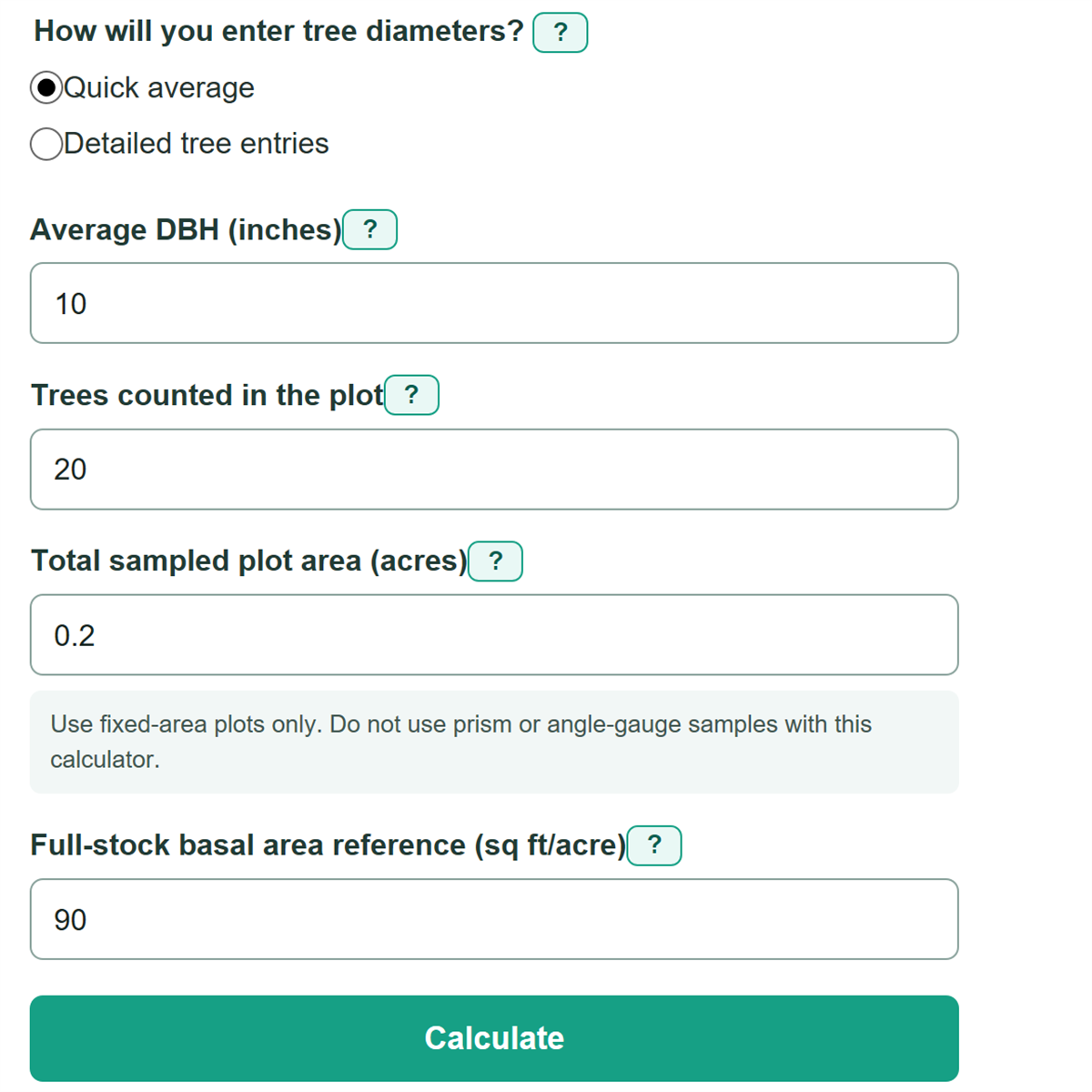
- Choose Quick average if you have one stand average, or Detailed tree entries if you measured every sampled tree.
- Measure DBH at 4.5 feet above ground and enter diameter in inches, not trunk circumference.
- Enter the trees from the same fixed-area sample and its combined Total sampled plot area in acres.
- Replace the example Full-stock basal area reference with a value that fits your forest type, region, stand condition, site, and management goal.
- Check that Estimated trees per acre matches your plot expansion and, in detailed mode, review Average-DBH shortcut change before relying on a quick average.
Definitions
DBH: Diameter at breast height: trunk diameter measured 4.5 feet above ground in the US.
Basal area: The cross-sectional area of a tree trunk at DBH. Stand basal area adds those areas, usually as square feet per acre.
Fixed-area plot: A sample with a known area in which every qualifying tree is counted or measured.
Quadratic mean DBH: A diameter that gives larger trees more weight because basal area depends on diameter squared.
Full-stock basal area reference: The basal area per acre used as the comparison point for this calculation. It must fit the local stand and management purpose.
Basal-area stocking percentage: Calculated basal area per acre divided by the entered full-stock basal area reference, multiplied by 100.
Common mistakes and quick fixes
Mistake: Entering trunk circumference as Average DBH.
Fix: Enter diameter in inches measured across the trunk, not the distance around it.
Mistake: Measuring Sampled tree DBH values near the tree base.
Fix: Measure each trunk at 4.5 feet above ground, then enter the diameter in inches.
Mistake: Treating Trees counted in the plot as trees per acre.
Fix: Enter the raw fixed-plot count and the matching Total sampled plot area ; the calculator expands the count to acres.
Mistake: Using a prism or angle-gauge tally as Total sampled plot area.
Fix: Use this calculator only with a known fixed-area sample. Prism and angle-gauge sampling need a basal area factor workflow.
Mistake: Leaving the example Full-stock basal area reference unchanged for every stand.
Fix: Replace it with a reference from an applicable local guide, management plan, extension publication, or forester.
Mistake: Using Average DBH for trees with very different diameters.
Fix: Choose Detailed tree entries and enter each sampled tree DBH so each diameter is squared separately.
Limitations & Key Assumptions / Boundary Conditions
- This calculator is for fixed-area plots with a known combined area. Do not use a prism or angle-gauge tree tally as a fixed-area count.
- The percentage compares your sample with the Full-stock basal area reference you enter. It does not choose a reference, assign a universal stocking class, or prescribe thinning.
- A suitable reference can differ by forest type, species, region, site, stand condition, and management goal.
- DBH measurement errors have a larger effect on basal area because diameter is squared in the calculation.
- Quick average mode assumes every sampled tree has the entered Average DBH. Detailed tree entries are more reliable when diameters vary.
- The results expand a sample to one acre. A small, poorly located, or unrepresentative plot can still give an unrepresentative stand estimate.
Methodology
Calculation method
The calculator uses a circular trunk cross section at DBH. The forester's constant is 0.00545415391248228 square feet per square inch squared, which equals π divided by 576.
tree density = trees counted in the plot / total sampled plot area
quick basal area per acre = 0.00545415391248228 x average DBH squared x tree density
In Detailed tree entries mode, the calculator squares every individual DBH before adding the values. This keeps large trees from being reduced to an ordinary average.
detailed basal area per acre = 0.00545415391248228 x sum of individual DBH squared / total sampled plot area
basal-area stocking percentage = 100 x basal area per acre / full-stock basal area reference
quadratic mean DBH = square root of (sum of individual DBH squared / number of sampled trees)
Shortcut check
Detailed mode also calculates basal area as if every tree had the ordinary arithmetic average DBH. It reports the signed difference from the detailed result as Average-DBH shortcut change. A negative value means the average-DBH shortcut estimates less basal area; equal DBHs produce 0% change.
Worked example
In Quick average mode, 20 trees in 0.2 acres equals 100 trees per acre. With an average DBH of 10 inches, basal area is about 54.54 sq ft/acre. With a full-stock reference of 90 sq ft/acre, the stocking percentage is about 60.60%.
Calculation choices
The calculator blocks zero or negative DBH values, plot area, and full-stock references. It also requires at least one valid detailed-tree DBH. Results are arithmetic estimates from the entered sample and reference, so field design and the selected local guide can change the practical interpretation.