
Calculate RAS recirculation flow, estimate a pump-label target after losses, or check the turnover from known delivered pump flow.
Table of contents
How to use our RAS Tank Turnover and Pump Capacity Calculator
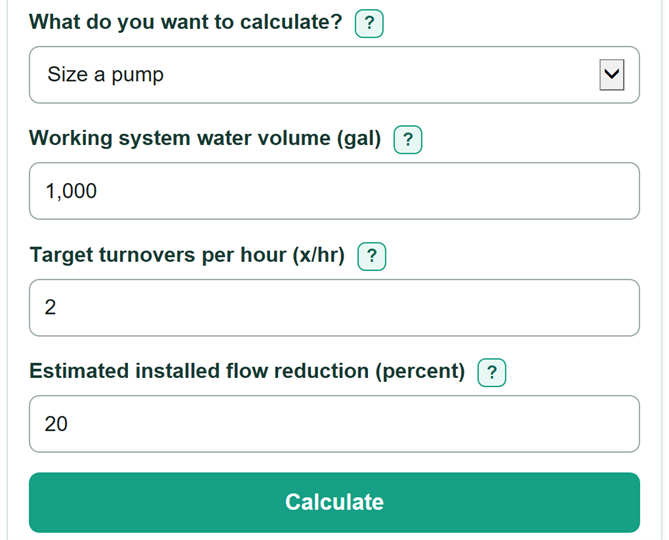
- Choose "Size a pump" to estimate capacity for a new pump, or "Check an existing pump" to assess installed flow.
- Enter the actual Working system water volume (gal), including culture tanks, sump, and water continuously connected to the loop.
- Enter Target turnovers per hour (x/hr) from your operating plan or adviser.
- For pump sizing, enter Estimated installed flow reduction (percent). For an existing pump, enter Known delivered pump flow (GPH) from a flow test or pump curve at installed conditions.
- Click Calculate and compare the required delivered flow with the pump curve at your expected installed head; a positive delivered-flow margin means the checked pump is above the entered target.
Definitions
Working system water volume: Water circulating in the same RAS loop at its normal operating level, including tanks, sump, and connected vessels.
Turnovers per hour (x/hr): The number of working-system water volumes that pass through the recirculation loop each hour.
Delivered pump flow (GPH): Flow that actually reaches the installed loop in gallons per hour, after lift, piping, fittings, filters, and other restrictions.
Installed flow reduction: The estimated percentage by which installed conditions reduce pump flow compared with the pump-label condition.
Pump-label flow: A pump capacity rating used for shopping; confirm the actual delivered flow on the pump curve at the expected installed head.
Capacity margin: Known delivered pump flow minus required delivered recirculation flow. A negative margin means more delivered flow is needed.
US liquid gallon: A volume equal to exactly 3.785411784 liters, used for the L/hr and L/min conversions.
Common mistakes and quick fixes
Mistake: Entering nominal tank capacity as Working system water volume (gal).
Fix: Add water at the normal operating level in culture tanks, sump, and continuously connected treatment vessels.
Mistake: Treating a pump's zero-head label rating as Known delivered pump flow (GPH).
Fix: Use a timed flow test or the manufacturer's pump-curve value at the installed head and plumbing condition.
Mistake: Using freshwater replacement rate as Target turnovers per hour (x/hr).
Fix: Enter the internal recirculation-loop target; freshwater exchange is a separate water-management measure.
Mistake: Entering 100 for Estimated installed flow reduction (percent).
Fix: Use a value from 0 up to, but not including, 100. At 100 percent reduction, no finite pump-label flow can deliver water.
Mistake: Reading a negative Delivered flow compared with target as zero shortfall.
Fix: Keep the sign: a negative GPH value is the extra delivered flow needed to meet the entered target.
Limitations & Key Assumptions / Boundary Conditions
- This is a circulation planning calculation. It does not size biofilters, oxygen systems, solids removal, ultraviolet treatment, pipes, or drains.
- The pump-label estimate uses one combined Estimated installed flow reduction (percent). It does not replace a pump curve or a hydraulic calculation using installed head, pipe size, pipe length, fittings, filters, and fouling condition.
- Use actual operating water for Working system water volume (gal). A changed water level, isolated tank, or bypassed treatment vessel changes the applicable volume.
- Known delivered pump flow (GPH) should come from a timed measurement or a pump curve at installed conditions. A zero-head nameplate rating can overstate actual circulation.
- Meeting Target turnovers per hour (x/hr) does not prove that flow is evenly distributed or that water quality, dissolved oxygen, stocking density, feed load, or species needs are met.
- A delivered flow of 0 GPH correctly gives zero achieved turnover and no finite achieved turnover time.
Methodology
Calculation method
The calculator first finds the recirculation flow that must be delivered to the loop. Let V be working system water volume in gallons and T be target turnovers per hour.
Q = V x T
Q is required delivered recirculation flow in GPH. In pump-sizing mode, r is the entered installed flow reduction as a decimal.
Estimated pump-label flow = Q / (1 - r)
In existing-pump mode, F is the known delivered pump flow in GPH. The calculator compares F with Q and keeps a negative margin when the pump is short of the target.
Achieved turnovers per hour = F / V
Delivered flow compared with target = F - Q
Turnover time is reported in minutes. If delivered flow is zero, achieved turnover is zero and achieved turnover time is shown as unavailable instead of dividing by zero.
Target time for one turnover = 60 / T
Achieved time for one turnover = 60 / achieved turnovers per hour
Metric flow uses the exact conversion of 1 US liquid gallon = 3.785411784 liters.
L/hr = GPH x 3.785411784; L/min = L/hr / 60
Worked example
For 1,000 gal of working water and a target of 2 x/hr, required delivered flow is 1,000 x 2 = 2,000 GPH. The target turnover time is 60 / 2 = 30 minutes. With a 20 percent installed flow reduction, the estimated pump-label flow is 2,000 / 0.80 = 2,500 GPH. A pump delivering 2,500 GPH in the installed loop would achieve 2.5 x/hr and have a +500 GPH capacity margin.