
Calculate a mixed-unit equimolar or weighted NGS library pool with per-library transfer volumes, molecular shares, and buffer volume.
Advanced options
Table of contents
How to use our NGS Library Pooling Calculator
- Choose Pooling plan: use Equimolar for equal molecular shares, or Weighted to enter a relative weight for each library.
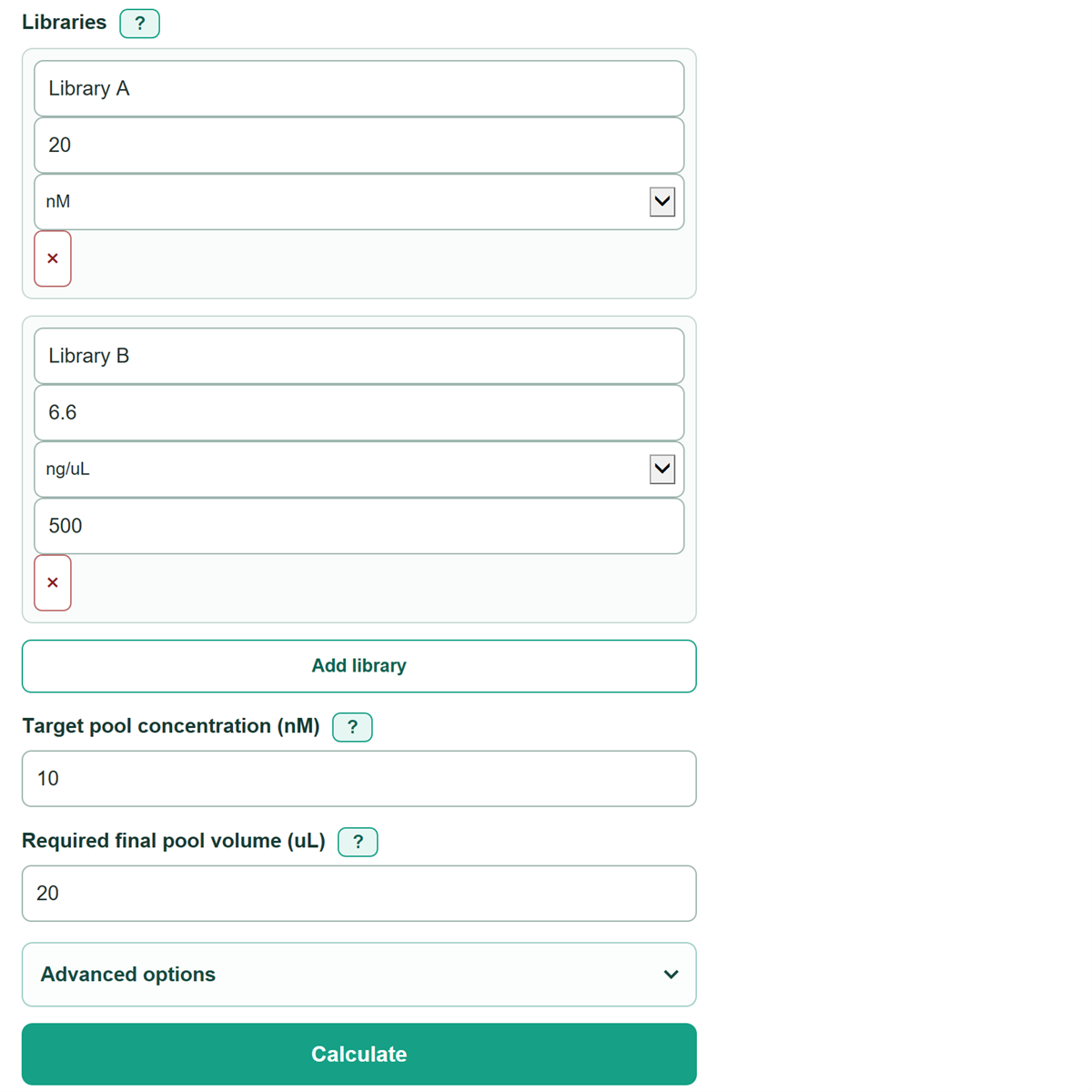
- Add each tube under Libraries, then enter its concentration and choose nM or ng/uL. For ng/uL, enter the final average library length in bp, including adapters.
- Enter the workflow-specific Target pool concentration (nM) and Required final pool volume (uL).
- Open Advanced options only if needed to add handling overage or your lab's Minimum reliable transfer (uL), then select Calculate.
- Check that the Library transfer plan matches your tube names, the planned molecular shares match the study design, and no transfer is flagged below your pipetting limit.
Definitions
Equimolar: Each included library receives the same molecular share of the pool.
Weighted: Each library receives a molecular share based on its positive relative weight. The calculator converts the weights to percentages that add to 100%.
nM: Nanomolar, a concentration based on the number of library molecules per volume.
ng/uL: Nanograms per microliter, a mass concentration. It must be converted to nM before molecular pooling.
Final average library length: The average size of the finished library in base pairs (bp), including adapters. It is needed only for ng/uL entries.
Highest reachable pool concentration: The greatest concentration possible at the chosen shares when the prepared pool contains no added buffer or water.
Common mistakes and quick fixes
Mistake: Entering a ng/uL result as though it were nM under Libraries.
Fix: Choose ng/uL for that row and provide its final average library length in bp so the calculator can convert it.
Mistake: Using insert size instead of final library length for a ng/uL row in Libraries.
Fix: Enter the final average library length including adapters, from the fragment-size QC result.
Mistake: Treating weights in the Weighted Pooling plan as percentages.
Fix: Enter positive relative values such as 1 and 3, then check Planned molecular shares to see the normalized percentages.
Mistake: Setting Target pool concentration (nM) above the Highest reachable pool concentration.
Fix: Lower the target, concentrate a source library, or revise the planned shares before preparing the pool.
Mistake: Ignoring a small Smallest library transfer because the math is valid.
Fix: Enter your Minimum reliable transfer (uL) and review every flagged transfer before pipetting.
Limitations & Key Assumptions / Boundary Conditions
- This calculation treats each entered library as a dsDNA source and uses 660 g/mol per bp as the mass-to-molarity conversion assumption.
- For ng/uL entries, accuracy depends on the final average library length, including adapters, and on the concentration measurement copied into Libraries.
- The target concentration and required volume must come from the applicable kit, instrument, core facility, or provider workflow. The example values are not universal loading instructions.
- A transfer below Minimum reliable transfer (uL) is a warning, not an automatic correction. Follow your pipette specification and laboratory procedure.
- Planned molecular shares describe the pool composition. They do not guarantee equal sequencing reads because library quality, size distribution, amplification, clustering, and run behavior can differ.
- A sub-pool entered as one library is treated as one source. Its transfer volume does not ensure equal representation of samples already inside that sub-pool.
Methodology
Calculation method
Each library is first expressed in nM. A direct nM entry stays unchanged. For a ng/uL entry, the calculator uses the stated final average library length and a dsDNA molecular-weight assumption of 660 g/mol per bp.
library concentration (nM) = concentration (ng/uL) * 1,000,000 / (660 * final average library length in bp)
Equimolar pooling gives every library the same share. Weighted pooling divides each positive relative weight by the total weight. The displayed percentage is the share multiplied by 100.
molecular share = library weight / total weight
The prepared volume is the required final volume plus any extra handling volume. For each library, the required transfer is its molecular share of the target pool amount, divided by that library's concentration.
library transfer (uL) = target pool concentration (nM) * prepared pool volume (uL) * molecular share / library concentration (nM)
The calculator subtracts all library transfers from the prepared volume to find Buffer or water to add. It also calculates the highest possible target concentration for the chosen shares with no buffer added. A requested target above that value is blocked because it would require a negative buffer volume.
highest reachable pool concentration (nM) = 1 / sum(molecular share / library concentration in nM)
Worked example
With two 20 nM libraries in Equimolar mode, a 10 nM target, and a 20 uL prepared volume, each library has a 50% share. Each transfer is 10 * 20 * 0.5 / 20 = 5 uL. The two transfers total 10 uL, so Buffer or water to add is 10 uL.
Rounding
The calculator keeps unrounded transfer values while totaling the plan, then rounds values for display. Use the unrounded internal calculation only as a planning value; choose a practical pipetting approach that follows your lab procedure.