
Enter peak feed, feed-label protein, and supplier capacity to estimate TAN-N load and biofilter media volume with a chosen margin.
Table of contents
How to use our RAS Biofilter Media and TAN Capacity Calculator
- Enter Peak daily feed from the highest planned ration, then choose the matching Feed amount unit.
- Copy Crude Protein (min.) from the guaranteed analysis on the feed bag.
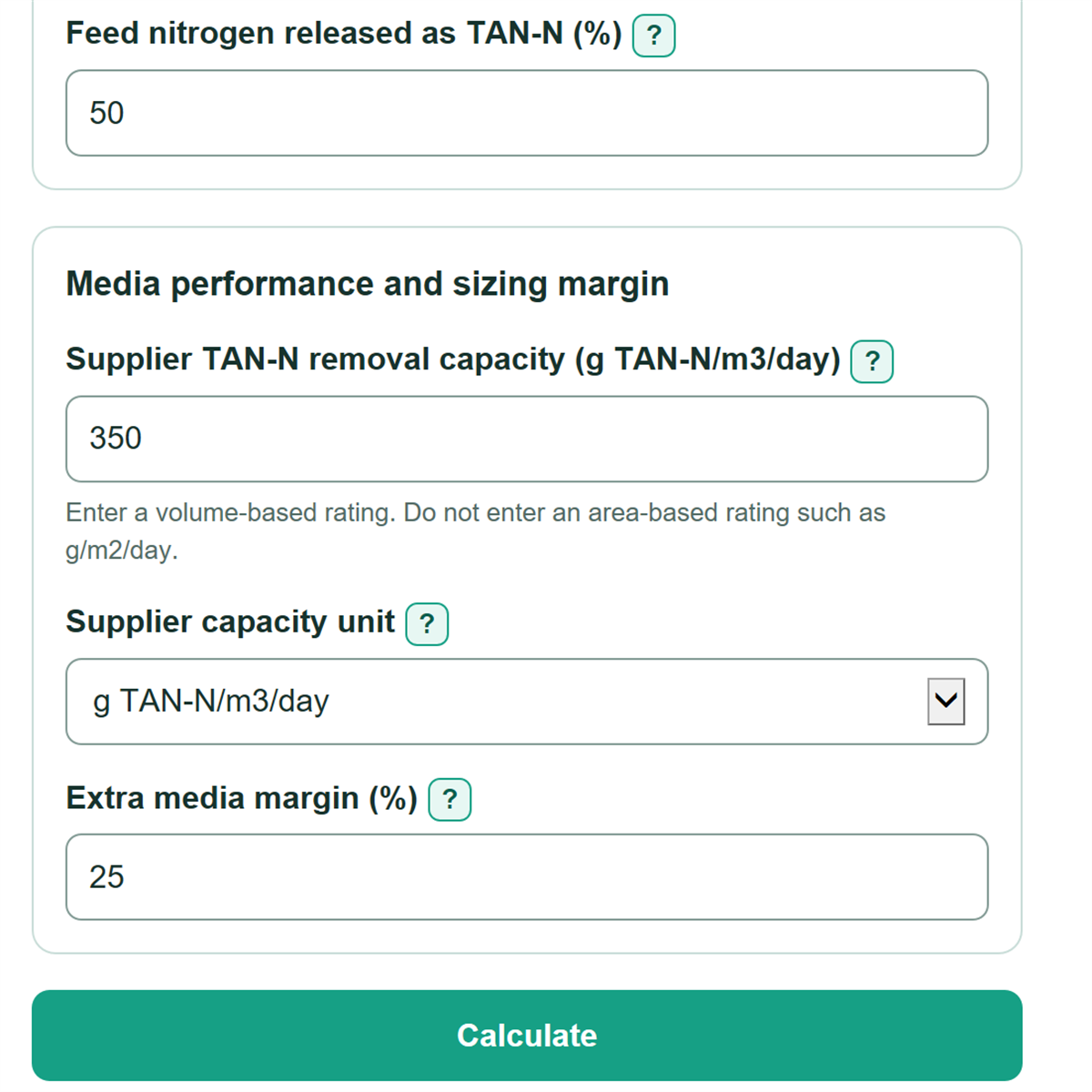
- Enter Feed nitrogen released as TAN-N, Supplier TAN-N removal capacity, its exact unit, and Extra media margin from the project design basis.
- Click Calculate. Start with Planned installed media after margin, then compare the shown capacity and media units with the supplier datasheet.
- Sanity-check the result by changing feed or capacity: more peak feed should require more media, while a higher valid capacity should require less media.
Definitions
TAN-N: Total ammonia nitrogen stated as the mass of nitrogen. It is a daily mass load here, not an ammonia concentration or a fish-toxicity reading.
Crude Protein (min.): The minimum protein percentage by weight printed in a feed's guaranteed analysis.
Feed nitrogen released as TAN-N: The planning share of feed nitrogen expected to become TAN-N. It is separate from the crude-protein percentage.
Supplier TAN-N removal capacity: The amount of TAN-N a cubic meter or cubic foot of media can remove per day under stated operating conditions.
Extra media margin: Added media above the calculated base requirement. It does not increase the demonstrated performance rating of the media.
Normalized capacity: The supplier capacity converted to g TAN-N/m3/day so both supported capacity units use one sizing calculation.
Common mistakes and quick fixes
Mistake: Entering average feed instead of Peak daily feed.
Fix: Use the highest planned daily ration that the biofilter must support.
Mistake: Copying a feed bag value into Feed nitrogen released as TAN-N.
Fix: Put the bag's protein value in Crude Protein (min.) ; use an approved biological assumption for TAN-N release.
Mistake: Entering a surface-area rating for Supplier TAN-N removal capacity.
Fix: Use only a volumetric rate in g TAN-N/m3/day or g TAN-N/ft3/day. An area-based rate cannot size media volume in this calculator.
Mistake: Choosing g TAN-N/ft3/day under Supplier capacity unit while leaving a value copied in g TAN-N/m3/day.
Fix: Select the unit printed on the supplier sheet before entering or checking the capacity value.
Mistake: Treating Planned installed media after margin as proof that a new filter is ready to carry the load.
Fix: Confirm start-up, water chemistry, oxygen, solids control, and mature media performance with the supplier or engineer.
Limitations & Key Assumptions / Boundary Conditions
- This is a preliminary feed-based media estimate. It does not design a vessel, pump, aeration system, solids filter, oxygen supply, or alkalinity addition.
- The calculation uses the entered mature-media capacity. Actual capacity can change with temperature, dissolved oxygen, pH, alkalinity, salinity, hydraulic loading, solids control, media type, and biofilm condition.
- A new, recently cleaned, or stressed biofilter may remove less TAN-N than a mature system. Do not treat a margin as a substitute for commissioning and monitoring.
- Use peak planned feed for sizing. A lower routine average can understate the required media volume.
- The protein-to-nitrogen divisor of 6.25 is a conventional crude-protein conversion factor. Feed-specific composition and fish metabolism can differ from this simplified mass balance.
- Zero peak feed correctly returns zero estimated TAN-N and media demand, but it does not mean an operating RAS can run safely without biofiltration.
Methodology
Calculation steps
The calculator first converts feed to kg/day. It estimates feed nitrogen from crude protein using the conventional 6.25 protein-to-nitrogen divisor, then applies the entered TAN-N release percentage.
feed_kg_day = feed_amount for kg/day, or feed_amount * 0.45359237 for lb/day
feed_nitrogen_g_day = feed_kg_day * 1000 * (crude_protein_percent / 100) / 6.25
daily_tan_g_day = feed_nitrogen_g_day * (tan_excretion_percent / 100)
The supplier capacity is converted to g TAN-N/m3/day before the media volume is calculated. A capacity entered in g TAN-N/ft3/day is multiplied by 35.3146667 because one cubic meter contains that many cubic feet.
normalized_capacity_g_m3_day = media_capacity, or media_capacity * 35.3146667
required_media_m3 = daily_tan_g_day / normalized_capacity_g_m3_day
installed_media_m3 = required_media_m3 * (1 + safety_margin_percent / 100)
installed_media_ft3 = installed_media_m3 * 35.3146667
Worked example
For 100 lb/day of feed at 40% crude protein and 50% TAN-N release, the estimated load is 1,451.50 g TAN-N/day. At 350 g TAN-N/m3/day, base media is 4.147 m3. A 25% margin raises planned media to 5.184 m3, or 183.07 ft3.
Calculation choices
The result is a media-volume calculation, not a reactor-volume calculation. It uses only the feed, protein, TAN-N release fraction, supplier volumetric capacity, and added margin entered in the calculator. Capacity must be greater than zero; protein and TAN-N release must each be from 0% through 100%.