
Calculate coating wet film thickness, expected dry film thickness, coverage, and material quantity from volume solids and job details.
Advanced options
Table of contents
How to use our Industrial Coating WFT, DFT and Coverage Calculator
- Choose What do you want to calculate? and Units to match your task and project documents.
- For planning, enter Coated area, Number of coats, Target DFT per coat, and the product's Volume solids from its Technical Data Sheet.
- For a field check, enter the wet-gauge reading in Measured WFT and the product's Volume solids.
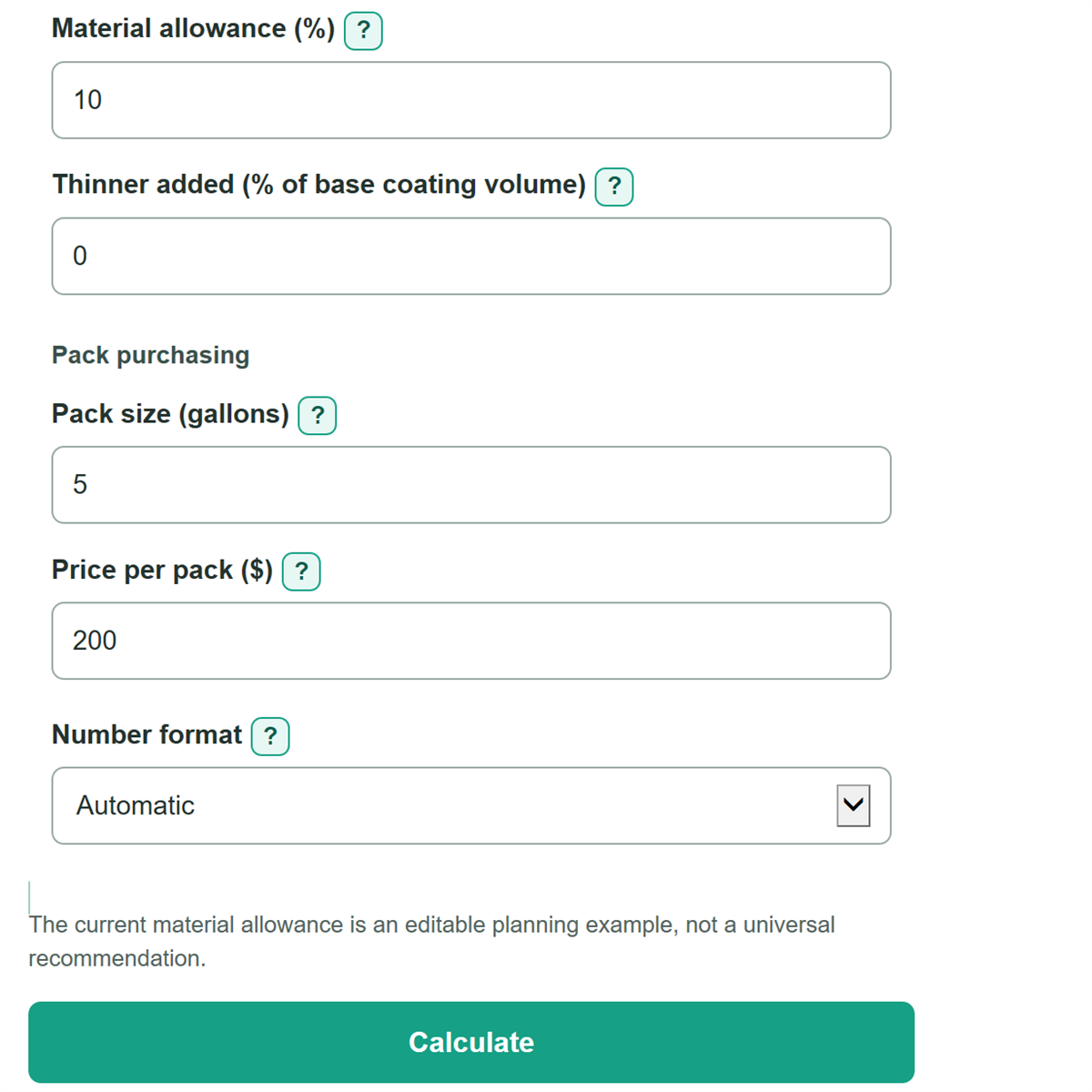
- Open Advanced options if needed to enter Material allowance (%), Thinner added (% of base coating volume), pack size, or price.
- Check that the required WFT or expected DFT is reasonable for the product instructions, then use the field-adjusted quantity rather than theoretical material needed when planning a purchase.
Definitions
WFT: Wet film thickness, the thickness of coating just after application. It is commonly checked with a wet-film comb or wheel gauge.
DFT: Dry film thickness, the thickness left after the coating cures and volatile liquid has left the film.
Volume solids: The percent of a coating volume that remains as dry coating solids. Use volume solids, not weight solids.
As-mixed volume solids: The volume-solids percentage after entered thinner is added. Adding thinner lowers this percentage when the thinner adds no coating solids.
Theoretical coverage per coat: Ideal area covered by one gallon or liter at the target DFT, before job losses or material allowance.
Material allowance: An added percentage above theoretical material use for expected job loss and uncertainty. It is not the same as transfer efficiency.
Mil: One thousandth of an inch. One mil equals 25.4 microns. [1]
Common mistakes and quick fixes
Mistake: Entering weight solids in Volume solids .
Fix: Copy the percent listed as volume solids on the product Technical Data Sheet; weight solids cannot be used for this calculation.
Mistake: Entering the total system thickness in Target DFT per coat .
Fix: Enter the target for one coat of this product, then enter the full Number of coats .
Mistake: Treating Measured WFT as a dry-film reading.
Fix: Use a wet-film comb or wheel reading taken immediately after application; use a dry-film gauge for the project's required final inspection.
Mistake: Ignoring planned reducer or solvent in Thinner added (% of base coating volume) .
Fix: Enter the added thinner as a percent of base coating volume so the calculator lowers the as-mixed volume solids.
Mistake: Buying only Theoretical material needed .
Fix: Use Field-adjusted material needed with an allowance that fits the job, then use Complete packs to buy when pack size is known.
Mistake: Entering a Price per pack ($) without a pack volume.
Fix: Enter a positive Pack size (gallons) , or clear the price if you only need thickness and material results.
Limitations & Key Assumptions / Boundary Conditions
- The calculation assumes the entered volume solids are correct for the actual product and mixed batch. Follow the product Technical Data Sheet for thinning limits, mixing ratio, induction time, and application requirements.
- Thinner is treated as added liquid with no coating solids. Products with reactive reducers, multi-part mixes, or unusual solids behavior may need product-specific calculation.
- Theoretical coverage is geometric ideal coverage. Surface profile, overspray, spray setup, pot loss, waste, stripe coating, and applicator skill can change actual use.
- Material allowance is an editable planning input, not a universal recommendation. Use project records or estimating rules where available.
- Expected dry film thickness from Measured WFT is an estimate from one wet reading and does not replace required dry-film inspection after cure.
- Pack cost includes coating packs only. Labor, surface preparation, equipment, freight, tax, containment, and other project costs are excluded.
- Whole-pack rounding assumes all calculated material must be purchased in complete packs of the entered size.
Methodology
Thickness and solids calculation
The calculator accepts volume solids as 65, 65%, or 0.65. A decimal fraction beginning with 0 is converted to a percent. If thinner is entered, the original Technical Data Sheet solids value stays unchanged and the calculation uses the lower as-mixed value. Wet-film thickness is calculated from dry-film thickness divided by the as-mixed solids fraction. This matches the usual volume-solids relationship between wet and dry film thickness. [2][3]
as_mixed_solids_fraction = (volume_solids / 100) / (1 + thinner_added / 100)
required_WFT = target_DFT / as_mixed_solids_fraction
expected_DFT = measured_WFT * as_mixed_solids_fraction
Coverage and material calculation
For US units, ideal coverage uses 1,604.1667 square foot-mils per US gallon, derived from the exact 231 cubic inches in a US gallon, 144 square inches in a square foot, and a mil of 0.001 inch. Metric results are converted from the same physical volume and area basis. [1]
theoretical_coverage = 1604.1667 * as_mixed_solids_fraction / target_DFT_mils
theoretical_material = coated_area * number_of_coats / theoretical_coverage
field_adjusted_material = theoretical_material * (1 + material_allowance / 100)
When a pack size is entered, the calculator rounds field-adjusted material upward to the next whole pack. Purchase cost is calculated only when both pack size and price per pack are entered.
packs_to_buy = ceil(field_adjusted_material / pack_size)
estimated_material_cost = packs_to_buy * price_per_pack
Worked example
With a 4 mil target DFT, 65% volume solids, 5,000 sq ft, two coats, and a 10% material allowance, required WFT is about 6.154 mils. Theoretical coverage is about 260.677 sq ft per gallon, theoretical material is about 38.362 gallons, and field-adjusted material is about 42.198 gallons. If 10% thinner is added, as-mixed volume solids becomes about 59.091%, so required WFT and material quantity increase.