
Compare equal-scope monobloc and split air-to-water heat pump quotes using upfront costs, electricity use, and discounted lifetime costs.
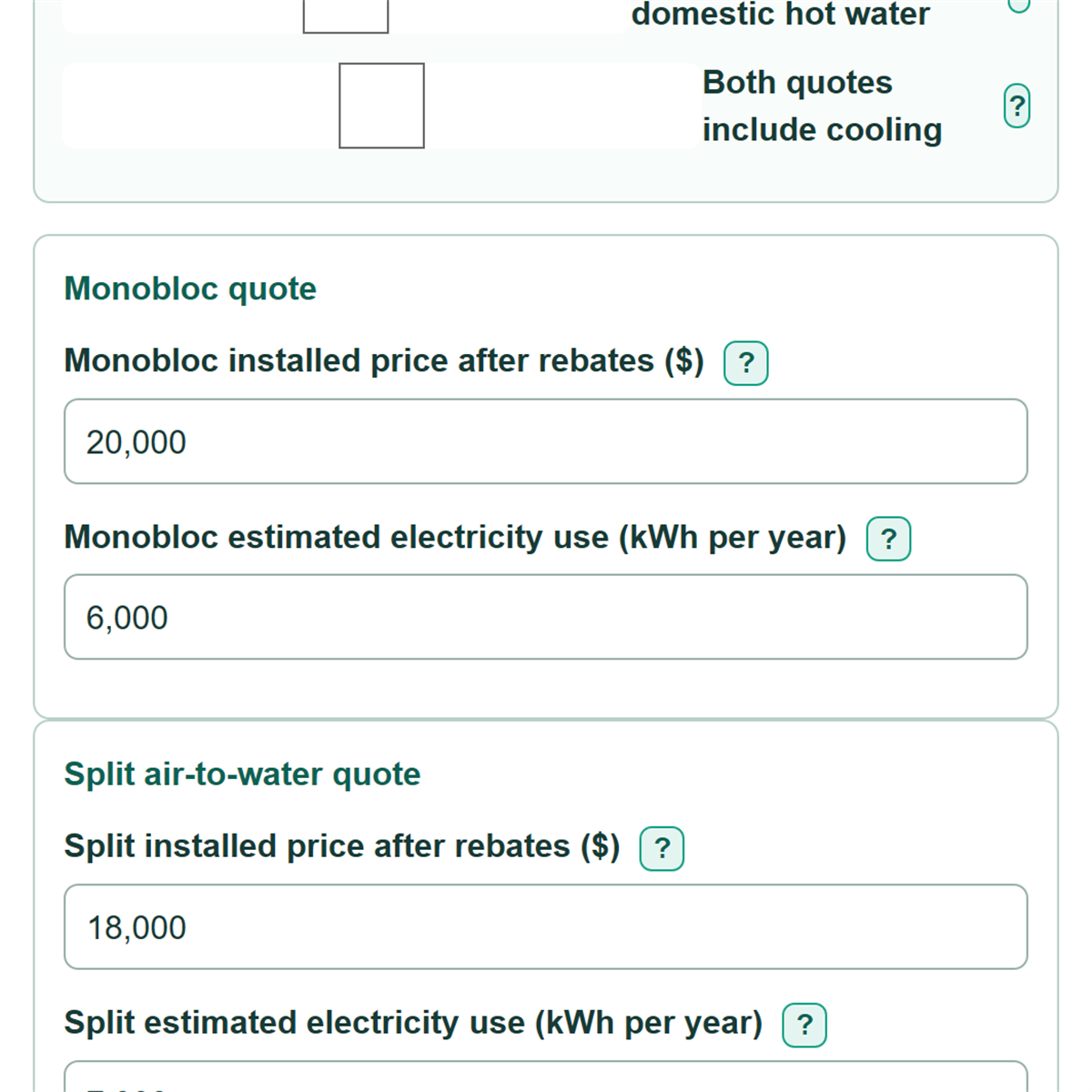
Monobloc quote
Split air-to-water quote
US planning estimates: 2025 electricity charge and a 15-year period. Replace them with your local bill and your own planning horizon.
Advanced options
Quote additions not already included
Separate yearly costs
Future-cost assumptions
Table of contents
How to use our Monobloc vs Split Air-to-Water Heat Pump Lifetime Cost Calculator
- Check every service that both proposals include under "Both quotes include space heating," "Both quotes include domestic hot water," and "Both quotes include cooling."
- Enter each quote's all-in amount in "Monobloc installed price after rebates ($)" and "Split installed price after rebates ($)."
- Copy each proposal's matching annual estimate into its "estimated electricity use (kWh per year)" field.
- Choose the bill format in "Electricity price unit," then enter the usage-based rate in "Electricity use charge (cents per kWh)." Exclude a fixed monthly customer charge.
- Check that the displayed services and both "first-year operating cost" amounts match the proposals before using the discounted cost difference and break-even year.
Definitions
Monobloc: An air-to-water heat pump with the refrigeration circuit contained in one outdoor unit; the project may have water piping outside.
Split air-to-water heat pump: An air-to-water system with separate indoor and outdoor refrigerant components connected by refrigerant lines. This is different from a typical ducted forced-air split heat pump.
Domestic hot water: Water used at taps, showers, and appliances. It is separate from water circulated to radiators or baseboards.
kWh per year: Kilowatt-hours used in one year. Electricity bills commonly measure use in kWh.
Electricity use charge: The part of an electric rate that changes with each kWh used. It can include supply and delivery charges.
Discount rate: A percentage used to convert future costs into comparable present-dollar amounts. A higher rate gives less weight to later costs.
Discounted cost difference: Monobloc discounted cost minus split discounted cost. A negative amount means the monobloc option costs less over the selected period.
Break-even year: The first whole year when the option with the higher upfront cost has caught up through lower discounted yearly costs.
Common mistakes and quick fixes
Mistake: Comparing proposals that do not provide the same services.
Fix: Check "Both quotes include space heating," "Both quotes include domestic hot water," and "Both quotes include cooling" only for services included in both annual estimates.
Mistake: Entering a quote total before rebates in "Monobloc installed price after rebates ($)" or "Split installed price after rebates ($)."
Fix: Enter the actual out-of-pocket installed amount after only the rebates already reflected in that proposal.
Mistake: Using the full electric bill divided by kWh for "Electricity use charge (cents per kWh)."
Fix: Add charges that change with kWh use, such as supply and delivery charges, and leave out a fixed customer charge.
Mistake: Counting the same backup energy twice.
Fix: Use "Monobloc backup and protection electricity (kWh per year)" or "Split backup and protection electricity (kWh per year)" only when that electricity is not already inside the matching estimated electricity use.
Mistake: Adding work already included in the proposal.
Fix: Fill in "Monobloc excluded quote work ($)" or "Split excluded quote work ($)" only for separately priced work excluded from the installed price.
Mistake: Treating "Break-even year for the higher-upfront option" as a guarantee.
Fix: Use it as a planning result based on the entered electricity use, price increase, maintenance, and discount rate.
Limitations & Key Assumptions / Boundary Conditions
- The comparison is only as fair as the proposal inputs. Both annual electricity estimates must cover the same selected services and similar comfort expectations.
- The calculator uses contractor or user-entered annual kWh. It does not model local weather, building heat loss, water temperature, equipment sizing, controls, or hourly utility rates.
- Blank optional quote work, backup or protection electricity, and maintenance are treated as $0 or 0 kWh. Enter them when they are separately expected.
- Electricity price changes, maintenance costs, repair costs, incentives, financing, taxes, fuel-account charges, resale value, and replacement costs are excluded unless reflected in an available input.
- Future annual costs are assumed to occur at the end of each year. Electricity-price escalation affects electricity costs; the entered annual maintenance amount does not escalate.
- A break-even result does not predict equipment life, reliability, comfort, installation quality, or whether either option is technically suitable for the home.
Methodology
Cost method
The calculator starts each option with its installed price after rebates plus any separately entered excluded quote work. It then adds the present value of yearly electricity and maintenance costs through the selected comparison period.
electricity price per kWh = entered price / 100 for cents per kWh; otherwise = entered price
first-year operating cost = (estimated electricity use + backup and protection electricity) x electricity price per kWh + annual maintenance
discounted operating cost = sum of first-year cost x (1 + electricity-price increase / 100)^(year - 1) / (1 + discount rate / 100)^year
lifetime cost = upfront cost + discounted operating cost
discounted cost difference = monobloc lifetime cost - split lifetime cost
A negative discounted cost difference means monobloc costs less. A positive difference means split costs less. The calculator checks each whole year from year 0 through the selected period to find the first point when the higher-upfront option has caught up.
Worked example
Suppose the monobloc quote is $20,000, the split quote is $18,000, annual use is 6,000 and 7,000 kWh, and electricity costs 17.3 cents per kWh. Their first-year electricity costs are $1,038 and $1,211. With a 15-year period, 0% electricity-price increase, and 3% discount rate, the lower annual monobloc cost catches up to its $2,000 higher upfront cost in year 15.
Planning assumptions
The initial 15-year comparison period and 3% discount rate are editable US planning defaults drawn from Department of Energy lifecycle-cost guidance. [1] The 17.3 cents per kWh starting electricity charge is an editable 2025 US residential planning estimate; replace it with the usage-based charges on your own bill. [2] Fixed customer charges are excluded because a replacement heat pump normally does not change an existing electric-account charge.