
Compare two natural-gas tankless water-heater quotes by estimated fuel, maintenance, payback, and cost over the years you choose.
Condensing heater
Advanced options
Calculation details
Table of contents
How to use our Condensing vs Non-Condensing Tankless Cost Calculator
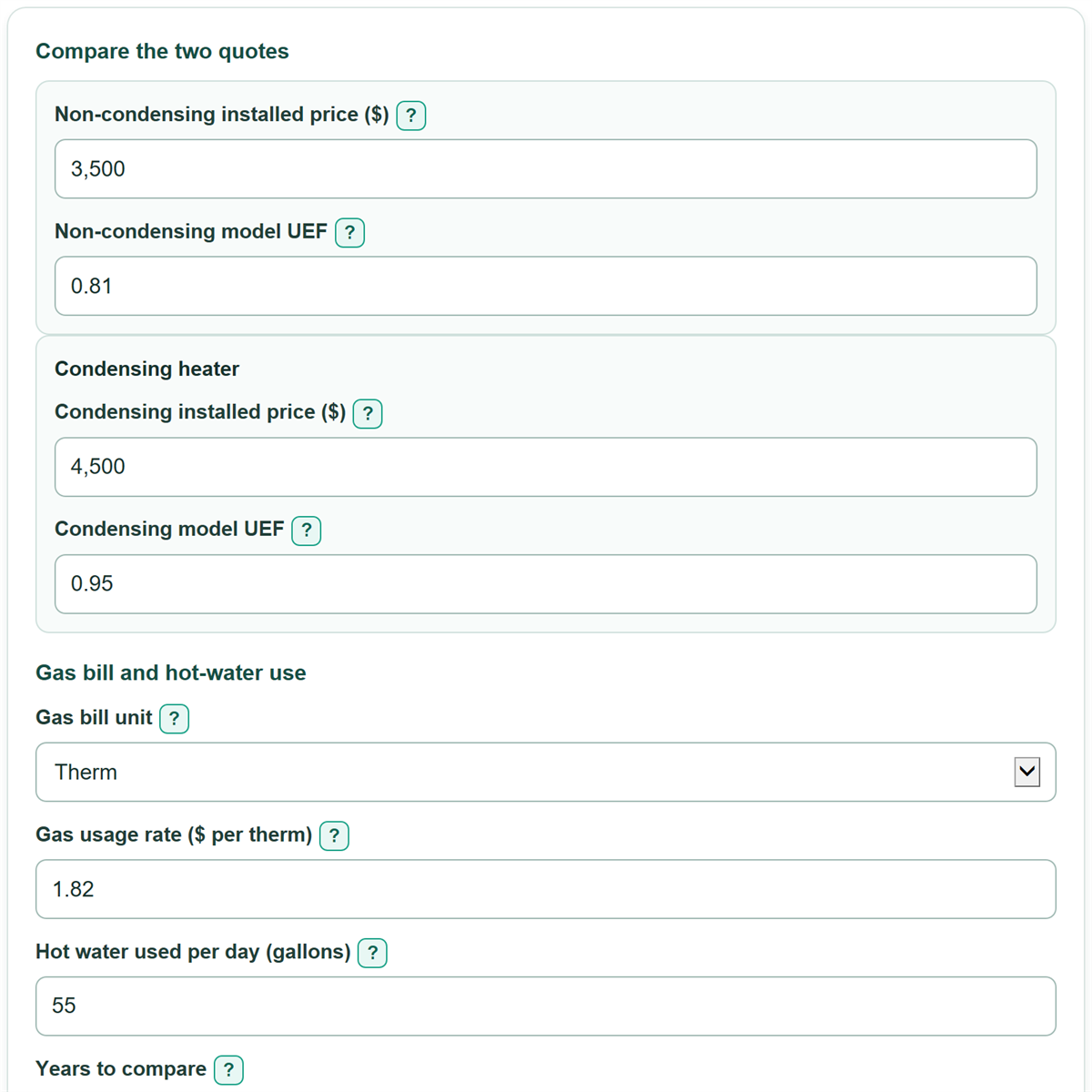
- Copy each all-in contractor quote into Non-condensing installed price and Condensing installed price, including required venting, gas-line, permit, and condensate work.
- Copy the Non-condensing model UEF and Condensing model UEF from each exact heater model; enter either a decimal such as 0.95 or a percent such as 95%.
- Choose the Gas bill unit, then enter the combined usage-based Gas usage rate from your bill. Do not include a fixed monthly customer charge.
- Enter Hot water used per day and Years to compare. Open Advanced options if you want to change water temperatures, maintenance allowances, or the CCF heat-content factor.
- Check that the Gas rate used after conversion matches your bill math, then compare the signed lifetime cost difference and the lower estimated lifetime-cost option.
Definitions
UEF (Uniform Energy Factor): A model-specific water-heater efficiency rating. A higher UEF means less purchased energy is estimated for the same modeled hot-water load. [1]
Therm: A natural-gas energy billing unit equal to 100,000 Btu in this model.
CCF: One hundred cubic feet of natural gas. The calculator uses the entered therms-per-CCF factor to convert a CCF price into a price per therm.
Mcf: One thousand cubic feet of natural gas, equal to 10 CCF in this calculator.
Dekatherm: An energy billing unit equal to 10 therms in this calculator.
Temperature rise: Heated water temperature minus incoming water temperature. It determines how much heat the model assigns to each gallon.
Simple payback time: The years of estimated annual ownership savings needed to recover a higher condensing installed price.
Common mistakes and quick fixes
Mistake: Entering the equipment-only price in Non-condensing installed price or Condensing installed price.
Fix: Use the all-in project quote, including labor, permits, venting, gas-line work, and required condensate work.
Mistake: Treating Non-condensing model UEF or Condensing model UEF as a whole number without a percent sign.
Fix: Enter 0.95, 95%, or another value from more than 0 through 1 after normalization.
Mistake: Copying a fixed customer charge into Gas usage rate.
Fix: Enter only usage-based supply and delivery charges that change with gas use.
Mistake: Using total household water from a water bill as Hot water used per day.
Fix: Estimate only water heated by this heater. Cold-water uses such as toilets and outdoor watering do not belong here.
Mistake: Leaving Heated water temperature below Incoming water temperature.
Fix: Set Heated water temperature above Incoming water temperature so the model has a positive temperature rise.
Mistake: Reading a negative Condensing lifetime cost minus non-condensing lifetime cost as an error.
Fix: A negative value means the condensing option has the lower estimated cost over the selected years.
Limitations & Key Assumptions / Boundary Conditions
- This is a planning comparison, not a heater-sizing calculation. A lower-cost option may still be unable to meet the home's peak simultaneous hot-water demand.
- The fuel estimate uses daily hot-water volume, water temperatures, UEF, and a simplified heat calculation. It does not reproduce the full standardized UEF test procedure.
- Incoming water temperature can change by season and location. Replace the example temperature with a local measurement or a reasonable local estimate when possible.
- The gas rate includes usage-based charges only. Fixed monthly gas customer charges are excluded because they usually do not change when both choices use natural gas.
- Installed quotes should already include equipment, labor, permits, venting, gas-line work, and condensing drainage or neutralizer work when required. Rebates, financing, taxes, and replacement equipment are not added automatically.
- A comparison period longer than either heater's actual service life does not add a replacement heater. Compare a shorter ownership period or account for replacement costs outside this model.
- Simple payback ignores future gas-price changes, financing, discounting, repairs beyond the maintenance allowance, and replacement timing.
Methodology
Calculation steps
The calculator first converts the entered usage-based gas price into dollars per therm. A CCF or Mcf bill needs the editable Gas heat-content factor (therms per CCF); a therm or dekatherm bill does not.
gas rate per therm = entered rate for therm; entered rate / therms per CCF for CCF; entered rate / (10 x therms per CCF) for Mcf; entered rate / 10 for dekatherm
It estimates useful heat for the entered daily hot-water use. The model uses 365 days per year, 8.34 pounds per gallon, and 1 Btu per pound per degree F as planning constants.
annual useful heat (Btu) = gallons per day x 365 x 8.34 x (heated water temperature - incoming water temperature)
Each heater's UEF divides that useful heat to estimate purchased therms. The resulting therms are multiplied by the converted gas rate. The default 55 gallons per day is the DOE federal medium daily-use planning category. [1]
annual therms = annual useful heat / (100,000 x UEF)
annual fuel cost = annual therms x gas rate per therm
Annual maintenance is added to annual fuel cost. Lifetime cost adds the one-time installed price to the selected years of annual ownership cost.
annual ownership cost = annual fuel cost + annual maintenance allowance
lifetime cost = installed price + (years to compare x annual ownership cost)
The lifetime difference stays signed: condensing lifetime cost minus non-condensing lifetime cost. A negative difference means condensing is estimated to cost less.
Worked example
With 55 gallons per day, a 120 F heated-water temperature, a 58 F incoming-water temperature, $1.82 per therm, UEF values of 0.81 and 0.95, and no maintenance allowance, the model estimates about $233 per year in fuel for the non-condensing heater and about $199 per year for the condensing heater. If condensing costs $1,000 more to install, the simple payback is about 29.1 years.
simple payback = condensing upfront premium / annual ownership savings, only when the premium is positive and annual savings are positive
If the condensing installed price is no higher, simple payback is 0 years. If its annual ownership cost is not lower, simple payback is shown as N/A.