
Compare your all-in head-gasket repair and installed engine replacement quotes on the same cost basis.
Engine replacement
Advanced options
Table of contents
How to use our Head Gasket Repair vs Engine Replacement Calculator
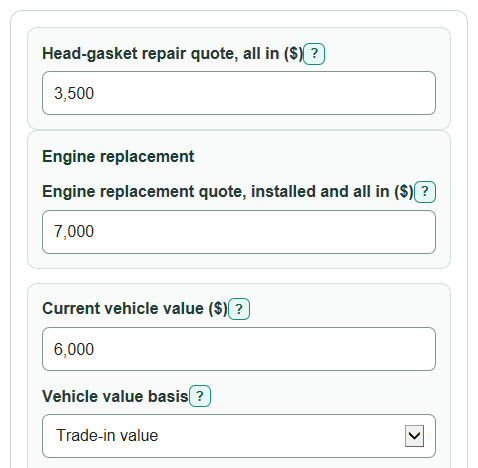
- Copy the customer-pay total from each written estimate into Head-gasket repair quote, all in ($) and Engine replacement quote, installed and all in ($).
- Enter Current vehicle value ($), then choose the matching Vehicle value basis so the percentages have clear context.
- Select the exact Replacement engine condition stated on the engine quote.
- Open Advanced options only for confirmed charges outside a quote or an expected refundable core credit; leave an unknown amount blank.
- Check that the adjusted totals match the quote scope, then compare the dollar difference and each cost share before asking the shop about diagnosis, included work, and warranty terms.
Definitions
All-in quote: The total amount you expect to pay for that path, including charges already listed on the estimate.
Core credit: A refund or credit tied to returning the old engine, often called the core, in eligible condition.
Replacement engine condition: The quote's description of the engine as used, rebuilt, remanufactured, or new. These descriptions do not mean the same thing.
Vehicle value basis: The type of value used for Current vehicle value ($), such as trade-in value, a current cash offer, or private-party value.
Cost as a share of vehicle value: The adjusted option cost divided by the entered vehicle value, shown as a percent.
Common mistakes and quick fixes
Mistake: Entering the engine assembly price in Engine replacement quote, installed and all in ($) instead of the installed customer-pay total.
Fix: Use the estimate total that includes installation, or add confirmed missing charges in Engine costs outside the quote ($) .
Mistake: Adding machining, tax, fluids, or shop fees twice in Repair costs outside the quote ($) .
Fix: Add only charges clearly excluded from Head-gasket repair quote, all in ($) .
Mistake: Treating a core charge as a guaranteed Expected refundable engine core credit ($) .
Fix: Enter a credit only after confirming the old engine is eligible and will be returned.
Mistake: Comparing costs with an old or unclear Current vehicle value ($) .
Fix: Use a recent appraisal or offer and select its matching Vehicle value basis .
Mistake: Reading a lower Engine cost compared with repair as proof that replacement is the better mechanical choice.
Fix: Use the cost comparison for budgeting, then ask about the diagnosis, engine condition, included parts, and warranty coverage.
Limitations & Key Assumptions / Boundary Conditions
- This calculator compares entered dollar amounts. It does not diagnose engine damage or decide which repair is mechanically suitable.
- Results are only as complete as the two quotes. Teardown can uncover cracks, warped parts, timing work, cooling-system damage, or other work not included in an estimate.
- A used, rebuilt, remanufactured, and new engine can have different history, included parts, labor needs, and warranty terms. The selected Replacement engine condition is context only, not a quality score.
- A core credit reduces the engine path only if you receive it. Eligibility, return timing, and shipping or handling terms can change the actual amount.
- Vehicle-value percentages are planning context, not a repair rule. Trade-in, cash-offer, and private-party values can differ.
- Future maintenance, fuel costs, financing, rental costs, downtime, resale value, and warranty coverage are not included unless they are already part of an entered quote.
Methodology
Calculation method
The calculator puts both choices on an entered all-in basis. Blank optional adjustment fields count as $0; nonblank adjustment fields must be valid nonnegative dollar amounts.
Adjusted repair cost = Head-gasket repair quote, all in ($) + Repair costs outside the quote ($)
Adjusted engine replacement cost = Engine replacement quote, installed and all in ($) + Engine costs outside the quote ($) - Expected refundable engine core credit ($)
Engine cost compared with repair = Adjusted engine replacement cost - Adjusted head-gasket repair cost
Cost as a share of vehicle value = Adjusted option cost / Current vehicle value ($) x 100
Reading the comparison
A positive Engine cost compared with repair means the engine path costs more on the entered amounts. A negative amount means the engine path costs less. A $0 difference is a tie.
Worked example
If the repair quote is $3,500 and confirmed repair costs outside the quote are $250, the adjusted repair cost is $3,750. If the installed engine quote is $7,000, outside engine costs are $400, and the expected core credit is $300, the adjusted engine cost is $7,100. The engine cost compared with repair is $3,350, meaning the engine path costs $3,350 more on those entries. With a $6,000 trade-in value, the two costs are 62.5% and 118.3% of vehicle value.