
Enter all four tire readings to find the lowest tread, estimate miles remaining, and plan a replacement date.
Wear history
Replacement planning
Table of contents
How to use our Tire Tread Life and Replacement Date Calculator
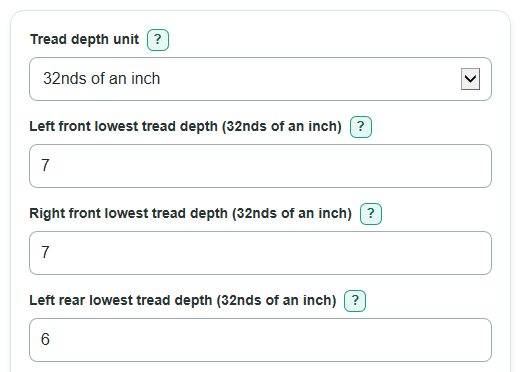
- Choose Tread depth unit to match your gauge or inspection report.
- Measure the main grooves on each tire and enter the lowest reading in Left front lowest tread depth, Right front lowest tread depth, Left rear lowest tread depth, and Right rear lowest tread depth.
- Enter the tire's starting depth in Original tread depth, then enter its driven distance in Miles driven on these tires.
- Set Plan to replace at and update Expected driving with your normal monthly mileage.
- Click Calculate. Check that the listed lowest tire is the tire you measured as most worn; if it is not, recheck the entries and units.
Definitions
Tread depth: The depth of the tire grooves that move water away from the road. This calculator uses the lowest main-groove reading for each tire.
32nds of an inch: A common US tread unit. A reading of 6/32 in can be entered as 6, 6/32, or 6/32 in when that unit is selected.
Limiting tire: The tire, or tied tires, with the lowest entered tread depth. Its reading controls the forecast.
Planning point: The tread depth entered in Plan to replace at. It can be higher than the minimum reference to give time for shopping and service.
Observed tread loss per 1,000 miles: Tread lost from the entered original depth to the lowest current reading, divided by miles driven and scaled to 1,000 miles.
2/32 in safety reference: NHTSA identifies a tire at 2/32 in of tread as worn out. [1]
Common mistakes and quick fixes
Mistake: Entering an average depth instead of the lowest main-groove reading in Left front lowest tread depth or another tire field.
Fix: Measure several main grooves across each tire and enter the lowest reading for that tire.
Mistake: Selecting millimeters under Tread depth unit while entering a 32nds reading such as 6/32.
Fix: Choose 32nds of an inch for entries such as 6 or 6/32, or convert all tread entries to millimeters first.
Mistake: Leaving the example value in Original tread depth when the tire started with a different depth.
Fix: Use the tire specification, installation record, or an early measurement for Original tread depth.
Mistake: Entering the vehicle's total odometer reading as Miles driven on these tires.
Fix: Subtract the installation odometer from the current odometer and enter that tire distance.
Mistake: Treating Estimated replacement date as a guaranteed deadline.
Fix: Update Expected driving when your routine changes and remeasure tread regularly.
Limitations & Key Assumptions / Boundary Conditions
- The forecast assumes future tread wear continues at the measured average rate from Original tread depth, the lowest current reading, and Miles driven on these tires.
- Alignment, inflation, tire rotation, load, road surfaces, driving style, and weather can change future wear, so estimated miles and date can move.
- The date uses Expected driving and 30 planning days per month. It is a planning estimate, not a service deadline.
- The 2/32 in reference is a US worn-tire safety reference. It is not a statement of every state rule, vehicle class, or tire application.
- This calculator cannot inspect treadwear bars, sidewall damage, bulges, cords, punctures, cracks, or severe uneven wear. Have a qualified tire professional inspect those conditions promptly.
Methodology
Calculation method
All tread entries are converted to 32nds of an inch internally. The calculator finds the lowest of the four current tire readings and lists every tire tied at that depth. It requires Original tread depth to be greater than every current tire reading so the measured-wear model has valid starting data.
depth factor = 1 for 32nds, or 32 / 25.4 for mm
lowest tread = minimum of the four current tire readings
tread worn = original tread - lowest tread
miles per 1/32 in worn = miles driven on these tires / tread worn
estimated miles remaining = (lowest tread - planning point) x miles per 1/32 in worn
Estimated miles remaining is set to zero when the lowest tread is at or below Plan to replace at. If the lowest tread is at or below 2/32 in, the status is Replace now; this safety reference takes priority over the planning forecast. [1]
estimated months remaining = estimated miles remaining / expected driving
estimated replacement date = local calculation date + estimated months remaining x 30 days
observed tread loss per 1,000 miles = tread worn / miles driven on these tires x 1,000
Worked example
If Original tread depth is 10/32 in, the lowest current reading is 5/32 in, and Miles driven on these tires is 30,000, the tire has worn 5/32 in. That is 6,000 miles per 1/32 in of wear. With Plan to replace at set to 4/32 in, the estimate is 6,000 miles remaining. At Expected driving of 899 miles per month, that is about 6.67 months.