
Compare your current and proposed wheel widths, offset or backspacing, and spacers to see how each wheel edge moves.
Advanced options
Table of contents
How to use our Wheel Offset, Backspacing and Fitment Change Calculator
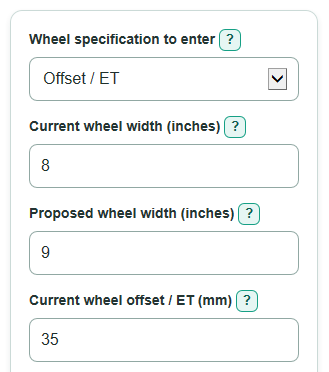
- Choose Wheel specification to enter based on the numbers printed on your wheel or shown in its listing.
- Enter the bead-seat measurements for Current wheel width and Proposed wheel width; do not use tire width.
- Enter either both signed Current wheel offset / ET and Proposed wheel offset / ET, or both backspacing values. Keep a negative offset sign if the wheel specification has one.
- Open Advanced options only if either setup uses a spacer, then enter Current spacer thickness and Proposed spacer thickness in the selected unit.
- Click Calculate and check both movement results. A positive inner movement means less suspension room, while a positive outer movement means the proposed wheel sits farther out.
Definitions
Wheel width: The bead-seat width of the wheel, usually printed in inches. It is not the tire width.
Offset / ET: The signed distance between the wheel centerline and hub mounting face. Positive offset places the mounting face outward from the centerline and moves the wheel inward; negative offset moves it outward. [2]
Backspacing: The distance from the hub mounting face to the inner wheel lip, usually stated in inches. It is another way to describe wheel position.
Effective offset: The wheel's offset after subtracting spacer thickness. A spacer lowers effective offset and moves the installed wheel outward.
Inner wheel edge movement: Change at the wheel edge nearest suspension parts. A positive value means the proposed edge is closer to the suspension.
Outer wheel edge movement: Change at the wheel edge nearest the fender. A positive value means the proposed edge moves farther outward.
Common mistakes and quick fixes
Mistake: Entering tire width in Current wheel width or Proposed wheel width.
Fix: Enter the wheel's bead-seat width, such as 8, 8.5, or 9 inches.
Mistake: Dropping the minus sign from Current wheel offset / ET or Proposed wheel offset / ET.
Fix: Copy the signed value exactly. For example, enter -12 for an ET-12 wheel.
Mistake: Filling in Current wheel backspacing while Wheel specification to enter is set to Offset / ET.
Fix: Choose Backspacing first, then enter both current and proposed backspacing values.
Mistake: Treating Current spacer thickness or Proposed spacer thickness as part of the stamped wheel offset.
Fix: Enter the stamped offset normally, then enter each spacer separately so the calculator can find effective offset.
Mistake: Reading Inner wheel edge movement as remaining clearance.
Fix: It is only a change from the current setup. Measure actual space to suspension parts separately.
Limitations & Key Assumptions / Boundary Conditions
- This compares static wheel-edge geometry only. It does not guarantee that a wheel and tire will fit without rubbing.
- Wheel width is treated as bead-seat width. Backspacing calculations add a 1-inch overall rim-width allowance for the wheel lips.
- Actual tire section width, tire shape, brake-caliper clearance, bolt pattern, hub bore, wheel diameter, steering lock, camber, suspension travel, and body clearance are not modeled.
- Spacer thickness is treated as a direct outward shift. Check that any spacer, wheel, and fastener setup is appropriate for the vehicle and installed correctly.
- Compare the signed movement with measured clearance on your own vehicle. A negative inner movement means more wheel-edge room, not proof that the tire or suspension will clear.
Methodology
Calculation method
The calculator converts every selected wheel specification to signed offset in millimeters, then subtracts each spacer thickness to get effective offset. One inch equals exactly 25.4 mm. [1]
offset from backspacing (mm) = (backspacing (in) - (wheel width (in) + 1) / 2) * 25.4
The added 1 inch estimates the total lip-to-lip rim width from the published bead-seat wheel width when calculating backspacing. [2]
effective offset (mm) = selected offset (mm) - spacer thickness (mm)
inner position (mm) = wheel width (in) * 25.4 / 2 + effective offset (mm)
outer position (mm) = wheel width (in) * 25.4 / 2 - effective offset (mm)
edge movement (mm) = proposed position (mm) - current position (mm)
Worked example
With an 8-inch ET35 wheel and 5 mm spacer as the current setup, and a 9-inch ET25 wheel with a 10 mm spacer as the proposed setup, the effective offsets are 30 mm and 15 mm. The proposed inner edge moves 2.3 mm farther from the suspension, while the outer edge moves 27.7 mm farther out.
Positive inner movement means closer to suspension. Positive outer movement means farther outward. Negative values are kept because they show movement in the opposite direction.
These formulas model wheel edges at rest. They do not include the tire's real shape or vehicle-specific clearance around brakes, suspension, steering, and bodywork.