
Estimate how much slab-edge insulation can reduce annual heating costs and whether the installed project cost meets your payback goal.
Advanced options
Calculation details
Table of contents
How to use our Slab Edge Insulation Savings and Payback Calculator
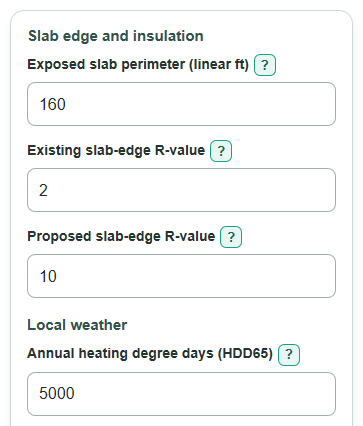
- Measure the Exposed slab perimeter in linear feet. Count only edge connected to outdoor or ground conditions, and add each exposed side for an irregular slab.
- Enter the Existing slab-edge R-value, Proposed slab-edge R-value, and local Annual heating degree days. Use a nearby NOAA climate-normal value for HDD65 when possible.
- Choose Heating energy type, then enter the usage-only Usage-only energy price from your bill and the Heating-system efficiency from equipment information.
- Enter the gross Installed project cost and expected Rebates and tax credits. Open Advanced options to adjust depth, upgraded perimeter share, and your Target payback time.
- Check that proposed annual edge heat loss is lower than current annual edge heat loss and that the quote is at or below the highest installed cost for your target payback.
Definitions
Exposed slab perimeter: The total length of slab edge connected to outdoor or ground conditions, measured in linear feet.
R-value: Resistance to heat flow. A higher R-value means less heat flow through the compared edge strip.
HDD65: Heating degree days using a 65 F base temperature. Higher annual HDD65 generally means a colder or longer heating season.
Usage-only energy price: The price per MCF of natural gas or per kWh of electricity that changes when energy use changes.
Heating-system efficiency: The share of purchased fuel energy that becomes useful delivered heat in this estimate.
Simple payback: Net project cost divided by estimated first-year annual heating-cost savings.
MCF: One thousand cubic feet of natural gas. The calculator uses 1,037,000 Btu per MCF and 3,412 Btu per kWh. [1]
Common mistakes and quick fixes
Mistake: Entering slab floor area for Exposed slab perimeter.
Fix: Enter only the outdoor or ground-exposed edge length in linear feet.
Mistake: Entering insulation thickness as the Existing slab-edge R-value or Proposed slab-edge R-value.
Fix: Use the insulation assembly's R-value; thickness in inches belongs in Compared edge depth.
Mistake: Using a total utility bill to fill Usage-only energy price.
Fix: Use only supply and delivery charges that change with energy use, not fixed monthly customer charges.
Mistake: Leaving Exposed perimeter upgraded at 100 when access prevents work on part of the slab edge.
Fix: Enter the percentage of exposed edge that will actually receive the proposed insulation.
Mistake: Entering incentives larger than the Installed project cost.
Fix: Correct the quote or enter only the rebates and tax credits expected for this project.
Mistake: Treating Estimated simple payback as a guaranteed recovery date.
Fix: Treat it as net project cost divided by first-year estimated savings, then compare it with your target and local project conditions.
Limitations & Key Assumptions / Boundary Conditions
- This is a simplified vertical edge-strip estimate. It is not a full foundation energy model or a formal slab F-factor calculation.
- The calculation treats the entered depth as a flat heat-flow strip and does not model two-dimensional soil heat flow, soil moisture, thermal bridges, frost protection, or detailed foundation geometry.
- Annual savings depend on local weather, indoor temperature, actual fuel heat content, equipment operation, and future energy prices. Actual savings can differ from the first-year estimate.
- Use only the part of the utility rate that changes with consumption. Fixed customer charges, meter fees, and unrelated taxes usually do not decline when heating use falls.
- Simple payback uses first-year savings only. It does not include financing, maintenance, energy-price escalation, inflation, discounting, or changes in equipment efficiency.
- Rebates and tax credits are included only as entered. Confirm eligibility, timing, and eligible costs before relying on them.
Methodology
Calculation method
Slab heat loss is concentrated around the perimeter, so this planning model represents the exposed edge as a simplified vertical strip [1]. The calculator converts the compared edge depth from inches to feet, and HDD65 is multiplied by 24 to convert annual degree days into degree-hours.
depth_ft = compared_edge_depth_inches / 12
current_loss = exposed_perimeter_ft * depth_ft * HDD65 * 24 / existing_R
The proposed loss applies the proposed R-value only to the upgraded share of perimeter. The remaining share keeps the existing R-value.
proposed_loss = depth_ft * HDD65 * 24 * (covered_perimeter_ft / proposed_R + uncovered_perimeter_ft / existing_R)
annual_heat_saved = current_loss - proposed_loss
Delivered heat savings are divided by heating-system efficiency to estimate purchased energy avoided. Natural gas uses 1,037,000 Btu per MCF, and electricity uses 3,412 Btu per kWh. [2]
purchased_energy_saved = annual_heat_saved / efficiency / fuel_conversion
annual_cost_savings = purchased_energy_saved * usage_only_energy_price
Net project cost is gross installed cost minus entered rebates and tax credits. If annual cost savings are positive, simple payback divides net project cost by those first-year savings. The highest gross installed cost that meets the selected target adds incentives back after multiplying annual savings by target years.
simple_payback_years = net_project_cost / annual_cost_savings
max_installed_cost = annual_cost_savings * target_payback_years + rebates_credits
Worked example
With 160 linear ft of exposed perimeter, 24 inches of compared depth, HDD65 of 5,000, R-2 existing insulation, R-10 proposed insulation, and full coverage, estimated delivered heat savings are 15,360,000 Btu per year. At 80% gas heating efficiency and $15.34 per MCF, the estimated annual heating-cost savings are $284.02. A $4,000 project with $500 in incentives has a $3,500 net cost and an estimated simple payback of 12.32 years.