
Compare fixed-price and price-cap heating oil quotes using your gallons, fees, and low, base, and high market-price scenarios.
Supplier quotes
Possible market prices
Advanced options
| Scenario | Cap plan | Fixed plan | Cap minus fixed |
|---|---|---|---|
| Low | |||
| Base | |||
| High |
Table of contents
How to use our Heating Oil Fixed-Price vs Price-Cap Contract Calculator
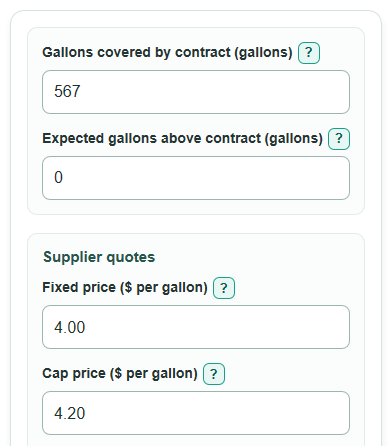
- Enter the protected amount from the quote in Gallons covered by contract, then enter any Expected gallons above contract from your seasonal-use estimate.
- Copy each supplier term into Fixed price, Cap price, Cap protection fee, and Flat cap-plan fee. Enter 0 for a fee that is not charged separately.
- Set Low market-price scenario, Base market-price scenario, and High market-price scenario in low-to-high order. These are planning cases, not forecasts.
- Click Calculate. A negative Base-case cap cost minus fixed cost means the cap plan costs less in your base scenario; a positive number means the fixed plan costs less.
- Check the low and high scenario comparison before choosing. Also review Base-case cost of gallons above contract, because those gallons are not protected by either quoted price.
Definitions
Fixed price: A stated fuel rate per protected gallon. The protected-gallon fuel charge does not change with the market-price scenario.
Price cap: A ceiling on the market-price portion charged for protected gallons. A cap contract may use a lower delivery-day price when the market is below the cap; contract terms should be reviewed carefully. [1]
Cap protection fee: A separate charge per protected gallon, entered in dollars. It is added even when the market price is below the cap.
Flat plan fee: A one-time dollar charge for one plan. It does not increase as protected gallons increase.
Overage gallons: Gallons expected above the contract allotment. This calculator prices them at each entered market-price scenario.
Break-even market price: The below-cap market price where the protected-gallon parts of both plans cost the same after the entered fees.
Common mistakes and quick fixes
Mistake: Putting all expected seasonal use in Gallons covered by contract when the supplier protects fewer gallons.
Fix: Put only the contract allotment in Gallons covered by contract and put the extra amount in Expected gallons above contract.
Mistake: Entering 10 in Cap protection fee when the quote says 10 cents per gallon.
Fix: Enter 0.10 in Cap protection fee because the label uses $ per gallon.
Mistake: Adding a per-gallon charge to Flat cap-plan fee.
Fix: Put per-gallon charges in Cap protection fee and use Flat cap-plan fee only for a one-time dollar charge.
Mistake: Treating Cap price as the price paid even when delivery-day oil costs less.
Fix: Use realistic Low market-price scenario and Base market-price scenario values; protected gallons use the lower market price when it is below Cap price.
Mistake: Reading a positive Base-case cap cost minus fixed cost as savings from the cap plan.
Fix: A positive value means the cap plan costs more, so the fixed plan costs less by that amount in the base scenario.
Mistake: Treating Estimated cap-plan payment per month as a guaranteed supplier budget payment.
Fix: It only spreads the base seasonal estimate over Payment plan length; check the supplier contract for actual billing rules.
Limitations & Key Assumptions / Boundary Conditions
- This is a quote comparison, not a heating-oil price forecast. Low, base, and high market prices are your planning assumptions.
- The cap applies only to Gallons covered by contract in this calculation. Expected gallons above contract are priced at the full scenario market price.
- It assumes the cap plan charges the lower of the market price and Cap price for protected gallons, then adds Cap protection fee and Flat cap-plan fee. Enter 0 for Cap protection fee if the supplier already built that fee into its quoted cap price.
- Taxes, delivery charges, minimum-delivery fees, credit-card charges, cancellation terms, contract expiration rules, and plan-specific service charges are excluded unless you include a different flat fee for each plan.
- Estimated monthly payments divide the base-case seasonal total evenly by Payment plan length. Actual budget bills, delivery timing, and later payment adjustments can differ.
- The 567-gallon starting value is only a 2020 Northeast planning estimate. Replace it with your contract amount or delivery history.
Methodology
Cost calculation
For each market scenario, the calculator first finds the fuel price used for protected cap-plan gallons. It uses the market price when that price is below the cap and uses the cap price otherwise.
capped_fuel_price = min(market_price, cap_price)
Expected gallons above the protected amount are priced at the full scenario market price for both plans.
overage_cost = overage_gallons * market_price
The fixed-plan total includes protected gallons at the Fixed price, any Flat fixed-plan fee, and scenario-priced overage.
fixed_total = contract_gallons * fixed_price + fixed_flat_fee + overage_cost
The cap-plan total includes the lower protected fuel price, the per-gallon Cap protection fee, the Flat cap-plan fee, and the same scenario-priced overage.
cap_total = contract_gallons * (capped_fuel_price + cap_premium) + cap_flat_fee + overage_cost
The comparison keeps its sign instead of changing negative values to zero.
cost_difference = cap_total - fixed_total
A negative difference means the cap plan costs less. A positive difference means the fixed plan costs less.
Break-even and example
The break-even calculation applies to protected gallons while the market price is at or below the cap. Overage does not change which plan is cheaper because both plan totals use the same market-priced overage assumption.
break_even_market_price = fixed_price + (fixed_flat_fee - cap_flat_fee) / contract_gallons - cap_premium
Example: with 567 protected gallons, a $4.00 fixed price, a $4.20 cap, a $0.10 per-gallon cap fee, no flat fees, and a $4.00 base market price, the fixed total is $2,268.00 and the cap total is $2,324.70. Cap minus fixed is $56.70, so the fixed plan costs less in that base case. The calculated break-even price is $3.90 per gallon.
Calculation scope
The maximum protected cap-plan cost uses the cap price for every protected gallon, plus the entered cap premium and flat cap fee. It excludes overage, taxes, delivery charges, and other charges not entered.
cap_max_protected_cost = contract_gallons * (cap_price + cap_premium) + cap_flat_fee
Monthly payment estimates divide each base-case seasonal total by Payment plan length. They show even-payment planning amounts, not a supplier promise. If the calculated break-even is above Cap price, the cap plan stays less expensive throughout the usable capped range. If it is below $0, the fixed plan stays less expensive for all nonnegative market prices.