
Compare a gaming PC and game console's yearly and lifetime electricity costs using your power draw, gaming time, electric rate, and ownership years.
A PC power-supply rating is its capacity, not its actual gaming power draw.
Advanced options
Table of contents
How to use our Gaming PC vs Game Console Lifetime Electricity Cost Calculator
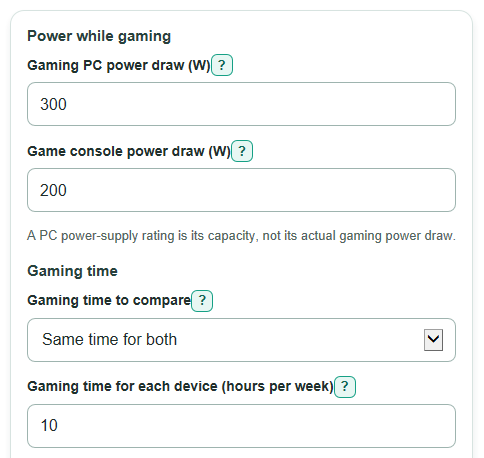
- Enter measured wall power for Gaming PC power draw and Game console power draw; do not enter a PC power supply rating.
- Choose Gaming time to compare. Use the same-time choice for a fair equipment comparison, or enter separate weekly times for your expected use.
- Replace Electricity rate with the usage-based cents per kWh from your utility bill, then enter Years of ownership.
- Open Advanced options only if inactive power, standby time, or a display and accessory setup belongs in your comparison.
- Check the signed PC cost minus console cost over ownership: a positive number means the console costs less, while a negative number means the PC costs less.
Definitions
Wall power: Electricity drawn from the outlet by the full device while it is in use. This is more useful than a PC power supply rating.
Watt (W): A measure of electrical power at a moment in time.
Kilowatt-hour (kWh): A measure of electricity used over time. A device using 1,000 W for one hour uses 1 kWh.
Inactive power: Average power used when a device is idle, asleep, in standby, or in rest mode rather than actively gaming.
Electricity rate: The usage-based price paid for each kWh, entered in cents per kWh.
PC cost minus console cost over ownership: Gaming PC lifetime electricity cost minus game console lifetime electricity cost. A positive value means the PC costs more.
Common mistakes and quick fixes
Mistake: Entering the wattage printed on a PC power supply as Gaming PC power draw.
Fix: Use wall power measured while playing a typical game, or use a model-specific gaming power reading.
Mistake: Typing dollars per kWh into Electricity rate when the label asks for cents/kWh.
Fix: Enter 18.44 for 18.44 cents/kWh, not 0.1844.
Mistake: Comparing different play schedules while expecting an equipment-only comparison.
Fix: Choose the same-time setting under Gaming time to compare and use Gaming time for each device.
Mistake: Adding the same TV or monitor to both setup totals.
Fix: Under Display and accessory setup, choose one shared display setup and enter Shared display and accessories power once.
Mistake: Entering inactive time that overlaps with gaming time.
Fix: For each device, make sure Gaming PC inactive time or Game console inactive time plus average daily gaming time is no more than 24 hours.
Mistake: Reading a negative PC cost minus console cost over ownership as an error.
Fix: A negative amount means the Gaming PC electricity cost over ownership is lower by that amount.
Limitations & Key Assumptions / Boundary Conditions
- Results estimate usage-dependent electricity charges only. Fixed monthly customer charges are excluded because they usually do not change with device choice.
- The electricity rate stays constant for all Years of ownership. Real utility prices, taxes, delivery charges, and time-of-use rates can change.
- Gaming power can vary by game, frame-rate cap, graphics settings, hardware, updates, and attached devices. A wall-meter reading during typical play gives the best input.
- Inactive power applies only for the entered inactive hours. Do not count time that is already included as gaming time.
- Display and accessory power is counted only while gaming. Choose a shared display setup when the same TV or monitor would be used with both devices.
- The comparison does not include purchase price, game costs, repairs, internet service, heat or air-conditioning effects, or resale value.
Methodology
How the calculation works
The calculator chooses one weekly gaming-time value for each device. With the same-time choice, both use Gaming time for each device. With different times, it uses the separate PC and console entries. Display power is added only during gaming, while inactive power is added for the entered hours each day.
annual kWh = ((gaming W + display W) x gaming hours/week x 52 + inactive W x inactive hours/day x 365) / 1000
It converts annual electricity use to cost using the entered rate in cents per kWh.
annual cost = annual kWh x electricity rate in cents/kWh / 100
Lifetime figures use the same ownership period for both choices.
lifetime cost = annual cost x years of ownership
The main comparison keeps the sign instead of changing negative values to zero.
PC cost minus console cost = PC lifetime cost - console lifetime cost
Worked example
With 300 W for the PC, 200 W for the console, 10 gaming hours per week each, no optional loads, a rate of 18.44 cents/kWh, and 5 years of ownership, the PC uses 156 kWh per year and the console uses 104 kWh per year. Their estimated lifetime electricity costs are $143.83 and $95.89, so the signed gap is +$47.94. The game console is the lower electricity-cost choice.
Rate default
The 18.44 cents/kWh starting value is a May 2026 US residential average planning estimate from the U.S. Energy Information Administration. Replace it with a rate from your own bill when possible. [1]