
Compare portable and standby generator costs over time using your outage plan, fuel rates, upkeep, setup costs, and replacement assumptions.
Portable generator setup
Standby generator setup
Advanced options
Test and exercise running
Optional replacements
The starting numbers are editable examples, not current market averages. Replace them with your quotes, manuals, bills, and local outage estimate.
Cost comparison
Portable cost details
Standby cost details
Table of contents
How to use our Portable vs Standby Generator Lifetime Cost Calculator
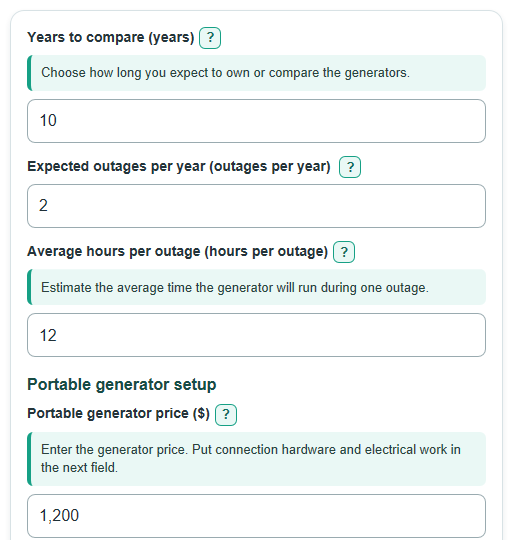
- Enter Years to compare, Expected outages per year, and Average hours per outage for one household outage scenario.
- Enter the portable generator price, safe home-connection setup cost, yearly upkeep, fuel type, manual fuel-use rate, and local fuel price.
- Enter the standby generator price, installation cost, yearly upkeep, fuel type, manual fuel-use rate, and local fuel price.
- Open Advanced options only if you plan test-running hours or expect either generator to be replaced during the comparison period.
- Check the lower-cost option, then compare the fuel, upkeep, and upfront cost cards to see which assumption is driving the gap.
Definitions
Home-connection setup: Hardware and work that let a portable generator supply selected home circuits, such as an inlet, cord, interlock or manual transfer equipment, electrical labor, and permits.
Expected load: The amount of electricity you expect to use while the generator runs. Use the fuel-use row in the manual closest to that load.
Fuel-use rate: Fuel consumed each hour while running. Liquid fuels use gallons per hour; natural gas uses cubic feet per hour.
Exercise hours: Scheduled test-running time outside a real outage. These hours use fuel and are added to annual outage running hours.
Upfront cost: The equipment price plus the portable connection setup or standby installation cost paid before ongoing fuel and upkeep.
Lifetime cost: Upfront cost plus fuel, yearly upkeep, and any optional replacement included during the chosen period.
Standby cost minus portable cost: Standby lifetime cost less portable lifetime cost. A positive number means standby costs more; a negative number means standby costs less.
Common mistakes and quick fixes
Mistake: Entering only the generator price in Portable home-connection setup.
Fix: Include the inlet, transfer equipment or interlock, cord, electrical labor, and permit that apply to your planned connection.
Mistake: Treating Standby installation cost as only labor.
Fix: Include applicable transfer equipment, pad, electrical work, fuel-line work, permits, inspection, and labor from the installer quote.
Mistake: Using a maximum-load figure for Portable fuel use at expected load.
Fix: Use the fuel-use rate from the manual at a load close to what you expect to run during an outage.
Mistake: Entering a natural-gas bill price per therm or per CCF as Portable fuel price.
Fix: Convert the usage charge to dollars per 1,000 cubic feet before entering it, because the natural-gas rate uses cubic feet per hour.
Mistake: Changing Standby generator fuel but leaving a rate copied from a different fuel.
Fix: Check that Standby fuel use at expected load and Standby fuel price match the selected fuel's units.
Mistake: Entering Portable replacement cost without a Portable replacement year.
Fix: Enter a whole replacement year within Years to compare, or clear the replacement cost if no replacement is planned.
Limitations & Key Assumptions / Boundary Conditions
- Results use the outage frequency, outage duration, fuel price, fuel-use rate, and upkeep amounts you enter. Future storms, fuel prices, and service needs can differ.
- Fuel prices and yearly upkeep are held constant over the full comparison period. The calculation does not adjust for inflation or the time value of money.
- The model includes at most one optional replacement for each option. It does not estimate wear from engine hours or predict generator life.
- Natural gas cost uses dollars per 1,000 cubic feet and a fuel rate in cubic feet per hour. Check local natural-gas availability during an outage; utility service is not guaranteed.
- The calculation does not include financing, taxes, tax credits, insurance changes, resale value, generator sizing, appliance coverage, food-loss prevention, or property damage avoided during an outage.
- A portable setup connected to home wiring needs appropriate equipment and professional guidance. Do not use a generator in an enclosed or partially enclosed space.
Methodology
How the comparison is calculated
Both options use the same outage plan. The calculator first finds annual outage running time, then adds each option's separate test-running hours.
annual outage hours = Expected outages per year x Average hours per outage
annual running hours = annual outage hours + test-running hours per year
For gasoline, propane, and diesel, hourly fuel cost is the manual fuel-use rate in gallons per hour multiplied by the local price per gallon. For natural gas, the entered price is per 1,000 cubic feet, so it is divided by 1,000 before multiplying by the hourly cubic-feet rate.
liquid fuel cost per hour = gallons per hour x dollars per gallon
natural gas cost per hour = cubic feet per hour x dollars per 1,000 cubic feet / 1,000
fuel cost over the comparison = annual running hours x fuel cost per hour x Years to compare
Upfront portable cost is Portable generator price plus Portable home-connection setup. Upfront standby cost is Standby generator price plus Standby installation cost. Yearly upkeep is multiplied by Years to compare. A replacement cost is added once only when its matching replacement year is within the comparison period.
lifetime cost = upfront cost + fuel cost over the comparison + yearly upkeep x years + replacement cost included
Standby cost minus portable cost = standby lifetime cost - portable lifetime cost
Worked example
With 2 outages per year lasting 12 hours each, annual outage running time is 24 hours. A portable generator using 0.75 gallons per hour at $4.00 per gallon costs $3.00 per running hour, or $720 in fuel over 10 years when there are no portable test-running hours. Its full lifetime total also includes its upfront setup cost and yearly upkeep.
Calculation choices
All dollar inputs are treated as nominal dollars entered by the user. The calculator does not discount future costs, increase fuel prices over time, or estimate different outage use for portable and standby equipment. A zero cost gap is shown as a tie.