
Compare a DC and AC ceiling fan using their watts, prices, use pattern, and your electricity rate to see which costs less over time.
Advanced options
Table of contents
How to use our DC vs AC Ceiling Fan Lifetime Cost Calculator
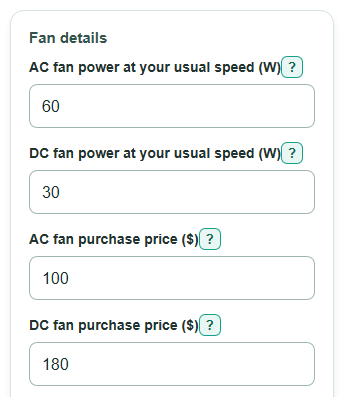
- Enter each fan's power at the speed you usually expect to use, not just its highest listed wattage.
- Enter Hours used per day and Days used per year to match year-round, seasonal, or overnight use.
- Replace Electricity rate with the usage-based price from your utility bill, then enter both purchase prices and Years you expect to own the fan.
- Open Advanced options only if AC fan installation cost and DC fan installation cost differ or need to be included.
- Calculate, then check that the yearly electricity costs fit the watt difference and your use pattern before using the ownership-period savings to choose a fan.
Definitions
AC fan: A fan compared here by its entered running power and costs. Its motor type alone does not determine its electricity use.
DC fan: A ceiling fan with a DC motor and built-in electronics that connects to normal household AC power. Compare its actual watts rather than assuming a fixed efficiency difference.
Watt (W): A measure of power, or how fast the fan uses electricity while running.
Kilowatt-hour (kWh): A unit of electricity use on utility bills. One kWh equals 1,000 watt-hours.
Electricity rate ($/kWh): The usage-based price paid for each kWh. The editable starting value of $0.173/kWh is a 2025 US residential planning estimate. [1]
Upfront cost: Purchase price plus that fan's installation cost.
Ownership period: The years used to compare both fans. It is not a promise of either fan's service life.
Payback time: The time needed for a higher DC upfront cost to be recovered through lower yearly electricity cost.
Common mistakes and quick fixes
Mistake: Entering the highest listed watts instead of the power used at your normal setting in AC fan power at your usual speed or DC fan power at your usual speed.
Fix: Use a specification for the usual speed or a watt-meter reading. Keep light-kit power out unless both fan entries include equal light use.
Mistake: Treating Hours used per day as an average across every day of the year while also entering only seasonal use in Days used per year.
Fix: Enter hours for a day when the fan runs, then enter the number of days it is used.
Mistake: Adding a fixed utility customer charge to Electricity rate.
Fix: Use the usage-based electricity price in $/kWh. A fixed monthly customer charge normally stays the same with either fan.
Mistake: Entering only the price difference in DC fan purchase price.
Fix: Enter the full purchase price of each fan so AC fan total ownership cost and DC fan total ownership cost can be compared fairly.
Mistake: Assuming a negative DC fan savings over your ownership period is an error.
Fix: A negative value means the DC fan costs more over the selected period, even if its Yearly electricity savings with the DC fan is positive.
Mistake: Expecting Time for DC electricity savings to repay its higher upfront cost to apply in every comparison.
Fix: Payback is only possible when the DC fan starts with a higher upfront cost and has positive yearly electricity savings.
Limitations & Key Assumptions / Boundary Conditions
- The estimate uses the same hours, days, electricity rate, and ownership period for both fans.
- Entered watts are treated as constant whenever a fan runs. Real power can change with speed, controls, and operating conditions.
- Light-kit use, standby power, repairs, replacement, removal, sales tax, financing, and time-of-use electricity pricing are excluded.
- Fixed monthly utility customer charges are excluded because choosing one fan normally does not change them.
- Payback is a simple cost recovery calculation. It does not account for inflation, future rate changes, discounting, or the value of money over time.
- A lower total cost does not measure airflow, noise, appearance, reliability, warranty coverage, or installation suitability.
Methodology
Cost calculation
The calculator first finds yearly running hours from the use pattern. It then converts each fan's watt-hours to kWh, multiplies by the electricity rate, and adds the selected years of electricity cost to each fan's upfront cost.
annual_runtime_hours = hours_per_day * days_per_year
annual_energy_kWh = fan_watts * annual_runtime_hours / 1000
annual_electricity_cost = annual_energy_kWh * electricity_rate
upfront_cost = purchase_price + installation_cost
lifetime_total_cost = upfront_cost + annual_electricity_cost * ownership_years
Comparison and payback
DC savings stay signed so the direction remains clear. A positive savings number means the DC fan costs less overall. A negative number means it costs more overall during the chosen ownership period.
DC_lifetime_savings = AC_lifetime_total_cost - DC_lifetime_total_cost
annual_operating_savings = AC_annual_electricity_cost - DC_annual_electricity_cost
payback_years = (DC_upfront_cost - AC_upfront_cost) / annual_operating_savings
Payback is shown only when the DC fan has a higher upfront cost and positive yearly electricity savings. If it starts no more expensive and does not cost more to run, payback is Immediate. If annual savings are zero or negative, payback is No payback.
Worked example
With a 60 W AC fan, a 30 W DC fan, 8 hours per day, and 200 days per year, each fan runs 1,600 hours yearly. The AC fan uses 96 kWh per year and the DC fan uses 48 kWh per year. At $0.173/kWh, their yearly electricity costs are $16.61 and $8.30. With purchase prices of $100 and $180, no installation cost, and 10 years of ownership, the AC total is $266.08 and the DC total is $263.04. The DC fan saves $3.04 over the period.
Calculation scope
The $0.173/kWh starting rate is an editable US residential planning estimate from EIA data. [1] The calculation excludes fixed customer charges because they normally do not change with the fan choice. It also uses the entered power as a constant, so measured or usual-speed wattage gives a better estimate than maximum nameplate watts.