
Compare induction and electric coil cooktop costs using your quotes, cooking time, electricity rate, and planned ownership years.
Table of contents
How to use our Induction vs Electric Coil Cooktop Lifetime Cost Calculator
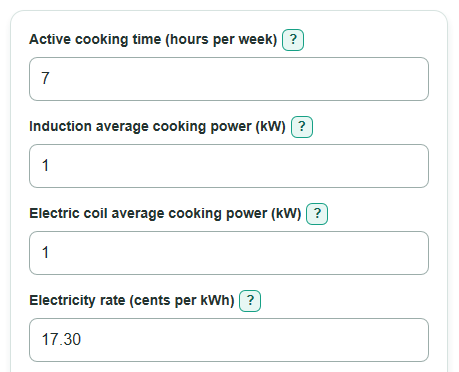
- Enter burner-on time in Active cooking time, then enter a realistic average kW for each cooktop rather than its highest listed power.
- Replace Electricity rate with the variable cents-per-kWh rate from your utility bill if you have it.
- Enter separate product and site-work quotes in the induction and electric coil price and installation fields, using 0 only for costs that truly do not apply.
- Choose Years to compare, then use Advanced options only if cookware, repair allowances, or replacements matter to your decision.
- Click Calculate. Check that the annual electricity use and annual electricity cost fit your cooking routine before relying on the lifetime cost advantage.
Definitions
Active cooking time: Weekly time when at least one burner is on. It is not total meal-prep time.
Average cooking power: The average electricity draw in kW while cooking. It can be much lower than a cooktop's maximum or boost rating.
kW: Kilowatt, a measure of power used at a moment.
kWh: Kilowatt-hour, a measure of electricity use. One kW used for one hour equals one kWh.
Electricity rate: The variable charge for electricity, entered in cents per kWh. The 17.30 default is a 2025 US residential planning estimate; replace it with your bill rate when possible. [1]
Lifetime cost advantage: Electric coil lifetime cost minus induction lifetime cost. A positive number means induction costs less; a negative number means induction costs more.
Energy-only payback time: Years of electricity savings needed to recover a higher initial induction cost. It excludes repairs and future replacements.
Service life: A planning estimate for years until replacement. A blank service-life field means replacements are not modeled.
Common mistakes and quick fixes
Mistake: Entering maximum or boost wattage in Induction average cooking power.
Fix: Use the average kW while cooking across your normal mix of high heat and simmering.
Mistake: Counting chopping, waiting, and table time in Active cooking time.
Fix: Enter only time when one or more burners are on; account for simultaneous burners through average cooking power.
Mistake: Adding the cooktop price again in Induction installation and electrical work or Electric coil installation and electrical work.
Fix: Put appliance quotes in the cooktop price fields and put labor, circuit, receptacle, panel, or countertop work in the installation fields.
Mistake: Using a bill total that includes fixed customer charges as the Electricity rate.
Fix: Use the variable delivered cents-per-kWh rate because fixed monthly charges stay the same for both electric cooktop choices.
Mistake: Treating Expected induction repairs during comparison as a yearly amount.
Fix: Enter one repair allowance for the entire Years to compare period.
Mistake: Entering a service life and expecting cookware to repeat with every replacement.
Fix: Induction service life and Electric coil service life repeat only the entered cooktop price and installation cost.
Limitations & Key Assumptions / Boundary Conditions
- This is a planning comparison, not a product performance test. Average cooking power and active cooking time can vary by cookware, burner setting, food, and cooking habits.
- The calculator uses one electricity rate for all cooking. Time-of-use rates, tiered prices, taxes, and changing utility prices can change actual costs.
- Fixed monthly utility customer charges are excluded because they generally continue under either electric cooktop choice.
- Replacement modeling repeats the entered cooktop price and installation cost at the selected service-life interval. It does not estimate future inflation, discounts, resale value, or changing installation requirements.
- Cookware and repair allowances are user estimates. New induction-compatible cookware is added once, and repair allowances are added once for the full comparison period.
- Energy-only payback ignores repairs and replacements. A payback longer than Years to compare may not be reached during your planned ownership period.
Methodology
Cost calculation
Weekly burner-on time is converted to a planning year using 52 weeks. Each cooktop is calculated separately using its own average cooking power and the same entered electricity rate.
annual_hours = active_hours_week * 52
annual_kwh = average_power_kw * annual_hours
annual_cost = annual_kwh * electricity_rate / 100
For example, 7 hours per week is 364 hours per year. At 1.2 kW and 17.30 cents per kWh, induction uses 436.8 kWh per year and costs $75.57 per year. At 1.8 kW, electric coil uses 655.2 kWh and costs $113.35 per year.
Lifetime comparison
Each lifetime total adds initial costs, optional one-time costs, optional repair allowance, modeled replacement costs, and annual electricity cost for the selected number of years. Induction cookware is included only in the induction total.
replacement_count = blank_service_life ? 0 : max(0, ceil(years_to_compare / service_life) - 1)
induction_lifetime_cost = induction_price + induction_installation + induction_cookware + induction_repairs + replacement_count * (induction_price + induction_installation) + induction_annual_cost * years_to_compare
coil_lifetime_cost = coil_price + coil_installation + coil_repairs + replacement_count * (coil_price + coil_installation) + coil_annual_cost * years_to_compare
lifetime_cost_advantage = coil_lifetime_cost - induction_lifetime_cost
A replacement at the exact end of the comparison period is excluded. If 10 years are compared and service life is 10 years, the replacement count is zero.
Energy-only payback
Simple payback compares the higher initial induction cost with annual electricity savings. Initial cost includes cooktop price, installation or electrical work, and induction cookware. Repairs and replacements are excluded.
annual_energy_savings = coil_annual_cost - induction_annual_cost
initial_premium = induction_price + induction_installation + induction_cookware - coil_price - coil_installation
payback_years = initial_premium / annual_energy_savings
Payback is 0 years if induction has no higher initial cost and does not use more electricity. It is unavailable if induction has a higher initial cost but does not produce annual electricity savings. The method holds entered prices, cooking use, and electricity rate constant over the comparison period, so actual ownership costs can differ.