
Compare estimated monthly costs and find the free-hour usage share a free-nights electricity plan needs to beat a flat-rate plan.
Advanced options
Table of contents
How to use our Free Nights vs Flat-Rate Electricity Plan Calculator
- Enter your typical Monthly electricity use from a recent bill in kWh per month.
- Estimate Electricity used during free hours based on the plan's exact free window, or use interval data if you have it.
- Copy each plan's energy and delivery charges from its Electricity Facts Label, then choose whether Delivery charges during free hours apply.
- Open Advanced options to add provider and TDU monthly charges for a fuller bill estimate.
- Check the signed savings, cheaper-plan statement, and break-even share. Try a lower and higher free-hour percentage to see whether your choice changes easily.
Definitions
Free hours: The plan's stated time window when its provider energy charge is zero. Delivery may still be charged.
Paid-hours energy rate: The free-nights plan's provider energy charge for kWh used outside the free window, in cents per kWh.
Flat-plan energy rate: The provider energy charge applied to every kWh on the flat-rate plan, in cents per kWh.
TDU delivery rate: A per-kWh delivery charge from the local transmission and distribution utility. It is separate from the provider's energy rate.
TDU monthly charge: A fixed delivery charge added once per billing period, not once per kWh.
Break-even free-hour usage: The percentage of monthly kWh that must occur during free hours for the two estimated costs to match.
Common mistakes and quick fixes
Mistake: Entering an advertised average price in Free-nights paid-hours energy rate or Flat-plan energy rate.
Fix: Enter the plan's energy charge before delivery and fixed monthly charges.
Mistake: Assuming free electricity means Delivery charges during free hours are waived.
Fix: Check the Electricity Facts Label and choose the matching yes or no setting.
Mistake: Using total overnight time instead of actual use for Electricity used during free hours.
Fix: Estimate the share of kWh used in the free window, not the share of hours in a day.
Mistake: Adding a per-kWh delivery charge to TDU monthly charge.
Fix: Put the fixed monthly TDU amount in TDU monthly charge and the usage charge in TDU delivery rate.
Mistake: Treating a negative Estimated monthly savings with free nights as an error.
Fix: A negative number means the free-nights plan is estimated to cost more by that amount each month.
Limitations & Key Assumptions / Boundary Conditions
- This is a monthly planning estimate based on one total usage amount and an estimated free-hour share. It does not measure your actual 15-minute or hourly usage.
- Both plans are assumed to serve the same home, TDU zone, and billing period, so the same TDU delivery rate and TDU monthly charge are used for both.
- The free-nights provider energy charge is assumed to be zero during the plan's stated free hours. Read the plan terms to confirm the exact schedule and exclusions.
- Taxes, bill credits, minimum-use charges, usage tiers, contract fees, cancellation fees, deposits, and seasonal or promotional rate changes are excluded unless their effect is included in an entered charge.
- The yearly estimate multiplies one month's signed savings by 12. Actual usage and savings can change with weather, occupancy, and appliance use.
Methodology
Cost calculation
The calculator splits your monthly kWh into free-hour and paid-hour use. Rates entered in cents per kWh are divided by 100 before they are multiplied by kWh. Provider and TDU monthly charges are added once to each plan estimate.
free_kwh = monthly_kwh * free_share_percent / 100
paid_kwh = monthly_kwh - free_kwh
free_cost = paid_kwh * free_paid_rate_cents / 100 + (paid_kwh + delivery_flag * free_kwh) * tdu_delivery_rate_cents / 100 + free_provider_monthly_charge + tdu_monthly_charge
flat_cost = monthly_kwh * flat_energy_rate_cents / 100 + monthly_kwh * tdu_delivery_rate_cents / 100 + flat_provider_monthly_charge + tdu_monthly_charge
Savings and break-even point
Monthly savings is signed: a positive number means free nights costs less, while a negative number means it costs more. The shared TDU monthly charge is included in each bill estimate but cancels when comparing the plans.
monthly_savings = flat_cost - free_cost
annual_savings = monthly_savings * 12
shift_savings_per_kwh = (free_paid_rate_cents + tdu_delivery_rate_cents * (1 - delivery_flag)) / 100
break_even_share = (monthly_kwh * (free_paid_rate_cents - flat_energy_rate_cents) / 100 + free_provider_monthly_charge - flat_provider_monthly_charge) / (monthly_kwh * shift_savings_per_kwh)
If moving a kWh into free hours does not lower the free-nights cost, there is no useful break-even threshold. A break-even share below 0 percent means free nights already wins with no free-hour use. A share above 100 percent means it cannot win within the possible range.
Worked example
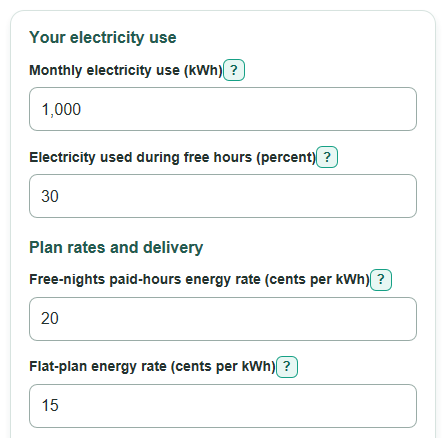
With 1,000 kWh, 30 percent used during free hours, a 20 cents per kWh paid-hours rate, a 15 cents per kWh flat-plan rate, and a 5 cents per kWh delivery rate that applies during free hours, the calculator gets 300 free-hour kWh and 700 paid-hour kWh. With provider monthly charges of $9.95 and $4.95 plus a shared $4.23 TDU monthly charge, the free-nights estimate is $204.18 and the flat-plan estimate is $209.18. Free nights saves $5.00 per month, and the break-even share is 27.5 percent.
Calculation choices
The calculation assumes the entered free-hour percentage matches the candidate plan's actual free window. It does not apply taxes, credits, minimum-use fees, tiers, or contract terms that are not entered as charges.