
Estimate how long a solar pool heater may take to recover its net cost using your seasonal heating bills and installer quote.
Table of contents
How to use our Solar Pool Heater Payback Calculator
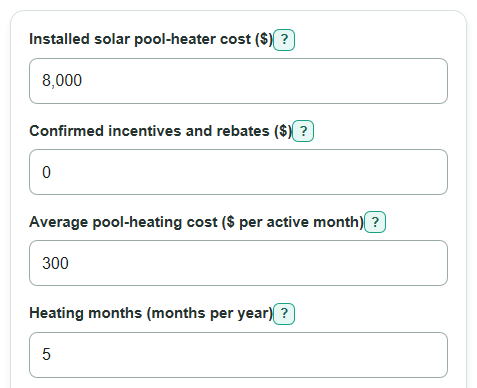
- Enter the full Installed solar pool-heater cost from the installer proposal, including labor, permits, plumbing, and controls.
- Enter only Confirmed incentives and rebates that you expect to receive for this project.
- Estimate the Average pool-heating cost from the part of your utility bill caused by running the current pool heater during active heating months.
- Enter Heating months for the months your heater normally runs, then enter the yearly added pump and maintenance amount in Extra solar operating and maintenance cost.
- Check that estimated annual heating expense avoided matches your actual pool-heating season; if it seems like a whole-year bill, lower the monthly cost or number of heating months before using the payback time.
Definitions
Solar pool heater: A solar thermal system that circulates pool water through collectors warmed by sunlight. DOE highlights solar pool heaters as a cost-effective pool-heating option [1]. It is different from solar electric panels that make electricity.
Active month: A month when the current pool heater normally runs and creates pool-heating expense.
Net upfront cost after incentives: Installed solar pool-heater cost minus confirmed one-time incentives and rebates.
Estimated heating expense avoided each year: Average pool-heating cost per active month multiplied by heating months per year.
Estimated annual net savings: Heating expense avoided each year minus extra solar operating and maintenance cost.
Simple payback: The estimated time for annual net savings to recover a positive net upfront cost. It does not include loan interest or changing energy prices.
Common mistakes and quick fixes
Mistake: Entering the whole household gas or electric bill as Average pool-heating cost.
Fix: Use only the extra bill amount caused by the pool heater, such as the difference from a similar non-heating month.
Mistake: Setting Heating months to 12 when the pool is heated only during part of the year.
Fix: Count only months when the current heater normally operates. A partial month can be entered as a decimal.
Mistake: Leaving out extra pump electricity or upkeep from Extra solar operating and maintenance cost.
Fix: Include added pump runtime, routine maintenance, and any yearly repair allowance you plan to use.
Mistake: Counting a possible tax credit or rebate in Confirmed incentives and rebates before you know that you qualify.
Fix: Enter only amounts confirmed for your specific project, then update the number if approval changes.
Mistake: Treating a short Estimated payback time as proof the system will heat the pool enough.
Fix: Ask the installer to confirm collector area, sun exposure, shade, and expected seasonal pool temperature for your site.
Limitations & Key Assumptions / Boundary Conditions
- This is a simple financial estimate, not a system-sizing or pool-temperature model.
- It assumes the solar system avoids the entered pool-heating expense during the entered active months. Shade, weather, collector area, pool cover use, and desired water temperature can change actual savings.
- Annual savings stay constant for the 10-year comparison. The calculation does not include changing fuel prices, inflation, taxes, financing, or a discount rate.
- Extra solar operating and maintenance cost is treated as the same amount every year. Major repairs, pump replacement, and collector replacement are not added unless included in that yearly amount.
- Incentives are subtracted as a one-time amount. Verify eligibility, deadlines, and whether an incentive is taxable before relying on it.
- A negative net upfront cost is preserved if entered incentives exceed installed cost, but that entry should be checked against the quote and program terms.
Methodology
Calculation method
The calculator keeps one-time project costs separate from yearly costs. It uses the pool-heating part of seasonal utility bills instead of estimating fuel use, heater efficiency, weather, or collector size.
estimated heating expense avoided each year = average pool-heating cost per active month x heating months per year
net upfront cost after incentives = installed solar pool-heater cost - confirmed incentives and rebates
estimated annual net savings = estimated heating expense avoided each year - extra solar operating and maintenance cost
estimated payback time = net upfront cost after incentives / estimated annual net savings
estimated net savings after 10 years = estimated annual net savings x 10 - net upfront cost after incentives
Worked example
With an $8,000 installed cost, $0 in incentives, $300 per active month, 5 heating months, and $250 per year in solar-side cost, avoided heating expense is $1,500 per year. Annual net savings are $1,250, estimated payback is 6.4 years, and estimated net savings after 10 years are $4,500.
How edge cases are handled
If annual net savings are zero or negative, the calculator reports that the entered costs do not produce a payback instead of dividing by zero. If net upfront cost is zero or negative while annual net savings are positive, payback is shown as 0 years. Signed net cost and 10-year savings are kept so you can see a deficit or surplus.
What can change the estimate
The method assumes the system can provide enough useful heat to avoid the entered seasonal cost. It does not test sun exposure, roof or rack space, collector sizing, local weather, pool heat loss, or a pool cover. Confirm those site details with a qualified installer before making a purchase decision.