
Estimate solar water heater savings, remaining backup cost, and simple payback using your installed quote and current water-heating energy cost.
Advanced options
Table of contents
How to use our Solar Water Heater Payback Calculator
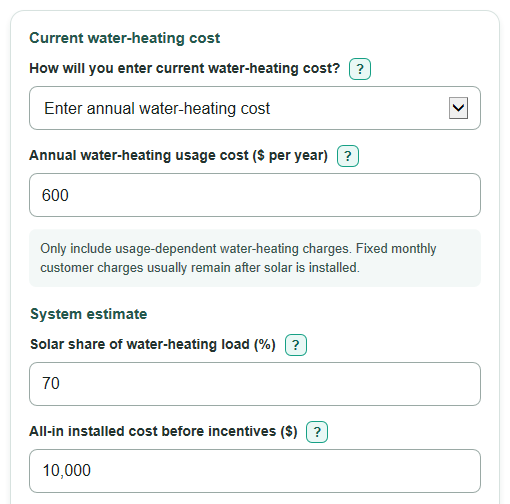
- Choose how you will enter current water-heating cost. Use the direct method if you already know the annual usage-only cost for water heating.
- For the fuel method, choose the Backup water-heater fuel, then enter Annual fuel use for water heating and the Variable fuel price from bills or supplier statements.
- Enter the Solar share of water-heating load from an installer proposal, then enter the All-in installed cost before incentives from a complete written quote.
- Open Advanced options to add only confirmed rebates, a confirmed federal tax credit, expected Annual maintenance and service, and your Time to compare costs.
- Check that Current annual water-heating usage cost used covers water heating only and excludes fixed customer charges before using Estimated simple payback to compare quotes.
Definitions
Solar share of water-heating load: The percent of annual hot-water energy expected to come from the solar water-heating system. It is not collector efficiency or the share of the whole household energy bill.
Variable fuel price: The part of an energy price that changes when you use more or less electricity, gas, propane, or fuel oil. Fixed monthly customer charges are excluded.
Current annual water-heating usage cost: The yearly usage-dependent energy cost for water heating before solar. In the fuel method, it equals annual fuel use times the variable fuel price.
Annual maintenance and service: Expected recurring yearly costs for inspection, pumps, controls, or heat-transfer-fluid service.
Net project cost: All-in installed cost minus entered confirmed rebates and confirmed federal tax credit.
Simple payback: The number of years of modeled annual savings needed to recover a positive net project cost. It does not include financing, changing fuel prices, or inflation.
Common mistakes and quick fixes
Mistake: Entering the full electric or gas bill as Annual water-heating usage cost.
Fix: Enter only the usage-dependent part tied to water heating, not space heating, appliances, or fixed customer charges.
Mistake: Entering a natural-gas price in Variable fuel price as though it were $ per kWh.
Fix: Choose Backup water-heater fuel first, then use the bill unit shown for that fuel, such as $ per therm for natural gas.
Mistake: Using collector efficiency as Solar share of water-heating load.
Fix: Enter the annual share of the hot-water load expected from solar, preferably from the installer design.
Mistake: Entering equipment-only pricing as All-in installed cost before incentives.
Fix: Include equipment, labor, plumbing, permits, roof work, tax, and other costs you must pay.
Mistake: Counting an unverified program as Other confirmed rebates or Confirmed federal tax credit.
Fix: Enter only documented amounts you expect to receive. The federal credit field starts at $0 for the 2026 planning case.
Mistake: Ignoring Annual maintenance and service when comparing Estimated simple payback.
Fix: Add expected recurring service costs so Estimated annual savings after maintenance reflects the full yearly estimate.
Limitations & Key Assumptions / Boundary Conditions
- This is a constant-dollar planning estimate. It does not model inflation, fuel-price changes, utility rate tiers, time-of-use prices, taxes, financing, loan payments, or investment returns.
- Annual savings depend heavily on the entered Solar share of water-heating load. Weather, shading, orientation, household hot-water use, equipment condition, and system controls can change actual solar output.
- Only usage-dependent water-heating energy cost is counted as avoidable. Fixed utility customer charges usually remain after installation.
- The calculator does not size collectors or storage, test site suitability, or replace an installer design.
- Incentive eligibility, payment timing, and tax treatment vary by program and taxpayer. Enter only confirmed dollar amounts.
- Simple payback is unavailable when annual maintenance equals or exceeds the modeled annual bill reduction. A negative net project cost or return value is kept as entered rather than hidden.
Methodology
Cost and savings calculation
The calculator first finds the current annual water-heating usage cost. With the direct method, it uses your entered annual cost. With the fuel method, it multiplies water-heating-only fuel use by the variable price in that fuel's bill unit. Fixed customer charges are excluded.
C = direct annual cost, or C = Q * P
In this formula, C is current annual water-heating usage cost, Q is annual water-heating fuel use, and P is variable fuel price.
The solar share is changed from a percent to a decimal. The calculator applies it to the current usage cost to estimate the bill reduction and the remaining backup-energy cost.
S = solar share percent / 100
G = C * S
B = C * (1 - S)
G is estimated annual bill reduction before maintenance, and B is estimated annual backup-energy cost after solar. Annual maintenance is then subtracted without forcing a negative result to zero.
N = G - M
N is annual savings after maintenance, and M is annual maintenance and service. Net project cost subtracts only the confirmed incentive amounts entered.
U = I - R - F
U is net project cost, I is all-in installed cost, R is other confirmed rebates, and F is confirmed federal tax credit. Estimated simple payback is shown only when both U and N are positive.
Y = U / N
The selected-time projection uses annual net savings multiplied by the chosen years, minus net project cost. Return is calculated only for a positive net project cost.
L = N * H - U
ROI = (L / U) * 100
Worked example
If current water-heating usage cost is $600 per year, solar share is 70%, and annual maintenance is $100, bill reduction is $420 per year and annual savings after maintenance is $320 per year. With a $10,000 net project cost, simple payback is 31.25 years.
What this estimate holds constant
The calculation keeps annual fuel cost, solar share, maintenance, and hot-water demand constant over the comparison time. The electricity suggestion of $0.1730 per kWh is a 2025 US planning average and should be replaced with the local variable bill rate. [1] The federal credit default is $0 for a project placed in service in 2026; confirm current eligibility before changing it. [2]