
Compare packaged HVAC and split system quotes by upfront cost, yearly costs, replacement timing, and discounted lifetime cost.
Advanced options
Table of contents
How to use our Packaged HVAC vs Split System Lifetime Cost Calculator
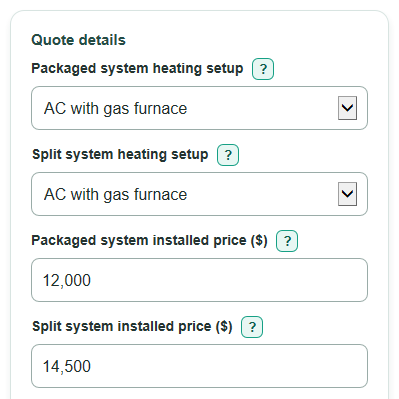
- Choose the heating setup shown on each contractor quote so you can spot options that provide different heating functions.
- Enter each installed quote, then enter yearly energy and maintenance estimates for the same home and comfort settings.
- Enter each expected life, your shared Planning period, and a Discount rate; use 0% to compare future dollars without discounting.
- Open Advanced options to add one-time project work excluded from either quote and any value or disposal cost at plan end.
- Click Calculate, then check the signed cost gaps: a negative Split lifetime cost minus packaged lifetime cost means the split system costs less.
Definitions
Packaged system: HVAC equipment with major components in one outdoor cabinet. Its heating setup can still be gas, electric, heat pump, or no heat.
Split system: HVAC equipment with an outdoor unit and an indoor unit connected by refrigerant lines. Its heating setup may differ from the packaged quote.
Present value: A future cost restated in today's dollars using the Discount rate. A cost paid later has a lower present value when the rate is above 0%.
Planning period: The shared number of years used to compare both options.
Expected life: The assumed number of years before a full system replacement is added to the model.
End value: Remaining or resale value at the end of the plan, entered as positive. A disposal cost is entered as negative.
Common mistakes and quick fixes
Mistake: Treating "packaged" and "split" as if they have the same heating function.
Fix: Compare Packaged system heating setup and Split system heating setup with the contractor proposals before judging annual energy costs.
Mistake: Entering an incomplete quote as Packaged system installed price or Split system installed price.
Fix: Put excluded duct, electrical, permit, roof, pad, indoor-unit, line-set, access, or disposal work in the matching added project work field.
Mistake: Including utility account fees that would stay the same with either option in annual energy cost.
Fix: Enter only the HVAC-related energy difference in Packaged annual energy cost and Split annual energy cost.
Mistake: Adding one-time conversion work again at every replacement.
Fix: Enter it once in Packaged added project work or Split added project work; future replacements use the installed price only.
Mistake: Reading a positive Split lifetime cost minus packaged lifetime cost as savings for the split system.
Fix: A positive value means the split system costs more; a negative value means it costs less.
Mistake: Entering a disposal expense as a positive Packaged value at plan end or Split value at plan end.
Fix: Enter remaining or resale value as positive, and enter a disposal cost as a negative number.
Limitations & Key Assumptions / Boundary Conditions
- This is a quote-based cost comparison. It does not size equipment, check duct design, predict comfort, or estimate actual energy use from efficiency ratings.
- Annual energy and maintenance amounts stay constant in nominal dollars. The calculation does not forecast utility-rate changes, fuel-price changes, inflation, tax credits, rebates, financing, or repair spikes.
- Each future replacement uses the entered installed price in today's dollars. One-time added project work is charged only at the first purchase and is not repeated.
- Replacements are added only when expected life ends before the Planning period. A replacement exactly at plan end is excluded.
- The comparison is most fair when both quotes provide the same cooling capacity, heating function, installation scope, and comfort target. Different heating setups can change costs for reasons unrelated to equipment layout.
- End value is a user estimate. A large positive value can produce a negative modeled lifetime cost if it exceeds all modeled costs.
Methodology
Cost calculation
The calculator first adds each installed quote and its one-time added project work. It then adds yearly energy and maintenance costs, discounted because they are treated as paid at the end of each year. Future full replacements use the installed price only.
U_i = installed_price_i + extra_scope_cost_i
A_i = annual_energy_cost_i + annual_maintenance_i
PVAF(r,H) = H when r = 0; otherwise (1 - (1 + r)^(-H)) / r
R_i = sum(installed_price_i / (1 + r)^(k * life_i)) for k * life_i < H
E_i = end_value_i / (1 + r)^H
LCC_i = U_i + A_i * PVAF(r,H) + R_i - E_i
In these formulas, i means packaged or split, r is Discount rate divided by 100, and H is Planning period. A positive end value lowers lifetime cost. A negative end value is a disposal cost and raises lifetime cost.
Comparing the options
Split lifetime cost minus packaged lifetime cost = LCC_split - LCC_packaged
Split upfront cost minus packaged upfront cost = U_split - U_packaged
A positive signed gap means the split system costs more. A negative signed gap means the split system costs less. If the displayed lifetime costs are equal after rounding, the calculator reports a tie.
Worked example
With a 10-year period and a 0% discount rate, suppose the packaged option has a $10,000 installed price and $2,300 in yearly energy plus maintenance. Suppose the split option has a $12,000 installed price, $1,000 in added project work, and $1,750 in yearly costs. The modeled totals are $33,000 for packaged and $30,500 for split, so the signed lifetime gap is -$2,500. The split option starts $3,000 higher but catches up in year 6.
Assumptions and limits
Yearly energy and maintenance costs are held constant, and the same Discount rate applies to both options. The break-even year is the first whole year when the option that started with the higher adjusted upfront cost has cumulative discounted cost no greater than the other option. At the final year, the calculation also includes the discounted end value. If that point never occurs, break-even is reported as not reached within the Planning period.