
Compare gas and electric oven costs over your chosen years, including purchase, installation, energy use, and an added gas account charge.
Advanced options
Table of contents
How to use our Gas vs Electric Oven Lifetime Cost Calculator
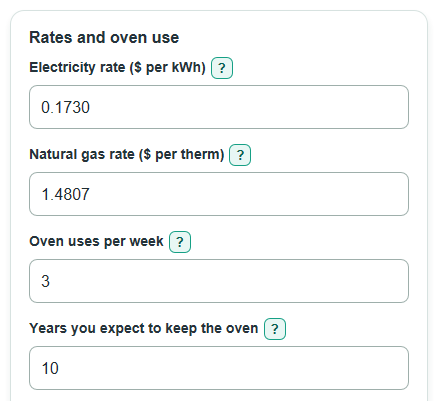
- Enter the electricity and natural gas usage rates from recent utility bills. Use the usage rate, not a monthly bill total.
- Enter your normal Oven uses per week and the Years you expect to keep the oven.
- Add separate purchase and installation quotes for each oven so one-time costs stay visible.
- Choose whether the gas oven would add or keep a gas account. Enter Added gas service charge only if the oven is the reason for that account.
- Open Advanced options to replace the per-use energy examples, then check whether the lower-cost choice and any break-even time make sense for your ownership period.
Definitions
kWh: Kilowatt-hour, the unit electric utilities use to bill for electricity. It measures energy, not just appliance power.
Therm: A natural-gas billing unit equal to 100,000 Btu of heat energy. [2]
Energy per use: Energy used for one normal oven session, including preheating. It is different from the oven's maximum power or maximum gas input.
Upfront cost: Purchase price plus installation cost paid once at the start.
Added gas service charge: A fixed monthly gas account or meter charge included only if the gas oven makes the household open or keep gas service.
Break-even time: The positive number of years until the two calculated lifetime costs become equal.
Common mistakes and quick fixes
Mistake: Entering a full monthly electric bill as the Electricity rate.
Fix: Enter the all-in usage rate in $/kWh from the bill, not the total amount due.
Mistake: Counting cooktop meals in Oven uses per week.
Fix: Count baking and roasting sessions only, because this calculator covers the oven rather than the cooktop.
Mistake: Adding Added gas service charge even though another appliance already needs gas service.
Fix: Choose "No, gas service is already needed" for Would the oven add or keep a gas account? The added yearly gas service cost will be $0.
Mistake: Using an oven's maximum rating as Electric oven energy per use or Gas oven energy per use.
Fix: Use energy for one normal session, including preheating, from product information or a measured estimate when available.
Mistake: Treating a negative Gas cost minus electric cost over your ownership period as an error.
Fix: A negative value means the gas oven costs less over the selected years; a positive value means it costs more.
Limitations & Key Assumptions / Boundary Conditions
- The comparison covers the oven only. It does not include cooktop energy use.
- Energy per use is an estimate that can change with oven size, temperature, preheating, cooking time, cycling, and self-cleaning.
- Utility rates can include taxes, delivery charges, tiers, and seasonal prices. An all-in rate from a recent bill is usually more useful than a national planning default.
- The calculator keeps utility rates and energy use constant over the selected years. It does not model inflation or future rate changes.
- It excludes repairs, maintenance, financing, resale value, replacement appliances, permits, and costs outside the entered installation quotes.
- The added gas service charge belongs in the comparison only when the gas oven changes whether the household needs a gas account.
- A break-even time beyond your selected ownership period is mathematically possible, but it does not mean the costs become equal while you own the oven.
Methodology
Cost calculation
The calculator first turns weekly oven sessions into a yearly count. It applies the same session count to both ovens so the comparison uses the same cooking routine.
sessions per year = oven uses per week * 52
Each annual energy cost is the yearly session count times energy per use times the matching utility rate. The electricity planning default is a 2025 US residential estimate and should be replaced with a local bill rate when possible. [1]
electric annual energy cost = sessions per year * electric kWh per use * electricity rate
gas annual energy cost = sessions per year * gas therms per use * natural gas rate
The gas service charge is added only when the gas oven would create the need for a gas account.
added gas service cost per year = added gas service charge * 12, or $0 when gas service is already needed
Each lifetime total adds the one-time purchase and installation costs to recurring costs over the selected ownership period.
electric lifetime cost = electric upfront cost + electric annual energy cost * ownership years
gas lifetime cost = gas upfront cost + (gas annual energy cost + added gas service cost per year) * ownership years
The signed gap is gas lifetime cost minus electric lifetime cost. A positive gap means gas costs more; a negative gap means gas costs less.
gas cost minus electric cost = gas lifetime cost - electric lifetime cost
Break-even time
A break-even time is shown only when the cost lines cross after purchase. For example, if gas costs $200 more upfront but saves $20 per year in recurring costs, the break-even time is 10 years.
break-even years = (gas upfront cost - electric upfront cost) / (electric annual energy cost - gas annual energy cost - added gas service cost per year)
If recurring costs are equal, or the calculated time is zero or negative, there is no future break-even under the entered values.