
Estimate your home's design heating load and equivalent heat-pump size from a cold-period fuel bill and local temperatures.
Advanced options
Table of contents
How to use our Heat Pump Size from Heating Fuel Use Calculator
- Choose the fuel and bill unit that exactly matches the usage line on your gas bill or fuel-delivery record.
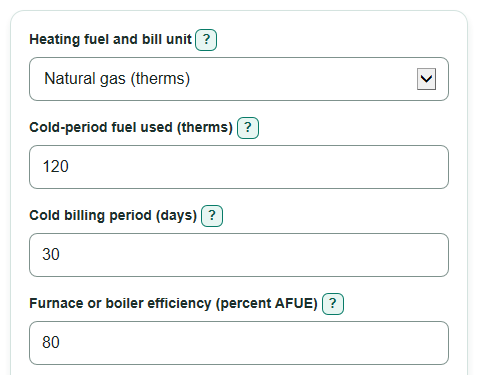
- Enter fuel used and the cold billing period days from the same bill, then enter your furnace or boiler efficiency.
- Enter your usual indoor temperature, the average outdoor temperature for those bill dates, and your local outdoor heating design temperature.
- Open Advanced options only if you have a warm-season bill on the same meter; enter both summer baseline fields to remove estimated non-heating fuel use.
- Check that the estimated design heating load is positive and compare it with a proposed heat pump's published heating capacity at your design temperature, not its nominal tonnage alone.
Definitions
AFUE: Annual Fuel Utilization Efficiency. It is the percentage of fuel energy that the existing furnace or boiler delivers as useful heat over a heating season.
Heating design temperature: A local cold-weather planning temperature used to estimate the heat needed during a cold design condition. It is not the record-low temperature.
Summer baseline fuel: Fuel used when space heating is off, such as fuel for water heating, cooking, or clothes drying. The calculator removes its daily average from the cold-period fuel total.
BTU/hr: British thermal units per hour, a rate of heat flow. A larger heating load means the home needs more heat each hour at the design temperature.
Heating ton: A capacity unit equal to 12,000 BTU/hr. It expresses load in familiar equipment-size terms but does not guarantee a heat pump's output in cold weather.
Common mistakes and quick fixes
Mistake: Entering the dollar amount of a bill as Cold-period fuel used.
Fix: Enter the metered therms, CCF, or gallons from the bill's usage line. Do not use charges, taxes, or fees.
Mistake: Using the current outdoor temperature for Average outdoor temperature for the bill period.
Fix: Use a weather-history average for the exact dates covered by the cold bill.
Mistake: Entering only Summer baseline fuel used or only Summer baseline billing period.
Fix: Fill in both summer fields from the same warm-period bill, or clear both fields.
Mistake: Treating Equivalent heating capacity as the heat pump's cold-weather output.
Fix: Compare Estimated design heating load with the proposed model's published heating capacity at the Outdoor heating design temperature.
Mistake: Using a record-low temperature as Outdoor heating design temperature.
Fix: Use a local heating design condition from a contractor or design-condition reference.
Limitations & Key Assumptions / Boundary Conditions
- This is a planning estimate from one billing period, not a room-by-room Manual J load calculation or a final equipment selection.
- The method assumes fuel use changes mainly with the difference between indoor and outdoor temperature. Sun, wind, occupancy, thermostat setbacks, and fireplace use can shift the estimate.
- Use a cold bill with an outdoor average warmer than the local design temperature. A mild bill requires more scaling and can be less representative.
- The efficiency entered for the existing furnace or boiler is treated as the delivered-heat fraction during the billing period. Actual operation can differ from nameplate AFUE.
- A summer baseline is only an estimate of non-space-heating fuel use. It should come from the same account, fuel, and unit as the cold bill.
- Equivalent heating capacity is a load conversion only. Select equipment by checking the specific heat pump's published heating capacity at the local design temperature and considering any planned backup heat.
Methodology
Calculation method
The calculator converts the cold-period fuel quantity into heat energy, subtracts an optional daily summer baseline, applies the existing equipment efficiency, and scales the average heating rate to the colder design condition.
input_heat = bill_fuel_used * fuel_heat_content
Fuel heat content is 100,000 BTU per therm, 103,600 BTU per CCF, 91,452 BTU per propane gallon, or 138,500 BTU per heating-oil gallon.
baseline_per_day = baseline_fuel_used / baseline_days
space_heating_fuel = bill_fuel_used - baseline_per_day * bill_days
If both summer fields are blank, the baseline is zero. If the correction removes all cold-period fuel, the calculator stops because the inputs cannot support a space-heating estimate.
delivered_heat = space_heating_fuel * fuel_heat_content * equipment_efficiency / 100
average_delivered_heat = delivered_heat / (bill_days * 24)
heat_needed_per_degree = average_delivered_heat / (indoor_temperature - period_outdoor_temperature)
design_heating_load = heat_needed_per_degree * (indoor_temperature - design_outdoor_temperature)
equivalent_heating_tons = design_heating_load / 12000
Worked example
With 120 therms over 30 days, 80% efficiency, a 15-therm summer bill over 30 days, 70 F indoors, 30 F average outdoors, and a 10 F design temperature, 105 therms are assigned to space heating. The average delivered heat is about 11,667 BTU/hr, the heat needed per degree is about 292 BTU/hr per degree F, and the estimated design heating load is 17,500 BTU/hr, or about 1.46 tons.
Calculation choices
The design temperature must be lower than the bill-period outdoor average, and the indoor temperature must be higher than that outdoor average. The result estimates whole-home heat loss from past fuel use; it does not account separately for room balance, duct losses, future insulation work, or a heat pump's changing capacity at lower outdoor temperatures.