
Measure exterior doors, estimate weatherstripping to buy, and compare project costs with estimated savings over your chosen years.
Advanced options
Table of contents
How to use our Door Weatherstripping Savings Calculator
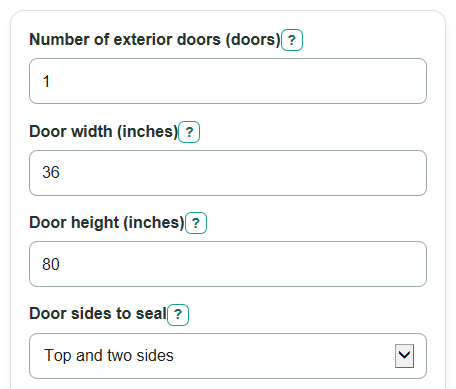
- Enter the Number of exterior doors, then measure each door's moving panel for Door width and Door height in inches.
- Choose Door sides to seal. Use top and two sides for common jamb weatherstripping, or all four sides only when sealing the bottom edge too.
- Enter your Yearly heating and cooling cost, then open Advanced options to set material price, installation cost, and your own cautious savings estimate.
- Set Years to look ahead and Replace weatherstripping every to include scheduled future project costs.
- Check that Weatherstripping to buy is enough for the package length sold in stores and that your chosen Expected energy-cost reduction is a realistic personal estimate.
Definitions
Weatherstripping: Flexible sealing material placed around door edges to reduce air leaks.
Waste allowance: Extra material added for cuts, fitting errors, and short offcuts.
Initial project cost: The first set of weatherstripping material plus the installation cost entered.
Replacement cycle: The number of years between planned new installations of the same weatherstripping.
Simple payback: The time estimated yearly energy savings need to equal the initial project cost. It does not include later replacements.
Net savings after planned replacements: Estimated energy savings over the selected years minus the initial project cost and every scheduled replacement cost.
Common mistakes and quick fixes
Mistake: Measuring trim or the door frame instead of the moving door for Door width and Door height.
Fix: Measure the edges where the weatherstripping will seal against the door.
Mistake: Choosing all four Door sides to seal when the bottom uses a door sweep rather than weatherstripping.
Fix: Choose top and two sides unless you will install weatherstripping on the bottom edge.
Mistake: Entering the full electric or gas bill as Yearly heating and cooling cost.
Fix: Enter only the yearly spending that heating and air conditioning affect.
Mistake: Treating Expected energy-cost reduction as a guaranteed utility-bill reduction.
Fix: Use a cautious percent based on your own expectation and compare several percent choices if you are unsure.
Mistake: Forgetting labor when entering Installation cost or setting an unrealistic Replace weatherstripping every schedule.
Fix: Enter 0 for DIY, or the full hired charge, and use the replacement schedule you expect for the product and door use.
Mistake: Typing a value such as 1,50 for Weatherstripping price.
Fix: Use 1.50 for a decimal price; commas are only for thousands, such as 1,500.
Limitations & Key Assumptions / Boundary Conditions
- This is a door-edge measurement and cost model, not a test of air leakage, insulation, HVAC efficiency, or actual utility bills.
- Estimated energy savings use your entered Expected energy-cost reduction. The calculator does not assign a savings percent based on door size, weatherstrip type, climate, or visible gaps.
- Yearly heating and cooling cost, annual savings, material price, and installation cost stay constant for every future year. Inflation, utility-rate changes, and discounting are not included.
- Replacement cost is assumed to equal the initial project cost, including the same material length and installation cost.
- A replacement scheduled exactly at the end of Years to look ahead is included.
- Material length is calculated in feet with the chosen extra-material percentage. Round up to a package size sold by your retailer.
- Door sweeps, thresholds, repairs to warped doors, and work needed to make a door close properly are outside this calculation.
Methodology
Measurement and material length
For top and two sides, the calculator adds one door width and two door heights. For all four sides, it adds two widths and two heights. It converts inches to feet, multiplies by the number of doors, then adds the chosen extra material.
sealed length = width + 2 x height (top and two sides)
sealed length = 2 x (width + height) (all four sides)
weatherstripping to buy = doors x sealed length / 12 x (1 + extra material percent / 100)
Costs and estimated savings
The initial project cost combines the unrounded material length times the entered price per foot with the entered installation cost. Estimated yearly energy savings use the heating and cooling cost and the reduction percent you choose. Weatherstripping is used around exterior doors to reduce air leakage, but this calculator does not turn that general purpose into a guaranteed savings rate. [1]
initial project cost = material length x price per foot + installation cost
estimated yearly energy savings = yearly heating and cooling cost x expected reduction percent / 100
Replacement-adjusted savings
The calculator counts a replacement whenever the replacement interval fits within the selected whole-year period. It subtracts the initial project cost and that same cost for each scheduled replacement from total estimated savings. Simple payback uses only the initial project cost. If estimated yearly energy savings are zero, simple payback is not available.
replacement count = floor(years to look ahead / replace weatherstripping every)
net savings after planned replacements = yearly savings x years - initial project cost x (1 + replacement count)
years to recover initial project cost = initial project cost / yearly savings
Worked example
For one 36-inch by 80-inch door sealed on three sides, the measured length is 196 inches. With 20% extra material, that is 19.6 feet. At $1.50 per foot and $0 installation cost, the initial project cost is $29.40. A $1,200 yearly heating and cooling cost with a 5% expected reduction gives $60 per year. Over 10 years with replacement every 3 years, there are 3 replacements and net savings are $482.40.