
Estimate your next 12 electric bills from monthly kWh, rates, fixed charges, tax, and simple seasonal assumptions.
| Month | Use (kWh) | Energy | Delivery | Fixed | Tax | Bill |
|---|
Table of contents
How to use our Electricity Bill Forecast Calculator
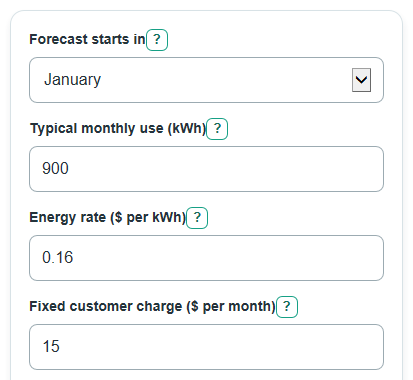
- Choose Forecast starts in so the 12-month table lines up with the calendar month you want to start from.
- Enter Typical monthly use, Energy rate, Fixed customer charge, and Delivery charge from a recent electric bill or plan document.
- Open Advanced options if you want to add Tax and other percent charges, pick a Usage pattern, or include expected changes by month 12.
- Select Calculate and read the summary cards first, then use the 12-month forecast table to see which month may be highest.
- Sanity-check the Forecast bill for the first month against a recent bill; if it is far off, recheck kWh, rates, and whether delivery is already included.
Definitions
kWh: Kilowatt-hour, the standard bill unit for electricity use over time. A home using 1,000 watts for 1 hour uses 1 kWh [1].
Typical monthly use: The amount of electricity you expect to use in an average month, measured in kWh.
Energy rate: The supply price for each kWh of electricity, entered as dollars per kWh.
Delivery charge: A per-kWh charge for moving electricity through wires to your home. Some bills combine this with the energy rate [2].
Fixed customer charge: A flat monthly charge that does not change when your kWh use changes.
Tax and other percent charges: A percent added after energy, delivery, and fixed charges.
Usage pattern: A planning choice that raises or lowers forecast kWh in certain calendar months while keeping the year-average multiplier at 1.0.
Common mistakes and quick fixes
Mistake: Typing a monthly dollar bill into Typical monthly use instead of kWh.
Fix: Enter the kWh number from your electric bill, not the bill total in dollars.
Mistake: Entering cents in Energy rate, such as 16 for 16 cents per kWh.
Fix: Enter dollars per kWh, so 16 cents becomes 0.16.
Mistake: Double-counting delivery by entering a Delivery charge when it is already included in Energy rate.
Fix: Set Delivery charge to 0 if your energy rate already includes delivery.
Mistake: Leaving Fixed customer charge out because it is small each month.
Fix: Enter the monthly fixed charge because it adds up across all 12 months.
Mistake: Using Tax and other percent charges as a decimal, such as 0.05 for 5%.
Fix: Enter 5 for 5%, or 0 if you do not want to include percent charges.
Mistake: Choosing Usage pattern without checking the Forecast bill for the first month.
Fix: Compare the first forecast month with a recent real bill and switch to Same every month if the seasonal pattern looks too high or low.
Limitations & Key Assumptions / Boundary Conditions
- The forecast uses the rates you enter. It does not look up utility prices, ZIP-code rates, plan terms, or local taxes.
- Seasonal patterns are simple planning multipliers, not weather forecasts. Actual heating and cooling use can differ a lot.
- The calculator does not model tiered rates, time-of-use pricing, demand charges, solar credits, late fees, one-time fees, or utility assistance credits.
- Delivery charge is kept constant for all 12 months. Only Energy rate changes over the forecast when Expected energy rate change by month 12 is used.
- Percent changes are spread evenly from the first forecast month to month 12. Real rate changes may happen all at once on a specific date.
- Money amounts are rounded to cents for display, so table rows can differ by a cent from a hand-added total.
Methodology
How each month is forecast
The calculator builds 12 rows starting with Forecast starts in. Each row gets a calendar month, a usage multiplier from Usage pattern, and a month index from 0 through 11.
kwh_m = monthly_kwh * pattern_multiplier_m * (1 + kwh_change_percent / 100 * month_index / 11)
rate_m = energy_rate * (1 + rate_change_percent / 100 * month_index / 11)
The flat pattern uses 1.00 for every month. The summer-higher pattern uses Jan-Dec multipliers of 0.90, 0.90, 0.95, 1.00, 1.10, 1.20, 1.25, 1.15, 1.05, 0.95, 0.80, and 0.75. The winter-higher pattern uses Jan-Dec multipliers of 1.25, 1.20, 1.10, 0.95, 0.85, 0.75, 0.75, 0.80, 0.90, 1.00, 1.15, and 1.30.
How charges are added
For each month, the calculator separates energy, delivery, fixed charge, and tax so the table looks closer to a real bill.
energy_m = kwh_m * rate_m
delivery_m = kwh_m * delivery_rate
fixed_m = fixed_charge
subtotal_m = energy_m + delivery_m + fixed_m
tax_m = subtotal_m * tax_rate / 100
bill_m = subtotal_m + tax_m
How summary results are made
The 12-month table is the source for the summary cards. The calculator adds the 12 monthly bills for Estimated bill for the next 12 months, finds the largest row for Highest forecast monthly bill, and divides the 12-month bill by 12 for Average forecast monthly bill.
estimated_12_month_bill = add all 12 bill_m values
average_forecast_month_bill = estimated_12_month_bill / 12
highest_forecast_month_bill = largest bill_m value
Mini-example
Suppose Typical monthly use is 1,000 kWh, Energy rate is $0.15 per kWh, Delivery charge is $0.04 per kWh, Fixed customer charge is $20 per month, Tax and other percent charges is 5%, and Usage pattern is Same every month. One month has an energy charge of $150, a delivery charge of $40, a fixed charge of $20, a subtotal of $210, tax of $10.50, and a bill of $220.50. With no use or rate change, the 12-month estimate is $2,646.00.