
Enter your single-phase loads by phase to see imbalance, neutral current, headroom, and a practical move plan.
Advanced options
Table of contents
How to use our Three-Phase Load Balancing Calculator
- Choose Loads are entered as: use amps for measured current, or kW if each load is real power.
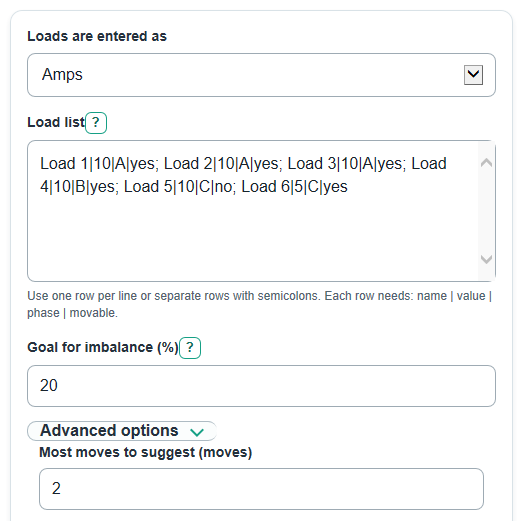
- Fill the Load list with one load per row: name, value, phase A/B/C, and movable yes/no.
- If you chose kW, enter Line-to-neutral voltage and Power factor so the calculator can convert each load to amps.
- Set Goal for imbalance, then use Advanced options if you want to limit Most moves to suggest or compare against a current target.
- Click Calculate, then sanity-check the results: the highest phase should make sense from your largest loads, and negative headroom means that phase is over the selected target.
Definitions
Load list: The roster of single-phase loads. Each row gives the load name, value, current phase, and whether that load is allowed to move.
Loads are entered as: The unit used for the load values. Amps are used directly. kW values are converted to amps using voltage and power factor.
Line-to-neutral voltage: The voltage from one phase conductor to neutral. It is used only for kW entries.
Power factor: A number from 0 to 1 that connects real power in kW to current in amps for AC loads.
Imbalance: How far the most different phase current is from the average of the three phase currents, shown as a percent.
Estimated neutral current: The calculated neutral conductor current for 120-degree three-phase wye currents. It does not include extra neutral current from harmonics.
Headroom: The selected current target minus the phase current. Positive headroom means room remains. Negative headroom means the phase is over the selected target.
Common mistakes and quick fixes
Mistake: Setting Loads are entered as to kW but typing amp values in Load list .
Fix: Choose amps for measured current, or convert your real power entries correctly before using kW mode.
Mistake: Putting a phase name other than A, B, or C in Load list .
Fix: Use only A, B, or C for the phase field on every row.
Mistake: Marking a load as maybe, true, or 1 in Load list .
Fix: Use yes if the load may be moved and no if it must stay on its current phase.
Mistake: Leaving Power factor at 1 in kW mode when the load has a known lower power factor.
Fix: Enter the known power factor between 0 and 1 so the amp conversion is closer.
Mistake: Setting Most moves to suggest too low and expecting the calculator to reach a strict Goal for imbalance .
Fix: Increase the move limit or mark more rows movable in Load list if the result says the goal was not reached.
Mistake: Treating Phase A headroom after suggested moves as a pass/fail code result.
Fix: Use it as a planning check only; negative headroom means Phase A is above your selected target.
Limitations & Key Assumptions / Boundary Conditions
- The load roster treats each row as one single-phase line-to-neutral load assigned to A, B, or C.
- The suggested moves are planning suggestions. They do not check electrical code, breaker compatibility, wire size, panel labeling, load type, or whether moving a circuit is physically allowed.
- The neutral current estimate uses 120-degree three-phase wye phasor math for fundamental current only. Harmonics and non-linear loads can make real neutral current higher.
- In kW mode, the same Line-to-neutral voltage and Power factor are applied to all kW rows.
- The search checks move plans up to Most moves to suggest. A higher limit can find a better plan, but the practical move count may be larger.
- Headroom is based on the user-entered Per-phase current limit and Use only this much of the limit. It is not a code-compliance decision.
Methodology
Current from each row
If Loads are entered as is amps, each load value is used as its current.
load_current_A = load_amp_value
If Loads are entered as is kW, the calculator converts real power to current using the entered voltage and power factor. The 1000 factor converts kilowatts to watts.
load_current_A = load_kw * 1000 / (line_to_neutral_voltage_V * power_factor)
Phase totals and imbalance
The calculator adds the currents assigned to each phase, then compares the most different phase to the average phase current.
phase_A_A = add currents assigned to A
phase_B_A = add currents assigned to B
phase_C_A = add currents assigned to C
average_current_A = (phase_A_A + phase_B_A + phase_C_A) / 3
imbalance_percent = max(abs(phase_A_A - average_current_A), abs(phase_B_A - average_current_A), abs(phase_C_A - average_current_A)) / average_current_A * 100
If all three phase currents are 0 A, the calculator avoids dividing by zero and reports that no useful load was entered.
Neutral current and headroom
The neutral current estimate uses the vector result for three phase currents spaced 120 degrees apart [1].
neutral_current_A = sqrt(phase_A_A^2 + phase_B_A^2 + phase_C_A^2 - phase_A_A*phase_B_A - phase_B_A*phase_C_A - phase_C_A*phase_A_A)
The planning target is the entered current limit multiplied by the selected percent of that limit.
target_current_A = phase_current_limit_A * continuous_target_percent / 100
phase_headroom_A = target_current_A - phase_current_after_A
Suggested move search
The calculator checks plans with 0 moves through the selected Most moves to suggest. Each movable load may move once to one of the other two phases. Plans that meet the imbalance goal and do not exceed the target current are ranked first. Among those, fewer moves wins, then lower imbalance, then lower highest phase current, then earlier row order and destination order A, B, C. If no plan meets the goal and target, the calculator shows the plan with the lowest after-move imbalance, using the same tie rules. This type of phase reassignment search is a practical way to compare load balance options [2].
Mini-example
With the default amp loads, the starting phase totals are A = 30 A, B = 10 A, and C = 15 A. The average is 18.33 A, so the starting imbalance is 63.64%. With one allowed move, moving one 10 A load from A to B gives A = 20 A, B = 20 A, and C = 15 A. The after-move imbalance is 18.18%, the estimated neutral current is 5 A, and the highest phase current is 20 A.