
Estimate how much home electricity your solar panels and battery can cover, plus grid imports, exports, and bill impact.
Table of contents
How to use our Solar Self-Sufficiency Calculator
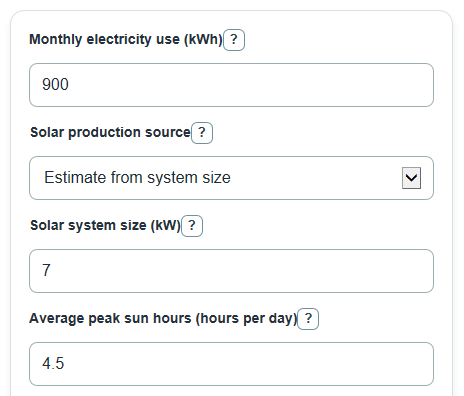
- Enter Monthly electricity use from one electric bill, or use your average month if you have a year of bills.
- Choose Solar production source, then either enter Solar system size and Average peak sun hours or enter Monthly solar production.
- Enter Usable battery size, using usable kWh if your battery spec lists both usable and nameplate capacity.
- Open Advanced options if you want to change Retail electricity rate, Solar export credit, Electricity used while solar is making power, or Solar performance after normal losses.
- Click Calculate, then sanity-check the results: Solar self-sufficiency cannot be above 100 percent, and Extra solar sent to the grid should rise when solar production is larger than home use and battery storage.
Definitions
kWh: A kilowatt-hour is a unit of electrical energy. Home electric bills usually measure use in kWh [1].
Solar self-sufficiency: The percent of Monthly electricity use covered by solar energy used right away or shifted through the battery.
Solar used at home: The percent of solar production that serves the home instead of becoming Extra solar sent to the grid.
Electricity bought from the grid: The kWh per month that solar and battery storage do not cover.
Extra solar sent to the grid: Solar kWh left after direct home use and battery charging in this monthly model.
Retail electricity rate: The price paid for each kWh bought from the grid before fixed charges, taxes, and other bill items.
Solar export credit: The credit for each extra solar kWh sent to the grid.
Peak sun hours: A way to express daily solar resource as the number of full-strength sun hours in a day.
Solar performance after normal losses: The percent of expected solar output kept after typical losses such as inverter conversion, heat, dirt, and wiring.
Common mistakes and quick fixes
Mistake: Using dollars from the bill instead of kWh for Monthly electricity use.
Fix: Enter the energy number labeled kWh, not the bill total in dollars.
Mistake: Leaving Solar production source on estimate while typing a value in Monthly solar production.
Fix: Change Solar production source to Enter monthly solar production if you already have a monthly kWh estimate.
Mistake: Entering battery nameplate capacity for Usable battery size when the usable capacity is lower.
Fix: Use the usable kWh from the battery spec, or enter 0 if there is no battery.
Mistake: Setting Solar export credit equal to Retail electricity rate when your utility pays less for exported solar.
Fix: Enter the actual Solar export credit from your rate plan so Estimated monthly bill after solar credits is not overstated.
Mistake: Treating Electricity used while solar is making power as a solar panel setting.
Fix: Enter the percent of your home electricity use that happens during solar-producing hours, before battery storage helps.
Mistake: Typing 1,01 or another broken comma format in Monthly solar production or Solar system size.
Fix: Use commas only as thousands separators, such as 1,000, and use a decimal point for decimals.
Limitations & Key Assumptions / Boundary Conditions
- This is a grid-tied monthly estimate, not an off-grid design or an outage backup guarantee.
- The model does not use hourly interval data, so it cannot see cloudy-day timing, evening peaks, appliance schedules, or seasonal changes inside the month.
- Battery shifting is limited to one full usable battery cycle per average day. It does not model battery charge rate, discharge rate, reserve settings, separate round-trip efficiency, or battery aging.
- Estimated monthly bill after solar credits includes imported energy cost and export credit only. Fixed charges, taxes, minimum bills, demand charges, time-of-use periods, and annual true-up rules can change the real bill.
- When Solar production source is Estimate from system size, production depends on Average peak sun hours and Solar performance after normal losses. A real site can differ because of shade, roof direction, roof tilt, snow, equipment clipping, and weather.
- A negative Estimated monthly bill after solar credits means export credits are larger than import energy charges before fixed utility charges. It does not guarantee the utility will pay cash.
- Solar self-sufficiency is capped by Monthly electricity use. Extra solar above home use may increase exports, but it cannot make the home more than 100 percent self-sufficient in this monthly energy model.
Methodology
How the calculator estimates monthly solar production
If Solar production source is Estimate from system size, the calculator multiplies Solar system size by Average peak sun hours, the average days per month, and Solar performance after normal losses. The average month uses 365.2425 divided by 12, or 30.436875 days.
monthly_solar_kwh = system_size_kw * peak_sun_hours_day * days_per_month * (performance_ratio_percent / 100)
If Solar production source is Enter monthly solar production, the calculator uses Monthly solar production directly.
monthly_solar_kwh = known_monthly_solar_kwh
How home solar use is split
Direct solar use is the smaller of total solar production and the part of Monthly electricity use that happens while solar is making power.
direct_solar_kwh = min(monthly_solar_kwh, monthly_usage_kwh * daytime_use_percent / 100)
Battery-shifted solar is limited by extra solar, remaining home use, and Usable battery size times the average days per month.
battery_shifted_kwh = min(max(monthly_solar_kwh - direct_solar_kwh, 0), monthly_usage_kwh - direct_solar_kwh, battery_usable_kwh * days_per_month)
Home use covered by solar is direct solar use plus battery-shifted solar.
self_supplied_kwh = direct_solar_kwh + battery_shifted_kwh
How self-sufficiency, imports, and exports are calculated
Electricity bought from the grid is the part of Monthly electricity use not covered by solar. Extra solar sent to the grid is solar production not used by the home.
grid_import_kwh = max(monthly_usage_kwh - self_supplied_kwh, 0)
solar_export_kwh = max(monthly_solar_kwh - self_supplied_kwh, 0)
Solar self-sufficiency compares Home use covered by solar with Monthly electricity use. Solar used at home compares Home use covered by solar with total solar production. If solar production is 0, Solar used at home is shown as N/A to avoid division by zero.
self_sufficiency_percent = self_supplied_kwh / monthly_usage_kwh * 100
self_consumption_percent = self_supplied_kwh / monthly_solar_kwh * 100
How the bill impact is calculated
The bill estimate compares the energy charge without solar to the import cost minus export credits after solar. The after-solar bill is not clamped at $0, because some rate plans can show credits before fixed charges.
bill_before_solar = monthly_usage_kwh * retail_rate_per_kwh
bill_after_solar = grid_import_kwh * retail_rate_per_kwh - solar_export_kwh * export_rate_per_kwh
bill_savings = bill_before_solar - bill_after_solar
Battery coverage at average home use divides Usable battery size by the home's average hourly use.
battery_coverage_hours = battery_usable_kwh / (monthly_usage_kwh / days_per_month / 24)
Mini-example
For 900 kWh of Monthly electricity use, a 7 kW Solar system size, 4.5 Average peak sun hours, 85 percent Solar performance after normal losses, a 10 kWh Usable battery size, 40 percent daytime use, a $0.17 Retail electricity rate, and a $0.05 Solar export credit, the model estimates about 815 kWh of monthly solar production. About 664 kWh is Home use covered by solar, so Solar self-sufficiency is about 73.8 percent. Electricity bought from the grid is about 236 kWh, Extra solar sent to the grid is about 151 kWh, and Estimated monthly bill after solar credits is about $32.53 before fixed charges and taxes.
Calculation choices used in the math
All energy flows are monthly kWh values. The calculator treats exported solar as separate from solar used at home, so Retail electricity rate and Solar export credit can produce different bill impacts even when the same number of kWh is involved.