
Estimate solar cost per kWh with a simple lifetime average and an adjusted LCOE that includes future timing.
Table of contents
How to use our Solar Levelized Cost of Energy Calculator
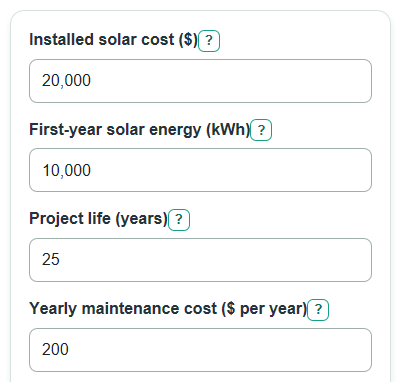
- Enter Installed solar cost, First-year solar energy, Project life, Yearly maintenance cost, and Electricity price to compare.
- Open Advanced options if you want to add Cost style, Discount rate, Yearly energy drop, Yearly maintenance increase, or one Planned replacement cost.
- Use Replacement year only when Planned replacement cost is above 0; otherwise the replacement year is ignored.
- Choose Number display if you want shorter rounded results or more decimal places, then select Calculate.
- Sanity-check the answer: if Discount rate, Yearly energy drop, Yearly maintenance increase, and Planned replacement cost are all 0, Adjusted solar cost per kWh should match Simple no-discount solar cost per kWh.
Definitions
Levelized cost of energy (LCOE): The average cost of each kWh over the project life. It divides lifetime costs by lifetime energy so solar can be compared with an electricity price.
Adjusted solar cost per kWh: The main LCOE result. It can include future-weighted costs, future-weighted energy, yearly output decline, maintenance growth, and one replacement cost.
Simple no-discount solar cost per kWh: A quick average that uses installed cost, flat yearly maintenance, project life, and first-year energy. It does not use the advanced timing inputs.
Discount rate: A percent per year used to give less weight to costs and energy that happen later.
Yearly energy drop: The percent drop in solar output each year after year 1. Solar panels can make less energy as they age [3].
Future-weighted lifetime cost: Installed cost plus maintenance and replacement costs after applying the discount rate to future years.
Future-weighted lifetime energy: The total solar kWh after yearly energy drop and discounting.
Common mistakes and quick fixes
Mistake: Entering a monthly or daily production number in First-year solar energy.
Fix: Use the total kWh the system is expected to make in its first full year.
Mistake: Putting loan interest, tax credits, or yearly upkeep into Installed solar cost without meaning to.
Fix: Enter the upfront net price in Installed solar cost, and put regular upkeep in Yearly maintenance cost.
Mistake: Using a negative Electricity price to compare when you want to show solar is cheaper.
Fix: Enter the comparison electricity price as 0 or more; the calculator keeps the signed difference in Adjusted solar cost minus comparison electricity price.
Mistake: Mixing Cost style with future costs that do not match the Discount rate.
Fix: Use today's-dollar costs with a today's-dollar Discount rate, or future-dollar costs with a rate that matches future dollars.
Mistake: Entering 100 in Yearly energy drop to mean the system lasts 100 percent of its life.
Fix: Enter the yearly percent decline, such as 0.5, and keep Yearly energy drop below 100.
Mistake: Adding a Planned replacement cost but leaving Replacement year outside the Project life.
Fix: Set Replacement year from 1 through Project life, or set Planned replacement cost to 0.
Limitations & Key Assumptions / Boundary Conditions
- The result is a planning estimate, not a full project finance model. It does not include taxes, incentives, loan terms, insurance, utility fixed charges, demand charges, net metering rules, or resale value.
- Installed solar cost is treated as a cost at the start of the project. Yearly maintenance, energy production, and replacement costs are treated as end-of-year amounts.
- Only one Planned replacement cost is included. If you expect several large replacements, combine them carefully or run separate cases.
- First-year solar energy must come from another estimate, such as a quote, design tool, or measured system output. This calculator does not estimate sunlight, roof angle, shading, weather, or system size.
- The Electricity price to compare is held constant. The calculator does not forecast future utility rate increases.
- Cost style matters. Do not mix today's-dollar costs with future-dollar escalation unless the Discount rate and Yearly maintenance increase are chosen to match that style.
- Very long Project life values can make results less meaningful because panel performance, equipment replacement, utility rules, and ownership plans can change.
Methodology
Core idea
Levelized cost of energy compares project costs with project energy on a cost-per-kWh basis. Public energy references commonly use LCOE to compare generation costs across resources [1]. This calculator shows a simple no-discount result and an adjusted result that applies the advanced timing inputs.
Simple no-discount result
The simple result treats first-year solar energy and yearly maintenance as the same every year.
simple_lcoe = (system_cost + annual_maintenance * project_life_years) / (first_year_energy * project_life_years)
Adjusted yearly values
For each year t from 1 through N, where N is Project life, the calculator first estimates energy after the yearly output drop.
energy_t = first_year_energy * (1 - annual_energy_drop_percent / 100)^(t - 1)
It also estimates maintenance after any yearly maintenance increase.
maintenance_t = annual_maintenance * (1 + maintenance_increase_percent / 100)^(t - 1)
Future values are then weighted with the discount factor for that year.
discount_factor_t = 1 / (1 + discount_rate_percent / 100)^t
Adjusted cost and energy totals
The installed cost is not discounted because it is assumed to happen at the start. Maintenance and replacement costs are discounted by year. This follows the common LCOE structure of dividing lifetime costs by lifetime energy [2].
present_value_costs = system_cost + sum(maintenance_t * discount_factor_t) + replacement_pv
replacement_pv = replacement_cost * discount_factor_replacement_year
The replacement term is used only when Planned replacement cost is above 0 and Replacement year is within Project life.
present_value_energy = sum(energy_t * discount_factor_t)
adjusted_lcoe = present_value_costs / present_value_energy
The comparison against the entered electricity price keeps the sign.
adjusted_vs_grid_price = adjusted_lcoe - grid_price
A negative comparison value means the adjusted solar cost per kWh is lower than the entered Electricity price to compare. A positive value means it is higher.
The cents display is a unit conversion only.
adjusted_lcoe_cents_per_kwh = adjusted_lcoe * 100
Mini-example
With Installed solar cost of $20,000, First-year solar energy of 10,000 kWh, Project life of 25 years, Yearly maintenance cost of $200, Electricity price to compare of $0.18 per kWh, and all advanced change rates at 0, the lifetime cost is $25,000 and the lifetime energy is 250,000 kWh.
simple_lcoe = 25000 / 250000 = 0.10 dollars per kWh
adjusted_vs_grid_price = 0.10 - 0.18 = -0.08 dollars per kWh
In this case, the adjusted solar cost is 8 cents per kWh below the comparison electricity price.