
Calculate the minimum front-to-front row pitch for tilted solar panel rows and see a simple layout fit.
Table of contents
How to use our Solar Panel Row Spacing Calculator
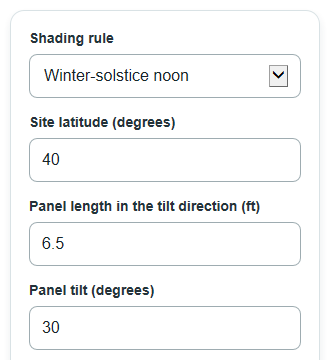
- Choose the Shading rule: use Winter-solstice noon for a quick conservative check, or Enter sun angle if you already have a design sun angle.
- Enter Site latitude for winter-noon mode, or Sun angle above the horizon for custom mode, then enter Panel length in the tilt direction and Panel tilt.
- Open Advanced options if you want layout results, then enter Usable area depth, north to south, Usable row width, east to west, Panel width across the row, and Panel power.
- Click Calculate and read Minimum front-to-front row pitch first; row pitch means the distance from the front edge of one row to the front edge of the next row.
- Sanity-check the result: a lower Sun angle used for spacing should make a larger Clear ground gap behind each row and usually fewer Rows that fit in the usable depth.
Definitions
Row pitch: The front-edge-to-front-edge distance from one solar panel row to the next row.
Sun angle above the horizon: The height of the sun in the sky, in degrees. A low sun angle makes a long shadow.
Panel length in the tilt direction: The panel dimension measured from the low edge up to the high edge.
Panel ground coverage per row: The north-south distance covered by the tilted panel when its length is projected onto flat ground.
Clear ground gap behind each row: The open ground distance needed for the shadow from one row before the next row starts.
Ground coverage ratio: Panel ground coverage per row divided by row pitch. A higher ratio means a denser layout.
Estimated DC system size: Total panels that fit multiplied by panel watts, converted to kilowatts.
Common mistakes and quick fixes
Mistake: Entering Site latitude with the wrong sign for the hemisphere.
Fix: Use a positive Site latitude north of the equator and a negative Site latitude south of the equator.
Mistake: Measuring Panel length in the tilt direction across the row instead of from low edge to high edge.
Fix: For Panel length in the tilt direction, use the side of the panel that rises with the tilt.
Mistake: Using roof slope or rack angle in the wrong unit for Panel tilt.
Fix: Enter Panel tilt in degrees from flat ground, from 0 to 90.
Mistake: Treating Minimum front-to-front row pitch as the open walkway between rows.
Fix: Minimum front-to-front row pitch includes Panel ground coverage per row plus Clear ground gap behind each row.
Mistake: Expecting Estimated DC system size to be annual energy.
Fix: Estimated DC system size is nameplate kW; it does not estimate yearly kWh.
Mistake: Entering total site size instead of usable space for Usable area depth, north to south or Usable row width, east to west.
Fix: Use the remaining rectangular area after setbacks, access paths, roof objects, and other blocked space.
Limitations & Key Assumptions / Boundary Conditions
- The spacing model assumes level ground, parallel rows, the same panel tilt on every row, and the same lower-edge height for each row.
- The winter-solstice noon option is a simple screening rule. It does not check every time of day, every date, or local horizon shading.
- The custom sun angle option depends on the angle you enter. If that angle is too high for your shading goal, the row pitch will be too tight.
- Rows that fit and Total panels that fit use a simple rectangle. They do not include aisles, fire setbacks, inverter limits, roof obstructions, wire paths, or gaps between panels.
- Estimated DC system size is nameplate capacity only. It is not an annual energy estimate and does not include weather, orientation losses, inverter clipping, soiling, or shade from nearby objects.
- The model is for same-plane row-to-row shading. It is not a full solar design, structural design, electrical design, or code compliance check.
Methodology
Solar angle used
If Shading rule is Winter-solstice noon, the calculator uses a simplified winter-solstice solar declination of 23.44 degrees. For northern latitudes, the winter declination is -23.44 degrees. For southern latitudes, the winter declination is +23.44 degrees.
solar_altitude_deg = 90 - abs(latitude_deg - declination_deg)
If Shading rule is Enter sun angle, the calculator uses Sun angle above the horizon directly and does not use Site latitude.
Row spacing math
The calculator first splits the tilted panel into a vertical rise and a flat-ground footprint. Angles are converted from degrees to radians before using sine, cosine, and tangent.
vertical_rise_ft = panel_length_ft * sin(tilt_deg * pi / 180)
row_ground_coverage_ft = panel_length_ft * cos(tilt_deg * pi / 180)
shadow_gap_ft = vertical_rise_ft / tan(solar_altitude_deg * pi / 180)
minimum_row_pitch_ft = row_ground_coverage_ft + shadow_gap_ft
ground_coverage_ratio = row_ground_coverage_ft / minimum_row_pitch_ft
Layout fit math
The layout section counts whole panels and whole rows only. If the usable width is smaller than Panel width across the row, Panels per row is 0. If the usable depth is smaller than Panel ground coverage per row, Rows that fit in the usable depth is 0.
panels_per_row = floor(available_east_west_ft / panel_width_ft)
rows_that_fit = floor((available_north_south_ft - row_ground_coverage_ft) / minimum_row_pitch_ft) + 1
total_module_count = rows_that_fit * panels_per_row
estimated_dc_system_size_kw = total_module_count * panel_watts / 1000
Mini-example
For latitude 40 degrees north, panel length 6.5 ft, tilt 30 degrees, 100 ft usable depth, 30 ft usable row width, 3.5 ft panel width, and 400 W panels, the winter-noon sun angle is 26.56 degrees. The panel ground coverage is about 5.63 ft, the shadow gap is about 6.50 ft, and the minimum row pitch is about 12.13 ft. The layout fits 8 rows and 8 panels per row, so it fits 64 panels for an estimated DC system size of 25.6 kW.