
Estimate demand-charge savings from a battery and see whether battery power or usable energy limits your peak cut.
Table of contents
How to use our Battery Peak Shaving Savings Calculator
- Enter your Current billing peak, Demand charge rate, Battery power limit, Usable battery energy, and Peak event length from your bill, quote, or estimate.
- Open Advanced options if you want to change Round-trip efficiency, Recharge energy price, Months per year this peak is reduced, Installed battery cost after incentives, or Planned peak target.
- Click Calculate and read Annual savings after battery losses first, then Battery-limited billing peak and Battery gap for planned target.
- Sanity-check the result: Feasible peak cut from battery should not be larger than Battery power limit or Usable battery energy divided by Peak event length.
- If Battery gap for planned target is positive, try a larger battery, a shorter Peak event length, or a less aggressive Planned peak target.
Definitions
Current billing peak: The highest demand, in kW, used to set the demand charge for the bill period.
Demand charge rate: The price charged for each kW of billing peak, usually shown as $ per kW-month.
Battery power limit: The most kW the battery can deliver at one time during the peak event.
Usable battery energy: The kWh the battery can actually deliver after reserve and operating limits.
Peak event length: The number of hours the battery must discharge to reduce the high-demand period.
Round-trip efficiency: The percent of recharge energy that comes back out of the battery.
Feasible peak cut from battery: The kW reduction allowed by the smaller limit: battery power, usable energy over time, or the current peak itself.
Battery gap for planned target: The extra kW of peak cut needed to reach the Planned peak target. A zero gap means the target is feasible under the entered limits.
Simple payback period: Installed battery cost after incentives divided by Annual savings after battery losses.
Common mistakes and quick fixes
Mistake: Entering an energy rate in Demand charge rate, such as 0.12 $ per kWh.
Fix: Use the bill line item for Demand charge rate in $ per kW-month.
Mistake: Using total battery capacity for Usable battery energy.
Fix: Enter the deliverable Usable battery energy after reserve and depth-of-discharge limits.
Mistake: Setting Peak event length too short because the bill shows only one peak number.
Fix: Estimate how long the high load lasts; a longer Peak event length can lower Feasible peak cut from battery.
Mistake: Expecting Planned peak target to change the savings by itself.
Fix: Savings use Battery-limited billing peak; Planned peak target only checks Battery gap for planned target.
Mistake: Leaving Round-trip efficiency at 100 percent for a rough real-world estimate.
Fix: Use the battery quote or a realistic Round-trip efficiency so Annual cost of battery losses is included.
Mistake: Reading Simple payback period as a full project finance result.
Fix: Treat Simple payback period as Installed battery cost after incentives divided by Annual savings after battery losses, before financing, maintenance, degradation, and tax effects.
Limitations & Key Assumptions / Boundary Conditions
- The calculator uses one billing peak, one Demand charge rate, and one Peak event length. It does not model full interval data, dispatch schedules, or separate weekday and weekend peaks.
- It assumes the battery can hold a flat discharge equal to the Feasible peak cut from battery for the whole Peak event length.
- It does not model demand ratchets, seasonal tariffs, time-varying demand charges, standby charges, or multiple demand charge line items.
- Annual savings after battery losses subtracts only the added recharge energy from round-trip losses. It does not include maintenance, battery degradation, taxes, financing, replacement, demand response revenue, or solar charging effects.
- Months per year this peak is reduced is a simple count from 0 to 12. If the site has different peaks in different months, run separate cases.
- Simple payback period is shown as N/A when Annual savings after battery losses is zero or negative, because dividing by zero or showing a negative payback would not be useful.
Methodology
How the peak cut is found
The calculator first finds the largest peak cut the battery can actually support. This avoids counting savings from a target the battery cannot reach. Battery management for bill savings depends on demand limits and battery operating limits, not only on the desired target [2].
feasible_peak_cut_kw = min(current_peak_kw, battery_power_kw, usable_energy_kwh / peak_event_hours)
new_billing_peak_kw = current_peak_kw - feasible_peak_cut_kw
How savings are estimated
Demand-charge savings are based on the feasible kW reduction and the entered $ per kW-month rate. Battery loss cost is estimated from round-trip efficiency and the price paid to recharge the battery.
monthly_demand_charge_savings = feasible_peak_cut_kw * demand_charge_rate
efficiency_decimal = round_trip_efficiency_percent / 100
energy_delivered_per_peak = feasible_peak_cut_kw * peak_event_hours
annual_recharge_loss_cost = ((energy_delivered_per_peak / efficiency_decimal) - energy_delivered_per_peak) * recharge_energy_price * peak_months_per_year
annual_savings_after_losses = monthly_demand_charge_savings * peak_months_per_year - annual_recharge_loss_cost
Target gap and payback
The planned target check compares the battery-limited peak with the target peak. A positive gap means the planned target needs more peak cut than the battery can supply with the entered power and energy limits.
battery_gap_for_planned_target_kw = max(0, new_billing_peak_kw - planned_peak_target_kw)
simple_payback_years = installed_battery_cost / annual_savings_after_losses
Simple payback is shown only when Installed battery cost after incentives is positive and Annual savings after battery losses is positive.
Worked mini-example
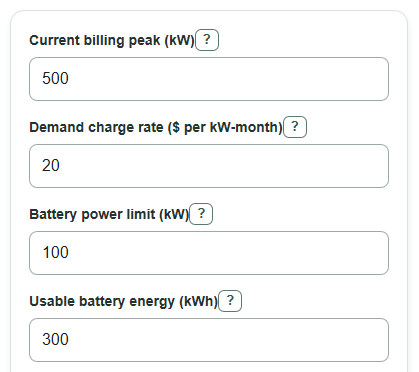
Suppose Current billing peak is 500 kW, Demand charge rate is $20 per kW-month, Battery power limit is 100 kW, Usable battery energy is 300 kWh, and Peak event length is 2 hours. The energy-based limit is 300 / 2 = 150 kW, so the feasible peak cut is the smaller value, 100 kW. The Battery-limited billing peak is 500 - 100 = 400 kW, and Monthly demand-charge savings before losses is 100 * $20 = $2,000. With 90 percent Round-trip efficiency, $0.10 per kWh Recharge energy price, and 12 Months per year this peak is reduced, Annual cost of battery losses is about $26.67. Annual savings after battery losses is $24,000 - $26.67 = $23,973.33. If Installed battery cost after incentives is $150,000, Simple payback period is about 6.26 years. If Planned peak target is 400 kW, Battery gap for planned target is 0 kW.