
Compare load management, a smaller EV charger setting, and a panel upgrade path using your panel size, home load, and charger draw.
Table of contents
How to use our EV Charger Load vs Panel Upgrade Calculator
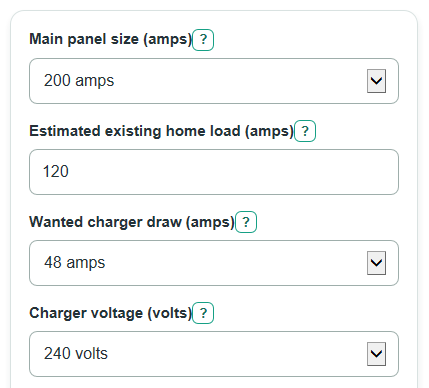
- Choose your Main panel size and enter your Estimated existing home load in amps.
- Select the Wanted charger draw, Charger voltage, and Smaller charger draw to compare.
- Open Advanced options only if you want to change the Planning limit or the Lowest charge rate you would accept.
- Click Calculate and read the first cards together: Load-managed max charging draw, Panel headroom with smaller charger, and Minimum listed panel size for wanted charger.
- Sanity-check the output: if Panel headroom before EV charger is negative, your existing load estimate is already over the planning limit, so ask an electrician to confirm the load before choosing an EV charging path.
Definitions
Main panel size: The amp rating of the home's main electrical panel or service, often shown on the main breaker.
Estimated existing home load: The estimated amps already used by the home before adding the EV charger.
Wanted charger draw: The charging current setting you want the EV charger to use. It is not the same as the breaker size.
Planning limit: The percent of the panel size used as the calculator's planning cap.
Headroom: The amps left under the planning cap after the listed loads are added. A negative headroom means the estimate is over the cap.
Load-managed max charging draw: The highest EV charging amps available under the planning cap when the charger can be throttled.
kW: Kilowatts, a unit of power. For this calculator, kW equals volts times amps divided by 1000.
Common mistakes and quick fixes
Mistake: Using breaker size as Wanted charger draw.
Fix: Enter the charger current setting for Wanted charger draw, not the breaker rating.
Mistake: Guessing too low for Estimated existing home load.
Fix: Use a real load calculation if you have one, or treat the result as a rough planning estimate until an electrician checks it.
Mistake: Leaving Planning limit at a value that does not match your planning goal.
Fix: Keep Planning limit at 80 for a conservative estimate, or change it only when you understand what the percent cap means.
Mistake: Reading a negative Panel headroom with smaller charger as zero capacity.
Fix: Keep the negative sign; it means the Smaller charger draw to compare is still over the planning limit.
Mistake: Treating Minimum listed panel size for wanted charger as a permit-ready service decision.
Fix: Use Minimum listed panel size for wanted charger as a conversation starter, then have an electrician do the code load calculation.
Mistake: Ignoring Charger voltage in a condo or shared building.
Fix: Choose 208 volts for Charger voltage if that is the supplied voltage; power in kW will be lower at the same amps.
Limitations & Key Assumptions / Boundary Conditions
- This is a planning estimate for comparing paths. It is not a permit-ready electrical load calculation.
- The Estimated existing home load controls the result. If that number is wrong, the comparison can point to the wrong path.
- The calculator uses a simple Planning limit percent, not the full NEC load calculation method, local amendments, utility rules, or equipment listing details.
- Minimum listed panel size for wanted charger is chosen from 100, 125, 150, 200, 225, 320, and 400 amps only. Real service options can vary by utility, meter equipment, and local practice.
- Charging power is AC power from Charger voltage and amps. The vehicle, charger, temperature, battery state, or onboard charger can reduce real charging speed [1].
- Load management here means the EV charger can reduce charging current when the home load is high. The calculator does not check whether a specific product is allowed for your installation.
- If the result says no listed panel size works, it means this calculator's listed sizes stop at 400 amps. It does not mean the project is impossible.
Methodology
How the comparison is calculated
The calculator first turns Main panel size and Planning limit into a simple planning capacity in amps.
planning_capacity_amps = service_amps * (planning_limit_percent / 100)
It then subtracts Estimated existing home load and the EV charger draw for each option. Signed headroom is kept. Positive headroom means amps are left under the planning cap. Negative headroom means that option is over the cap.
wanted_charger_headroom_amps = planning_capacity_amps - existing_load_amps - charger_amps
smaller_charger_headroom_amps = planning_capacity_amps - existing_load_amps - smaller_charger_amps
For load management, the charger is limited to the available planning headroom before the EV charger is added. The calculator does not allow a negative charging draw.
load_managed_max_amps = min(charger_amps, max(0, planning_capacity_amps - existing_load_amps))
For the upgrade comparison, the calculator finds the service size that would be needed for the entered existing load plus the wanted charger draw at the chosen Planning limit, then rounds up to the first listed panel size.
required_service_amps = (existing_load_amps + charger_amps) / (planning_limit_percent / 100)
minimum_panel_for_wanted_charger_amps = first listed size at or above required_service_amps
Charging power is estimated from volts and amps. Home Level 2 charging is commonly discussed in volts, amps, and kilowatts [1].
charging_power_kw = charging_amps * voltage / 1000
Worked mini-example
Suppose Main panel size is 200 amps, Planning limit is 80 percent, Estimated existing home load is 130 amps, Wanted charger draw is 48 amps, Smaller charger draw to compare is 32 amps, and Charger voltage is 240 volts. Planning capacity is 200 * 0.80 = 160 amps. Panel headroom before EV charger is 160 - 130 = 30 amps. Load-managed max charging draw is min(48, 30) = 30 amps. Panel headroom with wanted charger is 160 - 130 - 48 = -18 amps, so the wanted setting is over the planning cap. Panel headroom with smaller charger is 160 - 130 - 32 = -2 amps, so the smaller setting is still slightly over the cap. Required service for the wanted charger is (130 + 48) / 0.80 = 222.5 amps, so the first listed panel size at or above that number is 225 amps.
How the best path note is chosen
If Panel headroom with wanted charger is zero or positive, the note says the wanted charger fits this estimate. If the wanted charger does not fit but Panel headroom with smaller charger is zero or positive, the note points to the smaller charger setting. If neither fixed setting fits and Load-managed max charging draw is at or above Lowest charge rate you would accept, the note points to load management. If load-managed charging is below that floor, the note points toward an electrician review of a panel or service upgrade, a lower home load estimate, or a different charging plan.