
Compare Level 1 and Level 2 home EV charging time, energy use, and cost for your battery charge window.
Advanced options
Table of contents
How to use our Level 1 vs Level 2 EV Charging Calculator
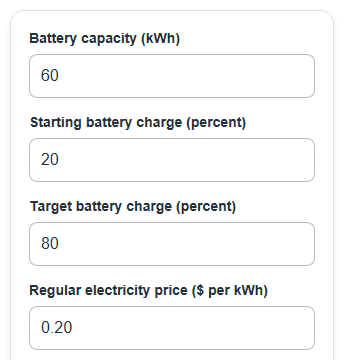
- Enter Battery capacity, Starting battery charge, Target battery charge, and Regular electricity price for the charging session you want to compare.
- Open Advanced options if you want to change Level 1 charging power, Level 2 charging power, Charging efficiency, or the Number display.
- If your utility has cheaper hours, enter Cheap-rate electricity price and Cheap-rate window length; leave Cheap-rate electricity price blank to hide those cost comparisons.
- Click Calculate to see Level 2 time saved, each charging time, energy from the wall, and session cost.
- Sanity-check the result: a larger battery fill, lower Charging efficiency, or lower charger power should make charging time longer.
Definitions
Level 1 charging: Regular 120-volt home EV charging, often from a standard household outlet [1].
Level 2 charging: Higher-power 240-volt home EV charging, usually much faster than Level 1 [1].
Battery capacity: The amount of energy the EV battery can store, measured in kilowatt-hours.
Kilowatt-hour (kWh): An energy unit equal to 1 kilowatt of power used for 1 hour.
Kilowatt (kW): A power unit that tells how fast energy is being delivered.
Charging efficiency: The percent of wall energy that reaches the battery after charging losses.
Energy used from the wall: The energy pulled from your home electrical system and billed by the meter in this simplified model.
Cheap-rate window: A set number of hours when your electricity price is lower than the regular price.
Common mistakes and quick fixes
Mistake: Entering driving range or battery percent in Battery capacity.
Fix: Enter the EV battery size in kWh for Battery capacity, or the usable battery size if you know it.
Mistake: Setting Target battery charge equal to or lower than Starting battery charge.
Fix: Make Target battery charge higher than Starting battery charge, with both values from 0 to 100.
Mistake: Typing cents into Regular electricity price, such as 20 for 20 cents.
Fix: Enter dollars per kWh, so 20 cents is 0.20 for Regular electricity price.
Mistake: Entering 0.90 in Charging efficiency when you mean 90 percent.
Fix: Enter 90 for Charging efficiency, because the label uses percent.
Mistake: Leaving Cheap-rate window length blank after entering Cheap-rate electricity price.
Fix: Enter the number of cheap hours for Cheap-rate window length, or clear Cheap-rate electricity price to skip cheap-rate results.
Mistake: Reading Level 2 cheap-rate cost advantage as the savings from buying or installing a charger.
Fix: Use Level 2 cheap-rate cost advantage only as a session energy-cost comparison for the rates and window you entered.
Limitations & Key Assumptions / Boundary Conditions
- The calculator uses steady charging power. Real EV charging can slow down near a high battery percent, especially close to full.
- Level 1 charging power and Level 2 charging power should be the actual wall power available to the EV, after any charger, circuit, or vehicle limits.
- The same Charging efficiency is used for both Level 1 and Level 2. Real efficiency can differ by vehicle, temperature, charger, and battery state.
- Cheap-rate results assume charging starts at the beginning of the Cheap-rate window length. A different start time can change the cost split.
- Costs include only energy price per kWh. Taxes, fixed utility charges, demand charges, charger installation, and subscription fees are not included.
- The calculator compares a single charging session. It does not estimate yearly savings, miles added, battery wear, or public fast-charging costs.
Methodology
How the calculation works
The calculator first finds the battery energy needed for the chosen charge window. It then adjusts for Charging efficiency to estimate Energy used from the wall, which is the energy used for time and cost.
energy_added_to_battery_kwh = battery_capacity_kwh * (target_charge_percent - start_charge_percent) / 100
wall_energy_used_kwh = energy_added_to_battery_kwh / (charging_efficiency_percent / 100)
Charging time is calculated separately for Level 1 charging power and Level 2 charging power.
charge_time_hours = wall_energy_used_kwh / charger_power_kw
level2_time_saved_hours = level1_charge_time_hours - level2_charge_time_hours
The regular-price cost uses the same wall energy for both levels.
single_rate_session_cost = wall_energy_used_kwh * home_rate_per_kwh
Cheap-rate window calculation
When Cheap-rate electricity price is entered, the calculator estimates how much wall energy can fit inside the cheaper hours for each charger level.
cheap_energy_kwh = min(wall_energy_used_kwh, charger_power_kw * off_peak_hours)
regular_energy_kwh = wall_energy_used_kwh - cheap_energy_kwh
cheap_rate_session_cost = cheap_energy_kwh * off_peak_rate_per_kwh + regular_energy_kwh * home_rate_per_kwh
level2_cheap_rate_cost_advantage = level1_cheap_rate_session_cost - level2_cheap_rate_session_cost
cheap_window_fit_percent = min(100, (off_peak_hours / charge_time_hours) * 100)
Mini-example
Suppose Battery capacity is 60 kWh, Starting battery charge is 20 percent, Target battery charge is 80 percent, and Charging efficiency is 90 percent. The battery energy added is 36 kWh, and Energy used from the wall is 40 kWh. With Level 1 charging power of 1.4 kW, Level 1 charging time is 28.57 hours. With Level 2 charging power of 7.2 kW, Level 2 charging time is 5.56 hours, so Level 2 time saved is 23.02 hours. At a Regular electricity price of $0.20 per kWh, Session cost at regular price is $8.00. If Cheap-rate electricity price is $0.10 per kWh for 8 hours, Level 1 cheap-rate session cost is $6.88 and Level 2 cheap-rate session cost is $4.00, so Level 2 cheap-rate cost advantage is $2.88.