
Compare flat-rate and time-of-use EV charging costs and see how much off-peak charging you need to save money.
Advanced options
Table of contents
How to use our EV Time-of-Use Charging Savings Calculator
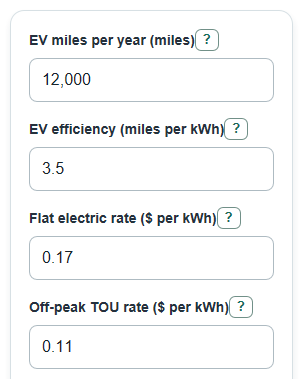
- Enter EV miles per year and EV efficiency to estimate how much battery energy your driving uses.
- Enter Flat electric rate, Off-peak TOU rate, Peak TOU rate, and Charging done off-peak as prices in $ per kWh and a percent from 0 to 100.
- Open Advanced options if you want to include Charging efficiency, Flat plan monthly fee, or TOU plan monthly fee.
- Select Calculate and read Yearly savings with the TOU plan first; positive means TOU is cheaper, while negative means the flat plan is cheaper.
- Sanity-check the result by comparing Off-peak charging needed to beat flat rate with your real charging habits and by checking that rates like 0.17 were not entered as 17 by mistake.
Definitions
Time-of-use plan (TOU): An electric plan where the price per kWh changes by time of day.
kWh: Kilowatt-hour, a unit of electrical energy used for electric bills and EV charging.
EV efficiency: Miles the EV drives for each kWh stored in the battery.
Charging efficiency: The percent of wall electricity that reaches the battery; losses make billed wall energy higher than battery energy.
Off-peak TOU rate: The cheaper TOU price for charging during lower-cost hours.
Peak TOU rate: The higher TOU price for charging during more expensive hours.
Blended TOU energy rate: The average $ per kWh from your off-peak share, off-peak rate, and peak rate, before fixed monthly fees.
Break-even off-peak share: The percent of charging that must happen off-peak for TOU to match the flat plan cost.
Common mistakes and quick fixes
Mistake: Entering cents instead of dollars in Flat electric rate, Off-peak TOU rate, or Peak TOU rate, such as 17 instead of 0.17.
Fix: Enter rates in $ per kWh, so 17 cents per kWh is 0.17.
Mistake: Using total household miles in EV miles per year when only some miles are driven by the EV.
Fix: Enter only the yearly miles you expect the EV to drive on electricity.
Mistake: Mixing up EV efficiency with kWh per 100 miles in the EV efficiency field.
Fix: Use miles per kWh; if your car shows kWh per 100 miles, convert it before entering the value.
Mistake: Putting battery charging percent or state of charge in Charging done off-peak.
Fix: Enter the percent of charging energy that happens during off-peak hours, not the battery's charge level.
Mistake: Leaving TOU plan monthly fee at 0 when the TOU plan has an extra monthly charge.
Fix: Add that fee so Yearly savings with the TOU plan and Off-peak charging needed to beat flat rate include it.
Mistake: Treating Yearly charging cost on TOU plan as your full electric bill.
Fix: Use it as the estimated EV charging part only; other home electricity use is not included.
Limitations & Key Assumptions / Boundary Conditions
- The comparison covers EV charging costs only, not the full home electric bill.
- The model uses two TOU periods: off-peak and peak. It does not model shoulder rates, seasonal schedules, holidays, or weekday versus weekend rules.
- Rates are user-entered. The calculator does not look up your utility tariff or confirm that you qualify for a plan.
- Monthly fees are treated as fixed plan fees. Demand charges, taxes, minimum bills, credits, and tiered energy prices are not modeled unless you fold them into your entered rates or fees.
- Charging efficiency is a single yearly average, so cold weather, charger type, and battery preconditioning can make real wall energy differ.
- If the break-even off-peak share is below 0 percent or above 100 percent, the algebra is still useful, but that share is outside normal charging behavior.
- Public charging, workplace charging, solar credits, and home battery behavior are not included.
Methodology
Energy used for driving
Home EV charging is billed as electricity use in kWh [1]. The calculator first estimates battery energy from driving miles and EV efficiency, then increases it for charging losses to estimate wall energy.
battery_kwh_per_year = annual_miles / ev_efficiency_mi_per_kwh
wall_kwh_per_year = battery_kwh_per_year / (charging_efficiency_percent / 100)
Plan costs
The TOU energy rate is a weighted average of the off-peak and peak rates. Monthly plan fees are added after energy cost, so an extra TOU fee can erase energy savings.
share = off_peak_share_percent / 100
effective_tou_rate = share * off_peak_rate_per_kwh + (1 - share) * peak_rate_per_kwh
annual_flat_charging_cost = wall_kwh_per_year * flat_rate_per_kwh + 12 * flat_plan_monthly_fee
annual_tou_charging_cost = wall_kwh_per_year * effective_tou_rate + 12 * tou_plan_monthly_fee
annual_savings_with_tou = annual_flat_charging_cost - annual_tou_charging_cost
Positive savings means the TOU plan costs less. Negative savings means the TOU plan costs more for the entered charging share and fees.
Break-even share
The break-even share solves for the off-peak charging percent where yearly flat cost and yearly TOU cost are equal.
break_even_share = (wall_kwh_per_year * flat_rate_per_kwh + 12 * (flat_plan_monthly_fee - tou_plan_monthly_fee) - wall_kwh_per_year * peak_rate_per_kwh) / (wall_kwh_per_year * (off_peak_rate_per_kwh - peak_rate_per_kwh))
break_even_off_peak_share = break_even_share * 100
If the off-peak and peak rates are equal, the denominator is zero, so the calculator does not divide by it and instead explains that the TOU energy periods have the same price.
Other outputs
cost_per_mile_tou = annual_tou_charging_cost / annual_miles
monthly_savings_with_tou = annual_savings_with_tou / 12
Mini-example
With 12,000 EV miles per year, 3.5 miles per kWh, and 90 percent charging efficiency, wall energy is about 3,809.52 kWh per year. With a flat rate of $0.17 per kWh, off-peak at $0.11, peak at $0.28, 80 percent off-peak charging, and no monthly fees, the blended TOU rate is $0.144 per kWh. The flat plan costs about $647.62 per year, the TOU plan costs about $548.57 per year, and Yearly savings with the TOU plan is about $99.05. The break-even off-peak share is about 64.71 percent, so an 80 percent off-peak share beats the flat plan in this example.