
Compare monthly EV charging costs at home, public Level 2 chargers, and DC fast chargers using your miles, efficiency, and prices.
Table of contents
How to use our EV Home vs Public Charging Cost Calculator
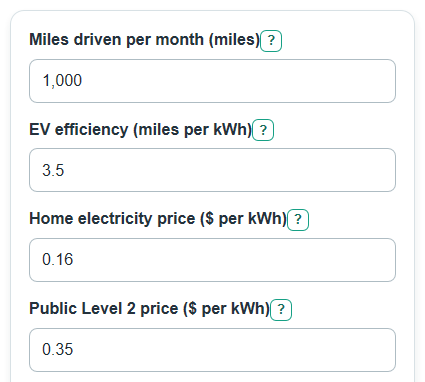
- Enter Miles driven per month and EV efficiency from your car, window sticker, or trip data.
- Enter Home electricity price, Public Level 2 price, and DC fast charger price in $ per kWh.
- Open Advanced options only if you pay a fixed fee or a public charger bills by the minute instead of by kWh.
- Use the effective public prices to sanity-check the result: a time-based price should look reasonable compared with the posted $ per kWh prices in your charging app.
- Read Home savings vs cheapest public option per month first; a positive number means home charging is cheaper, and a negative number means public charging is cheaper.
Definitions
kWh: Kilowatt-hour. This is energy used by the car. If your EV uses 300 kWh in a month, that is the energy amount being priced.
kW: Kilowatt. This is charging speed. A 7.2 kW charger can add about 7.2 kWh in one hour before real-world losses.
EV efficiency: Miles driven per kWh. A higher number means the car goes farther on the same amount of energy.
Level 2: A common AC charging type used at homes, workplaces, and public chargers. It is usually slower than DC fast charging.
DC fast: A faster public charging type that sends DC power to the car battery. Real speed can change during a session.
Effective price: The $ per kWh the calculator uses after converting any $ per minute price with charging speed.
Fixed fee: A monthly charge added to a charging option, such as an EV electricity plan fee or charging network membership.
Cost per mile: Monthly charging cost divided by Miles driven per month, with fixed fees spread across those miles.
Common mistakes and quick fixes
Mistake: Entering yearly driving in Miles driven per month.
Fix: Divide yearly miles by 12 before entering Miles driven per month.
Mistake: Using MPGe or battery size for EV efficiency.
Fix: Enter EV efficiency as miles per kWh, such as 3.5, not MPGe or total battery kWh.
Mistake: Using only the energy supply line for Home electricity price.
Fix: Use the all-in Home electricity price when you know it, including delivery charges that apply to each kWh.
Mistake: Filling both Public Level 2 price and Public Level 2 time price without realizing the time price takes over.
Fix: Use Public Level 2 time price only when the charger bills by the minute; otherwise leave it blank.
Mistake: Entering DC fast charger time price but leaving DC fast charging speed at a guess that is far from your real average.
Fix: Use the average DC fast charging speed from the session screen or app when time billing is used.
Mistake: Ignoring Public Level 2 membership fee or DC fast membership fee when comparing subscriptions.
Fix: Add the monthly fee to the matching field so cost per mile spreads that fee across your entered miles.
Limitations & Key Assumptions / Boundary Conditions
- The calculator compares three separate all-charging scenarios: all home, all public Level 2, or all DC fast. It does not model a mixed charging routine.
- It uses EV efficiency in miles per kWh as entered. Weather, speed, tires, cabin heat, and driving style can change real energy use.
- It does not add charging losses. If your rate is based on wall energy and your efficiency is based on battery energy, real home cost can be higher.
- Time-based public prices use a single average charging speed. DC fast speed often drops as the battery gets fuller, so a session average is better than a peak speed.
- Public prices can include idle fees, session fees, taxes, parking charges, or discounts that are not included unless you put them into a monthly fee or adjusted price.
- Negative Home savings vs cheapest public option per month is allowed. It means the cheapest public option is less expensive than home charging for the inputs entered.
- At very low Miles driven per month, fixed monthly fees can make cost per mile look high because the fee is spread across fewer miles.
Methodology
Energy needed for the month
The calculator first turns driving into charging energy using Miles driven per month and EV efficiency. EV energy use is commonly discussed in kWh, and charging power is commonly discussed in kW [1].
monthly_energy_kwh = monthly_miles / efficiency_mi_per_kwh
Public prices that bill by time
If Public Level 2 time price is filled in, the calculator replaces Public Level 2 price with an effective $ per kWh. If DC fast charger time price is filled in, it does the same for DC fast charger price. The conversion uses 60 minutes per hour and the matching charging speed.
effective_rate_per_kwh = price_per_minute * 60 / charging_speed_kw
If the time price is blank, the entered $ per kWh price is used directly.
Monthly and yearly costs
Each charging option multiplies monthly energy by its effective price, then adds the matching fixed monthly fee. Public charging can be priced in different ways, including energy-based fees, so converting to a common $ per kWh basis makes the options easier to compare [4].
monthly_cost = monthly_energy_kwh * effective_rate_per_kwh + monthly_fixed_fee
cheapest_public_monthly_cost = min(monthly_l2_charging_cost, monthly_dc_fast_charging_cost)
home_savings_vs_cheapest_public_monthly = cheapest_public_monthly_cost - monthly_home_charging_cost
annual_home_savings_vs_cheapest_public = home_savings_vs_cheapest_public_monthly * 12
Cost per mile divides each monthly scenario cost by Miles driven per month.
cost_per_mile = monthly_cost / monthly_miles
Worked example
For 1,000 miles per month, 3.5 miles per kWh, a home price of $0.16 per kWh, a public Level 2 price of $0.35 per kWh, and a DC fast price of $0.55 per kWh, monthly energy is 1,000 / 3.5 = 285.71 kWh. Home charging costs 285.71 * $0.16 = $45.71 per month. Public Level 2 costs 285.71 * $0.35 = $100.00 per month, and DC fast costs 285.71 * $0.55 = $157.14 per month. The cheapest public option is Level 2 at $100.00, so home savings are $100.00 - $45.71 = $54.29 per month, or $651.43 per year.
Sources
- Alternative Fuels Data Center: Charging Electric Vehicles at Home - Energy
- Alternative Fuels Data Center: Charging Electric Vehicles in Public - Energy
- Comparison: Your Car vs. an Electric Vehicle | US EPA - EPA
- DOE - Federal Workplace Charging Program Guide (kWh/session, fee = kWh $/kWh framework) - Energy