
Compare microinverter and string inverter solar quotes using price, yearly energy, electricity value, and your expected extra production.
Table of contents
How to use our Microinverter vs String Inverter Calculator
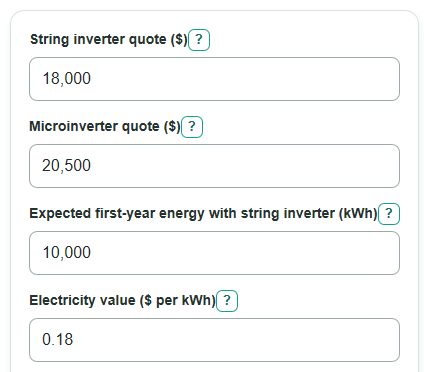
- Enter the String inverter quote and Microinverter quote using the same price basis, such as both before rebates or both after rebates.
- Enter Expected first-year energy with string inverter in kWh, then enter Electricity value as the dollar value of one saved kWh.
- Enter Expected microinverter extra energy as a percent; use 0 if you do not expect the microinverter system to make more energy.
- Open Advanced options only if you want to change Compare over, Annual output drop, or Number display.
- Click Calculate, then sanity-check the result: if Microinverter break-even extra energy is higher than your expected extra energy, the microinverter quote usually needs a non-money reason to make sense from these entries.
Definitions
String inverter quote: The installed price for the solar option that uses one or more central string inverters.
Microinverter quote: The installed price for the solar option that uses small inverters at the panel level.
Expected first-year energy with string inverter: The year-1 solar production estimate for the string inverter option, measured in kilowatt-hours (kWh).
Electricity value: The dollar value of one kWh of solar energy on your bill or export credit.
Expected microinverter extra energy: The percent more energy you expect the microinverter system to make compared with the string inverter system.
Annual output drop: The percent decrease in yearly solar output used for each year after year 1.
Microinverter net value over compare period: The microinverter option's extra energy value minus its extra upfront cost.
Microinverter break-even extra energy: The extra energy percent the microinverter option needs to exactly cover its price difference.
Common mistakes and quick fixes
Mistake: Mixing before-rebate and after-rebate prices in String inverter quote and Microinverter quote.
Fix: Put both quotes on the same price basis before comparing them.
Mistake: Entering solar system size in Expected first-year energy with string inverter.
Fix: Enter yearly production in kWh, not panel size in kW.
Mistake: Using a retail bill rate for Electricity value when exported solar is credited at a lower rate.
Fix: Use your best average $ per kWh value for the solar energy you expect to use or export.
Mistake: Treating Expected microinverter extra energy as a guaranteed number.
Fix: Use a cautious percent from a proposal, shade study, or production model, and test a lower percent too.
Mistake: Leaving Compare over at 25 years when you only care about a shorter ownership period.
Fix: Change Compare over to the number of years you want the money comparison to count.
Mistake: Entering Annual output drop as 50 instead of 0.5 for one-half percent per year.
Fix: Enter the percent directly, so 0.5 means 0.5% per year.
Limitations & Key Assumptions / Boundary Conditions
- The calculator compares money from quote prices and energy estimates only. It does not check electrical code, rapid shutdown rules, equipment compatibility, roof layout, warranty terms, or installer quality.
- Both quotes should cover the same system size, scope, rebate treatment, tax-credit treatment, and included equipment. If one quote includes work the other does not, adjust the prices first.
- Expected first-year energy with string inverter should come from a proposal, design tool, or production model. The calculator does not estimate shade, roof tilt, azimuth, weather, or panel temperature.
- Electricity value is treated as one average $ per kWh for all years. Time-of-use rates, net billing, export caps, fixed charges, and future rate changes can change the real bill value.
- Annual output drop is applied equally to both inverter choices. If the two proposals use different panels or degradation warranties, this simplified comparison may miss that difference.
- Microinverter payback time is based only on extra energy value paying back extra upfront cost. Maintenance, inverter replacement, monitoring, roof work, financing interest, and tax effects are not included.
- Break-even extra energy can be negative when the microinverter quote is cheaper. That means the microinverter option can make less energy and still tie on money for the chosen period.
Methodology
How the comparison is calculated
The calculator first adds the year-by-year production factors across the chosen Compare over period. Year 1 uses the full Expected first-year energy with string inverter. Each later year is reduced by Annual output drop.
energy_factor = N when d = 0
energy_factor = (1 - (1 - d)^N) / d when d is greater than 0
In these formulas, N is Compare over in years, and d is Annual output drop divided by 100.
string_total_energy = string_yearly_energy * energy_factor
micro_total_energy = string_total_energy * (1 + micro_extra_energy_percent / 100)
The calculator then turns total energy into dollar value using Electricity value.
string_total_bill_value = string_total_energy * electricity_value
micro_total_bill_value = micro_total_energy * electricity_value
The signed price difference is kept as entered by the quotes. A positive number means the microinverter quote costs more upfront. A negative number means it costs less upfront.
micro_extra_upfront_cost = micro_installed_cost - string_installed_cost
The main answer subtracts that extra upfront cost from the microinverter option's extra energy value.
micro_net_value_over_period = (micro_total_bill_value - string_total_bill_value) - micro_extra_upfront_cost
Lower-cost choice from these entries is Microinverter when Microinverter net value over compare period is positive, String inverter when it is negative, and Tie when it is exactly zero after rounding.
break_even_micro_extra_energy_percent = micro_extra_upfront_cost / (string_total_energy * electricity_value) * 100
Microinverter payback time is found year by year. If Microinverter extra upfront cost is 0 or lower, payback is 0 years. Otherwise, the calculator adds each year's extra energy value until it reaches the extra upfront cost. If the crossing happens during a year, it prorates that year.
yearly_extra_value_i = string_yearly_energy * (micro_extra_energy_percent / 100) * electricity_value * (1 - d)^i
Mini-example
Suppose String inverter quote is $18,000, Microinverter quote is $20,500, Expected first-year energy with string inverter is 10,000 kWh, Electricity value is $0.18 per kWh, Expected microinverter extra energy is 8%, Compare over is 25 years, and Annual output drop is 0%. The string option makes 250,000 kWh over the period, worth $45,000. The microinverter option makes 270,000 kWh, worth $48,600. The microinverter quote costs $2,500 more upfront, so Microinverter net value over compare period is ($48,600 - $45,000) - $2,500 = $1,100. The break-even extra energy is about 5.56%, and payback is about 17.36 years.
Sources
- Microinverters Vs. String Inverters: Which Is Right For You? | EnergySage - Energysage
- Microinverters vs String Inverters Solar Analytica - Solaranalytica
- Micro Inverter vs String Inverter: Pros, Cons & Which Is Better for Solar - Anern
- Microinverters vs String Inverters: 2026 Complete Guide | Solar Stack - Solar-stack