
Estimate a battery's lifetime cost per kWh using price, usable energy, cycle life, efficiency, yearly use, and optional fade.
Table of contents
How to use our Battery Lifetime Cost Calculator
- Enter Battery price as the cost you want to compare, using battery-only cost unless you want installed cost included.
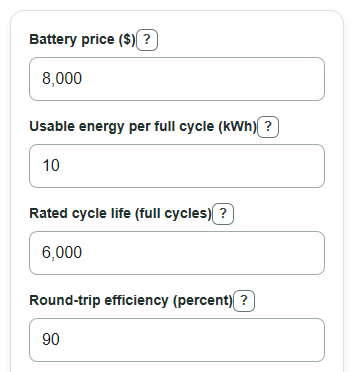
- Enter Usable energy per full cycle, Rated cycle life, Round-trip efficiency, and Full cycles used per year from the battery specs and your expected use.
- Open Advanced options if you want to add Calendar life cap or Capacity left at replacement for a more realistic replacement estimate.
- Click Calculate and read Cost for each kWh you get back first, then check Estimated service life and Lifetime limit used to see what controlled the result.
- Sanity-check the output by comparing Full cycles counted before replacement with Rated cycle life; a much lower value usually means Calendar life cap is controlling the estimate.
Definitions
Battery price: The cost used in the comparison. Use battery-only cost for battery economics, or include installation if you want a project-level number.
Usable energy per full cycle: The kWh the battery can normally give you in one full use. It can be lower than the nameplate capacity.
Rated cycle life: The number of full cycles the battery is rated to complete before replacement or a specified end condition.
Full cycle: Battery use equal to one full usable capacity. For example, two half uses count as about one full cycle.
Round-trip efficiency: The percent of stored energy you get back after charging and discharging. A 90 percent value means 10 percent is lost in the charge-discharge process.
Calendar life cap: An optional year limit that can cause replacement before all rated cycles are used.
Capacity left at replacement: The estimated percent of original usable capacity still available at replacement. The calculator uses it for a simple straight-line fade estimate.
Delivered kWh: Energy the battery gives back to the user after efficiency losses and the optional fade adjustment.
Common mistakes and quick fixes
Mistake: Entering the nameplate size in Usable energy per full cycle when the usable amount is lower.
Fix: Use the usable kWh the battery can normally deliver in one full cycle.
Mistake: Leaving Round-trip efficiency blank or typing a percent above 100.
Fix: Enter a percent from more than 0 to 100 for Round-trip efficiency.
Mistake: Treating Full cycles used per year as days owned instead of full-cycle equivalents.
Fix: Count partial use correctly; two half cycles are about one full cycle.
Mistake: Adding Calendar life cap when you do not actually want a time-based replacement limit.
Fix: Leave Calendar life cap blank so Rated cycle life controls unless another entered cap is shorter.
Mistake: Setting Capacity left at replacement to 80 when you want to ignore battery fade.
Fix: Use 100 for Capacity left at replacement if you want no straight-line fade adjustment.
Mistake: Comparing Cost for each counted full cycle between batteries with different Usable energy per full cycle.
Fix: Use Cost for each kWh you get back for the cleaner energy-based comparison.
Limitations & Key Assumptions / Boundary Conditions
- The calculator uses simple arithmetic, not a detailed battery aging model. Real battery life can change with temperature, charge level, depth of discharge, current, maintenance, and control settings.
- Capacity fade is treated as a straight line from 100 percent to Capacity left at replacement. Real fade can be faster or slower at different ages.
- Round-trip efficiency is kept constant for the whole life. Actual efficiency can vary with load, temperature, state of charge, and battery age.
- Calendar life cap is optional. If it is blank, the calculator assumes rated cycles are the only replacement limit.
- Battery price is not discounted over time. The result does not include financing, taxes, incentives, resale value, maintenance, electricity price, or the time value of money.
- The estimate works best for comparing batteries under the same usage pattern. It is less useful if the batteries would be cycled very differently in real life.
Methodology
How the math works
The calculator first turns Round-trip efficiency into a decimal, then counts how many full cycles are used before replacement. If Calendar life cap is entered, it compares the rated cycle limit with the calendar limit. Battery lifetime studies often separate cycling effects from calendar aging, and energy-cost assessments commonly include efficiency, cycle life, and service life assumptions [1].
efficiency_decimal = round_trip_efficiency_percent / 100
average_capacity_factor = (1 + end_capacity_percent / 100) / 2
cycles_counted = min(rated_cycles, calendar_life_years * cycles_per_year) when Calendar life cap is entered
cycles_counted = rated_cycles when Calendar life cap is blank
service_life_years = cycles_counted / cycles_per_year
total_delivered_kwh = usable_capacity_kwh * efficiency_decimal * average_capacity_factor * cycles_counted
lifetime_cost_per_delivered_kwh = purchase_price / total_delivered_kwh
cost_per_counted_cycle = purchase_price / cycles_counted
Mini-example
For a Battery price of $8,000, Usable energy per full cycle of 10 kWh, Rated cycle life of 6,000 full cycles, Round-trip efficiency of 90 percent, and Full cycles used per year of 250, with no Calendar life cap and 100 percent Capacity left at replacement, the efficiency decimal is 0.90 and the counted cycles are 6,000.
service_life_years = 6000 / 250 = 24 years
total_delivered_kwh = 10 * 0.90 * 1 * 6000 = 54000 kWh
lifetime_cost_per_delivered_kwh = 8000 / 54000 = 0.1481 $/kWh
The main result rounds to about $0.15 per kWh you get back. If you enter a 10-year Calendar life cap with the same yearly use, counted cycles drop to 2,500, so the lifetime cost per delivered kWh rises because the battery is replaced before using all rated cycles.
Sources
- U.S. Department of Energy (DOE) - Energy Storage Grand Challenge: Cost and Performance Assessment 2022 (LCOS, cycle/calendar life, efficiency) - Energy
- [2103.02166] Electrochemical Modeling of Calendar Capacity Loss of Nickel-Manganese-Cobalt (NMC)-Graphite Lithium Ion Batteries - Arxiv
- Battery Life - NLR