
Estimate your solar self-consumption, exported kWh, grid electricity needed, and the yearly value of self-used solar and optional EV charging.
Advanced options
Table of contents
How to use our Solar Self-Consumption Calculator
- Choose the Entry time scale that matches your numbers: Annual totals for yearly app or bill totals, or Daily averages for typical daily amounts.
- Enter Solar production, Home use before EV, Solar used at home before EV, and Retail electricity rate using the same time period for production and use.
- Open Advanced options if you want to change Export credit rate, test EV charging, estimate EV charging during solar hours, or change Number display.
- Click Calculate and read Solar production used at home first, then check the exported energy, grid electricity still needed, and dollar values.
- Sanity-check the output: Solar energy used at home plus Solar energy sent to the grid should be close to yearly Solar production, and any Input check note should be reviewed before using the estimate.
Definitions
kWh: Kilowatt-hour, the energy unit used for electricity use and production. One kWh is using 1 kilowatt for 1 hour [1].
Solar production: The solar energy made during the chosen time scale, entered in kWh.
Home use before EV: The home's electricity use before adding the optional EV charging amount.
Solar production used at home: The percent of solar production used by the home and eligible EV charging instead of being sent to the grid.
Export credit rate: The $ per kWh credit for solar energy sent to the grid. This depends on the utility plan and solar program [2].
Retail electricity rate: The $ per kWh price avoided when solar is used at home instead of buying electricity from the grid.
Home electricity covered by solar: The percent of total home use, including optional EV charging, covered by solar used at home.
Electricity still bought from the grid: The yearly kWh still needed after counting solar used at home.
Common mistakes and quick fixes
Mistake: Using monthly bill numbers while Entry time scale is set to Annual totals.
Fix: Convert monthly Solar production and Home use before EV to yearly totals, or change Entry time scale to Daily averages after converting to daily amounts.
Mistake: Entering Solar used at home before EV as 0.40 when you mean 40 percent.
Fix: Enter 40 in Solar used at home before EV because the input is in percent.
Mistake: Mixing Solar production from one year with Home use before EV from a different year.
Fix: Use Solar production and Home use before EV from the same time period so the self-consumption rate is meaningful.
Mistake: Leaving Export credit rate at the default when your utility credits exports at the full Retail electricity rate.
Fix: Set Export credit rate to the same value as Retail electricity rate if that matches your plan.
Mistake: Entering monthly EV energy in EV charging, which expects kWh per day.
Fix: Divide the monthly EV charging kWh by the number of days in the month, then enter that daily average in EV charging.
Mistake: Counting all EV charging as EV charging during solar hours when most charging happens at night.
Fix: Use only the percent of EV charging that happens while the solar system is producing.
Limitations & Key Assumptions / Boundary Conditions
- The calculator annualizes all results. Daily averages are multiplied by 365, and leap years are ignored.
- It uses flat Retail electricity rate and Export credit rate values. It does not model time-of-use prices, demand charges, taxes, fixed charges, minimum bills, or monthly true-ups.
- It does not use hourly solar or load data. Weather, seasons, shading, appliance timing, and weekend patterns can change real self-consumption.
- EV charging covered by extra solar assumes charging during solar hours can use solar that would otherwise be exported. Charger limits, car availability, and smart-charging settings are not modeled.
- Base solar used at home is capped at Solar production and Home use before EV. If the entered percent implies more home solar use than the home load can accept, the calculator shows an Input check note.
- Battery storage is not modeled. A battery can raise self-consumption and reduce exports in ways this simple EV scenario does not capture.
- Annual value from self-used and exported solar is an energy-value estimate, not a full utility bill forecast or a payback calculation.
Methodology
Annual energy setup
Electricity use and solar production are handled in kWh, the common billing and energy-use unit for electricity [1]. The calculator converts the entered time scale to yearly kWh so all outputs use the same period.
days_factor = 365 if Entry time scale is Daily averages, otherwise 1
solar_year = solar_input * days_factor
home_year = home_input * days_factor
Solar used before EV charging
The entered Solar used at home before EV percent is applied to yearly solar production, then capped so it cannot exceed home use before EV or total solar production.
base_self_kwh = min(solar_year * base_percent / 100, home_year, solar_year)
EV charging that can use extra solar
EV charging is entered as a daily average. Only the share entered in EV charging during solar hours can use leftover solar, and that added self-use is capped by solar that would otherwise be exported.
ev_year = EV charging * 365
ev_solar_hours_kwh = ev_year * EV charging during solar hours / 100
leftover_solar_kwh = max(solar_year - base_self_kwh, 0)
ev_added_self_kwh = min(ev_solar_hours_kwh, leftover_solar_kwh)
Energy flow outputs
Solar used at home includes the base home use plus the eligible EV charging. Exported solar and grid electricity still needed are not allowed to go below zero.
solar_used = base_self_kwh + ev_added_self_kwh
exported = max(solar_year - solar_used, 0)
total_home_use_year = home_year + ev_year
grid_needed = max(total_home_use_year - solar_used, 0)
Rates and yearly value
Self-consumption compares solar used at home with solar production. Self-sufficiency compares solar used at home with total home electricity use. Export credits can differ from retail electricity prices, so the EV value can be negative if the export credit is higher than the retail rate.
self_consumption_rate = 100 * solar_used / solar_year
self_sufficiency_rate = 100 * solar_used / total_home_use_year
annual_solar_value = solar_used * retail_rate + exported * export_credit
ev_value = ev_added_self_kwh * (retail_rate - export_credit)
Mini-example
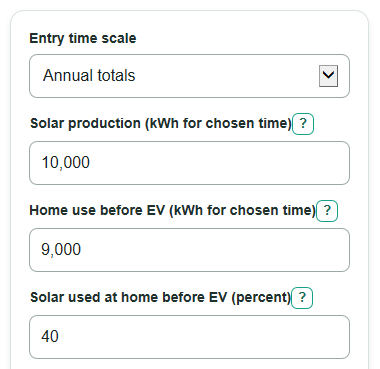
With annual Solar production of 10,000 kWh, Home use before EV of 9,000 kWh, Solar used at home before EV of 40 percent, Retail electricity rate of $0.30 per kWh, Export credit rate of $0.08 per kWh, EV charging of 10 kWh per day, and EV charging during solar hours of 70 percent, base self-use is 4,000 kWh. EV charging during solar hours is 2,555 kWh per year, which fits within the 6,000 kWh of leftover solar. Solar energy used at home is 6,555 kWh, exported solar is 3,445 kWh, Solar production used at home is 65.55 percent, and Home electricity covered by solar is about 51.82 percent. Annual value is $2,242.10, and Extra yearly value from EV solar charging is $562.10.