
Estimate yearly time-of-use battery savings and simple payback from your peak, off-peak, battery size, and cost inputs.
Advanced options
Mid-price period
Battery use
Table of contents
How to use our Home Battery Time-of-Use Savings Calculator
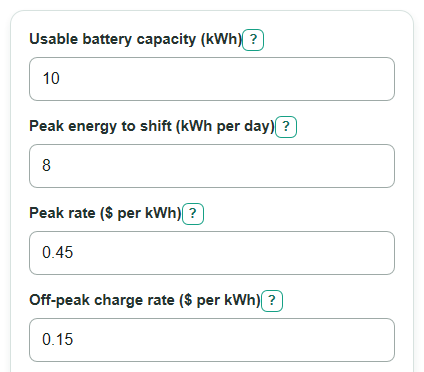
- Enter Usable battery capacity after any backup reserve, then enter Peak energy to shift for a normal day.
- Enter your Peak rate, Off-peak charge rate, and Installed battery cost; use energy charges only, not fixed monthly fees.
- Open Advanced options if your plan has a shoulder period, then fill Mid-price energy to shift, Mid-price rate, Round-trip efficiency, and Battery cycles used per day if needed.
- Select Calculate and read Annual TOU savings after battery losses first, then compare it with Simple payback from TOU savings.
- Sanity-check the result: if Total daily battery energy used for TOU shifting is larger than your real daily use, lower the shiftable kWh inputs.
Definitions
TOU: Time-of-use pricing, where electricity costs more during some hours and less during others.
Usable battery capacity: The battery energy, in kWh, that can be used for bill savings after any reserve you keep for backup power.
Peak energy to shift: Daily energy the battery can supply during the most expensive hours instead of buying from the grid then.
Off-peak charge rate: The low $ per kWh price used to charge the battery before it discharges later.
Mid-price energy to shift: Optional daily energy during a middle-price period, such as a shoulder rate, that may still be worth covering with the battery.
Round-trip efficiency: The percent of charging energy the battery gives back as usable energy. A 90 percent value means about 10 percent is lost.
Battery cycles used per day: How many times per day the calculator lets the battery deliver its usable capacity for TOU shifting.
Simple payback: Installed battery cost divided by first-year TOU savings, shown in years when savings are positive.
Common mistakes and quick fixes
Mistake: Entering total battery nameplate size for Usable battery capacity when part of the battery is saved for backup.
Fix: Use the kWh you allow for daily bill savings after any backup reserve.
Mistake: Putting your whole daily home use into Peak energy to shift .
Fix: Enter only the kWh used during the high-price hours that the battery can cover.
Mistake: Adding fixed monthly charges to Peak rate or Off-peak charge rate .
Fix: Use the energy price in $ per kWh only, because fixed fees usually do not change when the battery shifts energy.
Mistake: Leaving Round-trip efficiency at 100 percent because the battery is new.
Fix: Use the battery system's round-trip efficiency estimate; 90 percent means the calculator buys more off-peak energy than it later delivers.
Mistake: Using Mid-price rate when your plan has only peak and off-peak prices.
Fix: Set Mid-price energy to shift to 0 so the mid-price period does not affect the estimate.
Mistake: Reading Simple payback from TOU savings as a full battery investment return.
Fix: Treat it as payback from energy-price shifting only; backup value, incentives, demand charges, degradation, and solar self-use are outside this result.
Limitations & Key Assumptions / Boundary Conditions
- The estimate uses 365 similar days. It does not model weekday/weekend schedules, seasonal TOU windows, holidays, or changing rates.
- It counts energy-price arbitrage only. It does not include backup value, solar self-consumption value, demand charges, tax credits, financing, maintenance, or battery replacement.
- The calculator assumes the battery can charge enough during off-peak hours and discharge when the peak or mid-price energy occurs.
- Battery degradation is not modeled. Real savings can fall if usable capacity or efficiency declines over time.
- Entered shiftable kWh should come from your own usage pattern. If the home does not use that much energy during the high-price period, the savings will be too high.
- If a higher-price period is not above the loss-adjusted off-peak charging cost, the calculator skips that period instead of counting a loss as savings.
Methodology
Calculation steps
Time-of-use electricity rates charge different prices at different times, so the calculator estimates the value of buying low-price energy and using the battery during higher-price hours [1]. It first converts the off-peak charge price into the cost of 1 kWh delivered after battery losses.
charge_cost_per_kwh_discharge = offpeak_rate_per_kwh / (round_trip_efficiency_percent / 100)
Next it sets the daily battery discharge available for TOU shifting.
daily_discharge_limit = usable_battery_capacity_kwh * cycles_per_day
For each higher-price period, the calculator finds the savings margin per delivered kWh.
period_margin = period_rate_per_kwh - charge_cost_per_kwh_discharge
Only periods with a positive margin are used. Peak and mid-price periods are sorted from highest positive margin to lowest positive margin, then battery energy is assigned until the requested energy or the daily discharge limit is used.
period_discharge = min(period_kwh_per_day, remaining_daily_discharge_limit)
Daily savings are the covered kWh in each used period multiplied by that period's margin.
daily_savings = add(period_discharge * period_margin) for dispatched periods
Annual savings use a simple 365-day year.
annual_tou_savings_after_losses = daily_savings * 365
Simple payback divides installed cost by annual TOU savings. If annual savings are zero or negative, the calculator shows no TOU payback instead of dividing by zero.
simple_payback_from_tou_savings = installed_cost / annual_tou_savings_after_losses
Mini example
With 10 kWh usable capacity, 1 cycle per day, 90 percent efficiency, an off-peak rate of $0.15 per kWh, and a peak rate of $0.45 per kWh, the delivered off-peak cost is $0.15 / 0.90 = $0.1667 per kWh. If the battery covers 8 kWh of peak energy per day, the margin is $0.45 - $0.1667 = $0.2833 per kWh, so daily savings are about 8 * $0.2833 = $2.27. Annual TOU savings are about $827.33, and a $10,000 installed cost gives a simple payback of about 12.1 years.