
Compare gas and electric water heater costs using your hot water use, local energy prices, installed costs, and years to compare.
Table of contents
How to use our Gas vs Electric Water Heater Cost Calculator
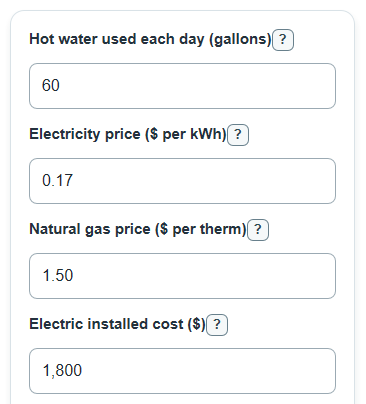
- Enter Hot water used each day, Electricity price, Natural gas price, Electric installed cost, Gas installed cost, and Years to compare.
- Open Advanced options only if you want to change Incoming cold water temperature, Water heater set temperature, Electric heater efficiency, or Gas heater efficiency.
- Click Calculate and read Total cost gap over selected years first; a positive number favors gas, and a negative number favors electric.
- Compare Yearly operating cost gap with the installed-cost difference to see whether lower bills are large enough to matter over your chosen time period.
- Sanity-check the energy outputs: Electricity used each year and Natural gas used each year should rise when you increase Hot water used each day or the temperature difference.
Definitions
kWh: A kilowatt-hour is a unit of electricity. The Electricity price field uses dollars per kWh.
Therm: A therm is a unit of natural gas energy. The Natural gas price field uses dollars per therm.
Installed cost: The upfront price to buy and put in the water heater, including labor and required parts when known.
Efficiency: The percent of input energy that becomes useful heat in the water. A lower efficiency needs more fuel for the same hot water.
Temperature rise: Water heater set temperature minus Incoming cold water temperature, measured in degrees F.
Total cost gap over selected years: Electric total cost minus gas total cost. Positive favors gas, and negative favors electric.
Gas price that ties electric yearly cost: The natural gas price where gas and electric yearly energy costs would be equal with your other inputs unchanged.
Common mistakes and quick fixes
Mistake: Entering tank size in Hot water used each day.
Fix: Enter the gallons of hot water delivered per day, not the heater tank capacity.
Mistake: Leaving Electricity price or Natural gas price at a national guess when your utility bill has local rates.
Fix: Use your bill's price per kWh and price per therm so Yearly operating cost gap reflects your home.
Mistake: Comparing Electric installed cost with Gas installed cost before adding venting, gas line, permit, or labor costs that apply.
Fix: Put the full installed price in each installed-cost field, even if one option needs extra work.
Mistake: Setting Water heater set temperature lower than Incoming cold water temperature.
Fix: Make the set temperature higher than the incoming temperature so the calculator has a positive temperature rise.
Mistake: Reading Total cost gap over selected years without checking its sign.
Fix: Positive means electric is estimated to cost more than gas; negative means electric is estimated to cost less than gas.
Mistake: Using Electric heater efficiency or Gas heater efficiency outside 1 to 100 percent.
Fix: Enter a percent from 1 to 100, such as 95 for an electric resistance heater or 60 for a lower-efficiency gas tank estimate.
Limitations & Key Assumptions / Boundary Conditions
- The estimate covers energy needed to heat delivered hot water. It does not model pipe heat loss, unusual standby losses, recirculation loops, or changes in daily use.
- Electric heater efficiency is limited to 100 percent, so the calculator is not a full model for heat pump water heaters with effective performance above 100 percent.
- Natural gas service charges, demand charges, sales tax, rebates, tax credits, maintenance, repairs, and future fuel-price changes are not included unless you build them into the installed cost or rates yourself.
- Temperature and efficiency inputs strongly affect operating cost. If you do not know them, the defaults are only a starting point.
- The gas price tie point compares yearly energy cost only. It does not include the difference between Electric installed cost and Gas installed cost.
- Inputs must be in the labeled units: gallons per day, $ per kWh, $ per therm, dollars, years, degrees F, and percent.
Methodology
How the cost is calculated
The calculator estimates the useful heat needed to warm the entered daily hot water amount, converts that heat into electricity and natural gas input energy, then applies your energy prices and installed costs.
It uses these constants: water weight is 8.345404 lb per US gallon, water specific heat is 1 BTU per lb per F, 1 kWh is 3412.141633 BTU, 1 therm is 100000 BTU, and 1 year is 365 days.
temp_rise_f = hot_water_temp_f - cold_water_temp_f
heat_btu_per_day = daily_hot_water_gal * 8.345404 * temp_rise_f * 1
electric_annual_energy = heat_btu_per_day * 365 / 3412.141633 / (electric_efficiency / 100)
gas_annual_energy = heat_btu_per_day * 365 / 100000 / (gas_efficiency / 100)
electric_annual_operating_cost = electric_annual_energy * electricity_price
gas_annual_operating_cost = gas_annual_energy * gas_price
electric_total_cost = electric_installed_cost + electric_annual_operating_cost * years
gas_total_cost = gas_installed_cost + gas_annual_operating_cost * years
total_cost_gap = electric_total_cost - gas_total_cost
annual_operating_cost_gap = electric_annual_operating_cost - gas_annual_operating_cost
gas_price_tie_point = electric_annual_operating_cost / gas_annual_energy
Worked mini-example
Using 60 gallons per day, 58 F incoming water, 120 F set temperature, 95 percent electric efficiency, 60 percent gas efficiency, $0.17 per kWh, $1.50 per therm, $1800 electric installed cost, $2400 gas installed cost, and 10 years, the temperature rise is 62 F.
The estimate is about 3496 kWh per year for electric and 188.87 therms per year for gas. That gives about $594.32 per year for electric energy and $283.31 per year for gas energy.
Over 10 years, the electric total cost is about $7743.19 and the gas total cost is about $5233.10, so the total cost gap is about $2510.09. Because the gap is positive, gas is estimated to cost less over the selected years.