
Estimate cash left in a BRRRR deal after refinance, plus cash flow, DSCR, and LTV sensitivity cases.
Table of contents
How to use our BRRRR Calculator
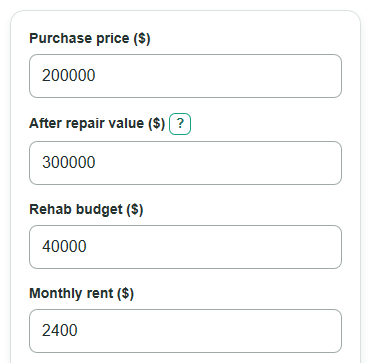
- Enter the main deal numbers: Purchase price, After repair value, Rehab budget, Monthly rent, and Monthly fixed operating expenses.
- Open Advanced options if you want to change financing, closing costs, rehab contingency, refinance LTV, or rent-based expense allowances.
- Click Calculate and read Cash left at target refinance LTV first, then compare the lower and higher LTV cases.
- Check Monthly cash flow after refinance and DSCR after refinance to see if the long-term loan payment fits the rental income.
- Sanity-check the output by asking if the After repair value, Monthly rent, rehab cushion, and LTV match what a lender or local market might actually support.
Definitions
BRRRR: A real estate strategy that stands for buy, rehab, rent, refinance, repeat.
After repair value: The estimated property value after the planned repairs are complete.
LTV: Loan-to-value ratio. It compares the loan amount with the property value. A 75% LTV refinance on a $300,000 value is a $225,000 loan.
Hard money loan: A short-term real estate loan often used for the purchase and rehab period before the long-term refinance.
Points: Up-front lender fees based on the loan amount. Two points means 2% of the loan.
NOI: Net operating income. It is rent after vacancy and operating expenses, before the refinance loan payment and income taxes.
DSCR: Debt service coverage ratio. It is NOI divided by the loan payment. Above 1.00 means modeled NOI covers the modeled payment.
Cash-on-cash return: Annual cash flow divided by cash left in the deal after refinance.
Common mistakes and quick fixes
Mistake: Entering the future repaired value in Purchase price.
Fix: Put the contract price in Purchase price and the repaired estimate in After repair value.
Mistake: Leaving Rehab budget too low and expecting Rehab contingency to cover every surprise.
Fix: Enter your best current repair estimate in Rehab budget, then use Rehab contingency only as the extra cushion.
Mistake: Putting the loan payment inside Monthly fixed operating expenses.
Fix: Use Monthly fixed operating expenses for non-debt costs only; Monthly refinance loan payment is calculated separately.
Mistake: Treating Refinance LTV as a guaranteed lender offer.
Fix: Use Refinance LTV as a test input and compare Cash left at lower LTV case to see what happens if the loan is smaller.
Mistake: Reading a negative Cash left at target refinance LTV as an error.
Fix: Negative cash left means the modeled refinance returns more cash than the modeled cash put in after costs.
Mistake: Using Cash-on-cash return after refinance when Cash left at target refinance LTV is zero or negative.
Fix: Treat cash-on-cash as N/A in that case and focus on Monthly cash flow after refinance and DSCR after refinance.
Limitations & Key Assumptions / Boundary Conditions
- The calculator is a deal check, not a loan approval. Lender rules, seasoning periods, appraisal reviews, reserves, and cash-out limits can change the refinance amount.
- After repair value and Monthly rent are estimates. A lower appraisal, lower rent, or longer vacancy can leave more cash in the deal and lower DSCR.
- Hard money interest is modeled as interest-only during Months before refinance, with points added as a financing cost.
- Monthly fixed operating expenses should exclude the refinance loan payment because the calculator computes Monthly refinance loan payment separately.
- Vacancy allowance, Management allowance, and Maintenance reserve are simple percentages of gross rent. Real repairs, capex, taxes, insurance, and HOA costs may not follow a steady monthly pattern.
- Income taxes, depreciation, selling costs, appreciation, rent growth, and future refinance changes are not included.
- The lower and higher LTV cases change only Refinance LTV. They do not change interest rate, appraisal, rent, expenses, or lender fees.
Methodology
Core project cost
The calculator first adds the rehab cushion to the entered repair budget, then builds the pre-financing project cost.
rehab_total = rehab_budget * (1 + rehab_contingency_percent / 100)
project_cost = purchase_price + purchase_closing_costs + rehab_total
Hard money phase
If Hard money loan includes rehab? is Yes, the hard money base includes Purchase price plus the rehab total. If it is No, the base is only Purchase price. The financing cost uses points plus interest for the hold period.
hard_money_base = purchase_price + funded_rehab
hard_money_loan_amount = hard_money_base * hard_money_loan_percent / 100
hard_money_interest_and_points = hard_money_loan_amount * hard_money_points_percent / 100 + hard_money_loan_amount * hard_money_rate_percent / 100 / 12 * hold_months_before_refi
total_cash_needed_before_refi = project_cost - hard_money_loan_amount + hard_money_interest_and_points
Refinance and cash left
LTV means loan-to-value ratio, a common lending measure that compares a loan amount with the property value [4]. The target refinance loan is the After repair value multiplied by Refinance LTV. Refinance concepts and costs can vary by lender [3].
refinance_loan_amount = after_repair_value * refi_ltv_percent / 100
cash_left = total_cash_needed_before_refi + hard_money_loan_amount + refi_closing_costs - refinance_loan_amount
The calculator keeps the sign. Positive cash left means cash is still tied up. Negative cash left means modeled refinance proceeds are larger than modeled cash invested after paying off hard money and refinance closing costs.
LTV sensitivity cases
The lower and higher cases use the same deal numbers and change only the refinance LTV. The lower case is clipped at 0%. The higher case is clipped at 100%.
low_ltv = max(0, refi_ltv_percent - refi_ltv_spread_percent)
high_ltv = min(100, refi_ltv_percent + refi_ltv_spread_percent)
cash_left_low_ltv = cash_left using low_ltv
cash_left_high_ltv = cash_left using high_ltv
Rental performance after refinance
NOI and DSCR are standard commercial real estate lending concepts used to compare property income with debt payments [1]. The calculator subtracts vacancy, fixed operating expenses, management allowance, and maintenance reserve before debt payment.
monthly_noi = monthly_rent * (1 - vacancy_percent / 100) - monthly_fixed_expenses - monthly_rent * management_percent / 100 - monthly_rent * maintenance_reserve_percent / 100
The refinance payment uses the standard amortizing loan payment formula. If the annual refinance rate is 0%, the payment is principal divided by the number of payments.
monthly_rate = refi_rate_percent / 100 / 12
number_of_payments = refi_term_years * 12
monthly_refi_payment = refinance_loan_amount * monthly_rate * (1 + monthly_rate)^number_of_payments / ((1 + monthly_rate)^number_of_payments - 1)
post_refi_monthly_cash_flow = monthly_noi - monthly_refi_payment
post_refi_dscr = monthly_noi / monthly_refi_payment
cash_on_cash_return_percent = post_refi_monthly_cash_flow * 12 / cash_left_target_ltv * 100
Capital recovered is based on the target refinance case. If total cash needed before refinance is zero, the calculator shows N/A for this percent to avoid division by zero. If cash left at target refinance LTV is zero or negative, cash-on-cash return is shown as N/A because the usual ratio is not meaningful.
capital_recovered_percent = (refinance_loan_amount - hard_money_loan_amount - refi_closing_costs) / total_cash_needed_before_refi * 100
Mini-example
With the default entries, the rehab total is $44,000, project cost is $249,000, hard money loan amount is $207,400, and hard money interest and points are $16,592. Cash needed before refinance is $58,192. At a $300,000 after repair value and 75% Refinance LTV, the target refinance loan is $225,000, so cash left at target refinance LTV is $45,592. With a 5 point LTV test range, the lower 70% case leaves $60,592 and the higher 80% case leaves $30,592. Monthly NOI is $1,268; after the modeled refinance payment, monthly cash flow is about -$229.