
Calculate a balloon loan's regular monthly payment, final balloon payment, total paid, and interest difference between two setups.
Table of contents
How to use our Balloon Loan Calculator
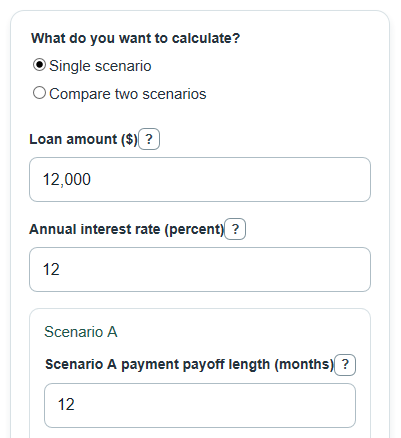
- Choose Single scenario for one loan setup or Compare two scenarios to test Scenario A against Scenario B.
- Enter the Loan amount ($) and Annual interest rate (percent). Use the yearly rate as a percent, such as 12 for 12 percent.
- Enter each scenario's payment payoff length (months). This sets the regular monthly payment as if the loan were paid over that longer time.
- Enter each scenario's balloon due after (months). This is the earlier month when the remaining balance is due.
- Click Calculate, then sanity-check the answer: a later balloon month usually means more interest, and if the balloon due month equals the payoff length, the final balloon should be about $0.
Definitions
Balloon payment: A larger final payment due at the end of a balloon loan, often because the regular payments did not fully pay off the loan by that date [1].
Loan amount ($): The starting amount borrowed before interest is added.
Annual interest rate (percent): The yearly interest rate entered as a percent. The calculator divides it by 100 and by 12 to get the monthly rate.
Payment payoff length (months): The number of months used to set the regular monthly payment, as if the loan were paid off over that full length.
Balloon due after (months): The month when the remaining balance is due as the final balloon payment.
Total interest through balloon month: Total paid through the balloon month minus the original loan amount.
Scenario B interest change compared with Scenario A: Scenario B total interest minus Scenario A total interest. Negative means Scenario B has lower interest.
Common mistakes and quick fixes
Mistake: Entering Annual interest rate (percent) as 0.12 for a 12 percent loan.
Fix: Enter 12, because the label asks for a percent, not a decimal.
Mistake: Making Scenario A balloon due after (months) greater than Scenario A payment payoff length (months) .
Fix: Use a balloon due month that is less than or equal to the Scenario A payoff length.
Mistake: Treating Scenario A payment payoff length (months) as the balloon date.
Fix: Use payoff length for the payment schedule, and use Scenario A balloon due after (months) for the date when the remaining balance is due.
Mistake: Leaving Scenario B payment payoff length (months) or Scenario B balloon due after (months) blank in compare mode.
Fix: Fill both Scenario B month fields, or switch What do you want to calculate? back to Single scenario.
Mistake: Reading Scenario B interest change compared with Scenario A as always a savings amount.
Fix: A positive value means Scenario B costs more interest, and a negative value means Scenario B saves interest.
Limitations & Key Assumptions / Boundary Conditions
- The calculator assumes monthly payments and monthly compounding based on the annual interest rate divided by 12.
- The final balloon payment is the remaining balance after the regular payment in the balloon due month.
- It does not include fees, taxes, insurance, late charges, prepayment penalties, points, or closing costs.
- It does not estimate what happens after the balloon payment, such as refinancing, selling the asset, or extending the loan.
- If the balloon due month equals the payment payoff length, the balloon payment should be about $0 because the scheduled payments fully pay off the loan.
- Real lender disclosures can differ because of exact day counts, payment dates, rounding rules, fees, or legal requirements.
Methodology
Payment math
The calculator first converts the annual percent rate into a monthly rate. It uses the standard fixed-payment loan formula to find the regular monthly payment for each scenario's payment payoff length [2].
monthly_rate = annual_rate_percent / 100 / 12
payment = principal * monthly_rate / (1 - (1 + monthly_rate)^(-payment_count))
If the monthly rate is 0, the payment is the principal divided by the payment count.
payment = principal / payment_count
Balloon balance
Next, the calculator finds the remaining balance after the regular payment in the balloon due month. That remaining balance is the final balloon payment.
balance_after_k = principal * (1 + monthly_rate)^k - payment * (((1 + monthly_rate)^k - 1) / monthly_rate)
If the monthly rate is 0, the balance is reduced by the regular payments already made.
balance_after_k = principal - payment * k
Very small balances within one cent of zero are displayed as $0.00 to avoid floating point noise.
Total paid and interest
The calculator assumes the borrower makes the regular payment for the balloon month and then pays the remaining balance.
total_paid = payment * k + balance_after_k
total_interest = total_paid - principal
Comparison math
In compare mode, the same formulas are run for Scenario A and Scenario B. The signed interest change keeps the direction clear.
interest_change_b_minus_a = scenario_b_total_interest - scenario_a_total_interest
winning_total_interest = min(scenario_a_total_interest, scenario_b_total_interest)
If both total interest amounts round to the same cents, the calculator shows a tie instead of forcing a winner.
Mini example
For a $12,000 loan at 12 percent annual interest, a 12-month payment payoff length, and a balloon due after 6 months, the monthly rate is 1 percent. The regular monthly payment is about $1,066.19. After 6 payments, the remaining balloon payment is about $6,179.05. Total paid through the balloon month is about $12,576.17, so total interest is about $576.17.