
Use this 401(k) contribution calculator to plan each remaining paycheck and avoid passing the yearly employee limit.
Table of contents
How to use our 401(k) Contribution Calculator
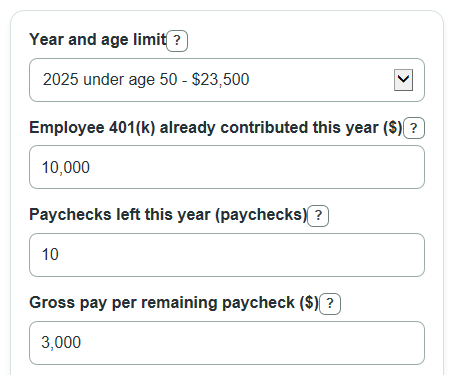
- Choose the correct Year and age limit, or choose Custom limit and enter your Custom employee limit if the dropdown does not match your plan year.
- Enter Employee 401(k) already contributed this year using year-to-date employee deferrals from all jobs, then enter Paychecks left this year.
- Enter Gross pay per remaining paycheck and Planned employee 401(k) per paycheck from your pay stub or payroll election screen.
- Open Advanced options only if you want the match estimate, then set Employer match, Match applies up to, and Plan has a year-end true-up.
- After you calculate, sanity-check the result: Employee 401(k) needed per remaining paycheck should fit inside your gross pay, and Paychecks until the employee limit is reached should not be earlier than your last remaining paycheck unless you are okay with maxing early.
Definitions
Employee 401(k) limit: The yearly cap on the money you personally defer into a 401(k), including traditional 401(k) and Roth 401(k) employee deferrals.
Catch-up: Extra employee contribution room for workers who meet certain age rules for that plan year.
Employee deferral: Money taken from your paycheck and sent to your 401(k) because you chose to contribute it.
Employer match: Money your employer adds based on what you put in, often limited to a percent of each paycheck.
Match cap: The part of pay that can receive a match. For example, a 6% cap means the match only applies to your contributions up to 6% of that paycheck's gross pay.
True-up: A year-end adjustment some plans use to add match that was missed because contributions were uneven during the year.
Gross pay: Pay before taxes, insurance, retirement deductions, and other paycheck deductions.
Common mistakes and quick fixes
Mistake: Using only your current job for Employee 401(k) already contributed this year after changing jobs.
Fix: Add employee traditional 401(k) and Roth 401(k) deferrals from all employers this year before entering Employee 401(k) already contributed this year.
Mistake: Choosing the wrong Year and age limit because catch-up rules apply by age and year.
Fix: Pick the Year and age limit that matches your plan year and age, or use Custom employee limit if your plan paperwork gives a different employee limit.
Mistake: Entering take-home pay instead of Gross pay per remaining paycheck.
Fix: Use pay before taxes and deductions for Gross pay per remaining paycheck, since 401(k) payroll percentages are based on gross pay in many plans.
Mistake: Setting Planned employee 401(k) per paycheck higher than Gross pay per remaining paycheck.
Fix: Lower Planned employee 401(k) per paycheck to an amount that can actually come out of one paycheck.
Mistake: Ignoring Plan has a year-end true-up when reading Estimated match missed from maxing early.
Fix: Check your plan summary or ask payroll whether Plan has a year-end true-up before treating Estimated match missed from maxing early as money you will lose.
Limitations & Key Assumptions / Boundary Conditions
- The match estimate uses a simple per-paycheck formula. Your plan document controls the real match, true-up, vesting, payroll timing, and eligible pay rules.
- The calculator plans employee 401(k) deferrals only. It does not model after-tax non-Roth contributions, mega backdoor Roth steps, employer annual additions limits, loans, hardship withdrawals, or rollovers.
- It does not estimate taxes, take-home pay, state rules, Social Security, Medicare, or investment growth.
- If Employee 401(k) already contributed this year is above the selected limit, the calculator keeps the signed over-limit amount visible instead of hiding it.
- The full-pay shortfall check is only a broad math test. Payroll systems usually cannot send every dollar of gross pay to a 401(k).
- For job changes, you are responsible for combining employee deferrals from all employers in Employee 401(k) already contributed this year.
Methodology
How the paycheck target is calculated
The calculator first picks the employee contribution limit from Year and age limit. If Custom limit is selected, it uses Custom employee limit instead.
room_left = limit - ytd_employee_deferral
Employee 401(k) limit room left before new contributions stays signed. A negative value means the year-to-date employee deferral entered is already above the selected limit.
needed_per_remaining_paycheck = max(0, room_left) / remaining_pay_periods
The needed amount is floored at zero because someone already at or above the employee limit does not need more employee deferrals to reach it.
How planned contributions are capped
The calculator counts only feasible new employee contributions up to the remaining employee limit room.
feasible_remaining_employee = min(max(0, room_left), planned_employee_per_period * remaining_pay_periods)
projected_year_end_employee_deferral = ytd_employee_deferral + feasible_remaining_employee
If the planned amount would hit the limit before the last paycheck, the calculator estimates the number of paychecks needed to reach the limit.
paychecks_until_employee_limit = ceil(max(0, room_left) / planned_employee_per_period)
When Planned employee 401(k) per paycheck is zero, this paycheck count is not applicable instead of infinity.
How the match estimate is calculated
For each remaining paycheck, the employee contribution is capped by the remaining employee limit room before that paycheck. The match then applies only up to the match cap.
match_for_one_paycheck = min(feasible_employee_contribution, gross_pay_per_period * employer_match_cap_percent / 100) * employer_match_rate / 100
estimated_employer_match_remaining = sum of match_for_one_paycheck over remaining_pay_periods
For the missed-match estimate, the calculator compares the planned pace with an even pace that uses Employee 401(k) needed per remaining paycheck on every remaining paycheck.
estimated_missed_match_if_no_true_up = 0 when true_up_available is yes; otherwise max(0, spread_match_total - planned_match_total)
Mini-example
Suppose the selected limit is $23,500, Employee 401(k) already contributed this year is $10,000, and Paychecks left this year is 10. The room left is $13,500, so Employee 401(k) needed per remaining paycheck is $1,350. If Planned employee 401(k) per paycheck is $3,000, Gross pay per remaining paycheck is $3,000, Employer match is 50%, and Match applies up to 6% of pay, the per-paycheck match cap is $3,000 * 6% * 50% = $90. The plan reaches the employee limit in 5 paychecks, so estimated remaining match is $450. Spreading $1,350 across all 10 paychecks would estimate $900 of match, so Estimated match missed from maxing early is $450 when no true-up is available.