
Estimate deductible mortgage interest and see if itemizing may beat the standard deduction for your federal return.
Advanced options
Table of contents
How to use our Mortgage Interest Tax Deduction Calculator
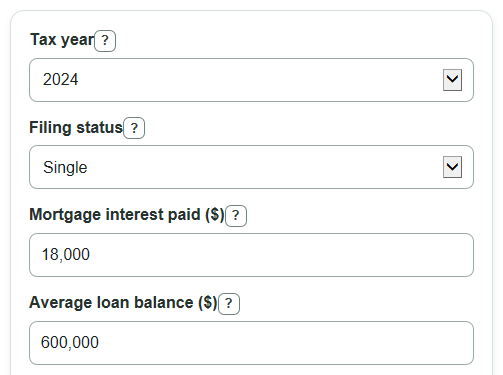
- Choose the Tax year and Filing status so the calculator can use the right standard deduction, SALT cap, and mortgage debt limit.
- Enter Mortgage interest paid and Average loan balance using yearly amounts. Form 1098 Box 1 is a common starting point for interest paid.
- Choose Mortgage debt limit to use, Loan type, and Loan money used for this home. If only some loan money was used for this home, enter Home-related part of loan balance.
- Open Advanced options if you want the itemized-vs-standard comparison to include Property taxes paid, State and local income or sales taxes paid, Other itemized deductions, and Marginal federal tax rate.
- Check the output before relying on it: Interest counted for the deduction should drop below 100% when the loan is over the cap or when only part of the debt was home-related.
Definitions
Mortgage interest paid: The interest you paid during the tax year on the loan, before any calculator proration.
Average loan balance: The average amount owed during the year. If you do not have an exact average, the middle of the beginning and ending balances is a common rough estimate.
Mortgage debt limit to use: The federal cap applied to qualifying home debt before the interest is counted. The selected cap is lower for married filing separately.
Home-related part of loan balance: The average part of the loan used to buy, build, or substantially improve the home that secures the loan.
Likely deductible mortgage interest: The estimated interest that remains after the home-use check and mortgage debt limit are applied.
Interest counted for the deduction: The percent of entered Mortgage interest paid that is included in the deductible interest estimate.
SALT deduction: State and local taxes, including property tax and either income tax or sales tax, limited by the federal cap in this calculator.
Marginal federal tax rate: The rate applied to your next dollar of taxable income. The calculator uses it only to estimate the extra federal tax savings from itemizing.
Common mistakes and quick fixes
Mistake: Using the full loan payment instead of only Mortgage interest paid.
Fix: Enter only the interest for the year, not principal, escrow, insurance, or the total monthly payment.
Mistake: Leaving Average loan balance at a purchase price or original loan amount after years of payments.
Fix: Use the average balance for the tax year, or estimate it from the beginning and ending loan balances.
Mistake: Choosing All was used for Loan money used for this home on a HELOC that paid credit cards, tuition, or a car loan.
Fix: Choose None or Only some, then enter Home-related part of loan balance only for money used to buy, build, or improve the home securing the loan.
Mistake: Choosing the older Mortgage debt limit to use without confirming the loan qualifies for grandfathered treatment.
Fix: Use the newer limit unless your tax records support the older limit; cash-out refinance cases may need detailed tracing.
Mistake: Treating Itemized deductions over standard deduction as tax savings.
Fix: Use Estimated federal tax savings from itemizing for the rough tax-savings estimate; the itemized-over-standard number is a deduction difference, not tax owed.
Mistake: Adding the same taxes twice in Property taxes paid and State and local income or sales taxes paid.
Fix: Enter property tax in Property taxes paid, and enter either state/local income tax or state/local sales tax in State and local income or sales taxes paid.
Limitations & Key Assumptions / Boundary Conditions
- This is a federal estimate for Schedule A planning. It does not calculate state tax rules, state mortgage-interest deductions, or local tax effects.
- The calculator assumes the Mortgage debt limit to use you choose is correct. It does not decide complex grandfathered-debt or refinance tracing issues for you.
- For HELOCs, home equity loans, and cash-out refinances, the result depends on your Loan money used for this home entry and your Home-related part of loan balance entry.
- The itemized comparison includes only the deductions entered here: deductible mortgage interest, capped state and local taxes, and Other itemized deductions.
- The Estimated federal tax savings from itemizing uses one Marginal federal tax rate. It is not a full tax return and does not model tax brackets, credits, AMT, phaseouts, or income limits outside the listed constants.
- If Average loan balance is a rough estimate, the deductible interest estimate is also rough, especially when the balance is near or above the mortgage debt cap.
Methodology
How the calculator counts mortgage debt
The calculator first chooses a mortgage debt cap from the selected Mortgage debt limit to use and Filing status. Newer debt uses a $750,000 base cap, while grandfathered debt uses a $1,000,000 base cap. Married filing separately uses half of the selected base cap. Qualified residence interest is subject to federal limits, so the calculator caps and prorates interest instead of treating every dollar as deductible [1].
debt_cap = base_cap, except married_separate uses base_cap / 2
Next, the calculator decides how much of the average debt is home-related. If Loan money used for this home is all home use, it uses Average loan balance. If only some was used for the home, it uses Home-related part of loan balance. If none was used for the home, it uses $0.
eligible_home_debt = average_loan_balance for all home use; eligible_home_debt_amount for partial home use; 0 for no home use
home_related_debt_counted = min(eligible_home_debt, debt_cap)
How deductible interest is estimated
The calculator prorates Mortgage interest paid by the part of the average loan balance that survives the home-use check and the debt cap.
deductible_mortgage_interest = mortgage_interest_paid * home_related_debt_counted / average_loan_balance
interest_eligible_percent = 100 * home_related_debt_counted / average_loan_balance
If Average loan balance is $0 or blank, the calculation is blocked because the proration would require division by zero. If Loan money used for this home is none, deductible mortgage interest is $0 rather than an error.
How the itemized comparison is calculated
The calculator adds property taxes and state or local income or sales taxes, then applies the SALT cap. The cap is $10,000 for most filing statuses and $5,000 for married filing separately.
salt_deduction_used = min(property_taxes_paid + state_local_taxes_paid, salt_cap)
The standard deduction depends on Tax year and Filing status. For 2024, the amounts used are $14,600 for single or married filing separately, $29,200 for married filing jointly or qualifying surviving spouse, and $21,900 for head of household. For 2025, the amounts used are $15,000, $30,000, and $22,500 in the same order.
itemized_minus_standard = deductible_mortgage_interest + salt_deduction_used + other_itemized_deductions - standard_deduction
estimated_federal_tax_savings_from_itemizing = max(0, itemized_minus_standard) * marginal_federal_tax_rate / 100
Itemized deductions over standard deduction is allowed to be negative. A negative value means the standard deduction is larger. Estimated federal tax savings from itemizing is floored at $0 because itemizing below the standard deduction does not create extra federal tax savings.
Worked mini-example
Suppose a single filer in 2024 paid $18,000 of mortgage interest, had a $600,000 average loan balance, used all loan money for the home, and chose the newer $750,000 debt limit. The home-related debt counted is $600,000 because it is below the cap, so 100% of the interest is counted and likely deductible mortgage interest is $18,000. If the same filer also enters $6,000 of property tax, $5,000 of state tax, and $2,000 of other itemized deductions, the SALT deduction used is capped at $10,000. Total itemized deductions for this comparison are $30,000, which is $15,400 over the 2024 single standard deduction of $14,600. At a 22% marginal federal tax rate, the rough federal savings from itemizing is $3,388.