
Calculate the loan fee taken out, the cash you receive, or the amount to borrow to receive a target amount.
Table of contents
How to use our Loan Origination Fee Calculator
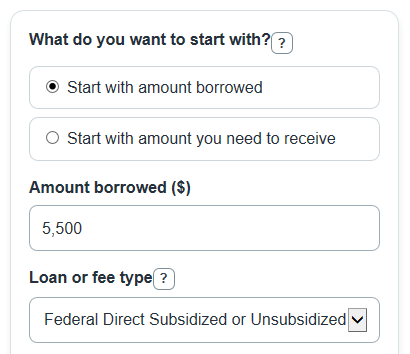
- Choose What do you want to start with? based on the number you know: the amount borrowed before the fee or the amount you need to receive after the fee.
- Enter Loan amount ($). Use the dollar amount before the fee in borrowed-amount mode, or the dollar amount you want after the fee in receive-amount mode.
- Pick Loan or fee type. Use a federal preset only if it matches your loan type and first disbursement period, or choose Custom fee percent and enter the fee shown by your lender or school.
- Select Calculate, then read Main dollar answer for your choice first. Check Origination fee taken from the loan, Other side of the loan amount, and Fee percent used to see the full breakdown.
- Sanity-check the output: a higher Fee percent used should make the Origination fee taken from the loan larger, and in receive-amount mode the main dollar answer should be higher than the Loan amount you entered unless the fee is 0 percent.
Definitions
Origination fee: A charge connected with making a loan. It is often a percentage of the loan amount [1].
Loan amount: The dollar amount you enter. Its meaning changes with What do you want to start with?: it can be the amount borrowed before the fee or the amount you want to receive after the fee.
Gross loan amount: The loan amount before the origination fee is taken out.
Net amount received: The amount left after the origination fee is subtracted from the gross loan amount.
Custom fee: The fee percent you type when the preset choices do not match your loan.
Fee percent used: The percent rate the calculator applied to the loan amount to find the fee dollars.
Common mistakes and quick fixes
Mistake: Entering the amount you need to receive in Loan amount while What do you want to start with? is set to Start with amount borrowed.
Fix: Change What do you want to start with? to Start with amount you need to receive if your Loan amount is the after-fee cash target.
Mistake: Picking Loan or fee type as a federal preset when your loan has a different fee or a different first disbursement period.
Fix: Choose Custom fee percent and enter the exact fee from your lender or school.
Mistake: Typing Custom fee as 0.01057 for a 1.057 percent fee.
Fix: Enter Custom fee as the percent number, such as 1.057, not the decimal rate.
Mistake: Reading Main dollar answer for your choice without checking Other side of the loan amount.
Fix: Use Other side of the loan amount to confirm both the before-fee loan amount and the after-fee amount received.
Mistake: Treating Origination fee taken from the loan as an extra bill paid later.
Fix: Read Fee source note and remember that this calculator treats the fee as taken out before the money is sent to you.
Limitations & Key Assumptions / Boundary Conditions
- The federal preset choices use the listed fee rates in the calculator: 1.057 percent for Federal Direct Subsidized or Unsubsidized and 4.228 percent for Federal Direct PLUS for first disbursement from Oct 1, 2020 to Sep 30, 2025.
- If your loan type, lender, school, or first disbursement date uses a different fee, choose Custom fee percent instead of a preset.
- The calculator assumes the origination fee is withheld from the loan before money is sent to you. It does not model fees paid separately at closing or added later.
- Displayed dollar amounts are rounded to the nearest cent, so hand calculations rounded earlier may differ by a cent.
- In start-with-amount-received mode, the fee percent must be less than 100 percent. A 100 percent fee would leave no money to receive.
- The result does not include interest, repayment schedule effects, school cost limits, loan approval limits, taxes, insurance, or other lender fees.
Methodology
How the calculator chooses the fee rate
The calculator first turns the selected fee into a decimal rate. Federal preset choices use their built-in percent. Custom fee percent uses the percent you enter.
fee_rate_decimal = fee_percent / 100
Start with amount borrowed
Use this mode when Loan amount is the amount accepted or borrowed before the fee is taken out.
origination_fee_amount = borrowed_amount * fee_rate_decimal
net_disbursed_amount = borrowed_amount - origination_fee_amount
In this mode, Main dollar answer for your choice is the net amount received. Other side of the loan amount is the borrowed amount you entered.
Start with amount you need to receive
Use this mode when Loan amount is the after-fee cash target. The calculator solves backward to find the gross loan amount needed before the fee.
borrowed_amount_needed = desired_net_amount / (1 - fee_rate_decimal)
origination_fee_amount = borrowed_amount_needed - desired_net_amount
In this mode, Main dollar answer for your choice is the borrowed amount needed. Other side of the loan amount is the amount you wanted to receive.
Rounding and example
Internal math uses the unrounded values, then displayed dollar amounts are rounded to the nearest cent.
display_money = round(raw_money * 100) / 100
Example:
if you borrow $5,500 with a 1.057 percent fee, the decimal rate is 0.01057. The fee is $5,500 * 0.01057 = $58.135, which displays as $58.14. The net amount received is $5,500 - $58.135 = $5,441.865, which displays as $5,441.87.