
Estimate the taxable part of a backdoor Roth IRA conversion and the tax cost using the IRA pro-rata rule.
Table of contents
How to use our Backdoor Roth IRA Tax Calculator
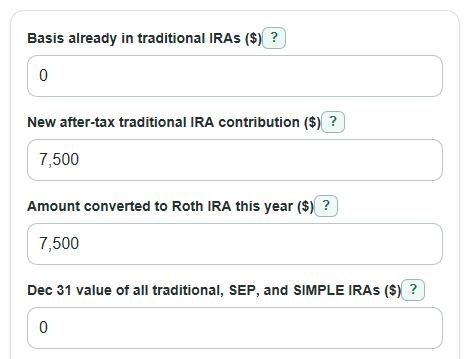
- Enter Basis already in traditional IRAs from prior years, then enter your New after-tax traditional IRA contribution for this tax year.
- Enter Amount converted to Roth IRA this year and the Dec 31 value of all traditional, SEP, and SIMPLE IRAs owned by the same person.
- Enter your Federal tax rate, and open Advanced options if you also need Other traditional IRA distributions this year, State tax rate, or IRA money you may move to a 401(k) before Dec 31.
- Click Calculate and read Estimated tax from the Roth conversion first, then compare Taxable part of the Roth conversion, Share of the conversion that is tax-free, and Basis left for future years.
- Sanity-check the result: if Dec 31 value of all traditional, SEP, and SIMPLE IRAs is 0 and your basis covers the conversion, the Taxable part of the Roth conversion should usually be $0.
Definitions
Basis already in traditional IRAs: After-tax IRA money from earlier years that should not be taxed again when distributed or converted.
New after-tax traditional IRA contribution: A nondeductible traditional IRA contribution for the current tax year. It is different from a direct Roth IRA contribution.
Dec 31 value of all traditional, SEP, and SIMPLE IRAs: The year-end total across the same person's traditional, SEP, SIMPLE, and rollover IRAs. Roth IRAs and workplace plans are not included.
Pro-rata rule: The rule that treats a person's traditional, SEP, and SIMPLE IRAs as one combined pool when figuring the taxable and tax-free parts of IRA distributions and Roth conversions.
Taxable part of the Roth conversion: The part of the conversion treated as pre-tax IRA money. This amount is usually added to taxable income.
Tax-free part of the Roth conversion: The part of the conversion covered by after-tax basis, so it is not taxed again.
Basis left for future years: After-tax IRA basis not used by this year's IRA distributions. It may carry forward for future pro-rata calculations.
Common mistakes and quick fixes
Mistake: Leaving Basis already in traditional IRAs blank because the money was already taxed.
Fix: Enter the after-tax IRA basis that has not been used yet, often from last year's Form 8606 line 14.
Mistake: Entering only one account in Dec 31 value of all traditional, SEP, and SIMPLE IRAs.
Fix: Add all traditional, SEP, SIMPLE, and rollover IRAs for the same person, but leave out Roth IRAs and workplace plans.
Mistake: Putting a direct Roth IRA contribution in New after-tax traditional IRA contribution.
Fix: Use only a nondeductible traditional IRA contribution for the tax year.
Mistake: Ignoring Other traditional IRA distributions this year when you also took withdrawals.
Fix: Enter those distributions so basis is spread across the Roth conversion and the other IRA distributions.
Mistake: Using an average tax rate for Federal tax rate when the conversion will be taxed on top of other income.
Fix: Use the rate you expect the taxable conversion dollars to fall in, often your marginal federal bracket.
Mistake: Treating IRA money you may move to a 401(k) before Dec 31 as guaranteed tax savings.
Fix: Use the comparison only if the workplace plan can accept the rollover before year-end; the calculator does not confirm eligibility.
Limitations & Key Assumptions / Boundary Conditions
- This is a planning estimate, not a tax filing form. Use your actual tax records and tax software or a tax professional for filing.
- The calculator assumes the New after-tax traditional IRA contribution is nondeductible and belongs to the same tax year as the conversion.
- The Dec 31 value must include all traditional, SEP, SIMPLE, and rollover IRAs owned by the same person. Leaving out an IRA can make the taxable amount look too low.
- The tax estimate multiplies the taxable conversion by the Federal tax rate plus the optional State tax rate. It does not model tax brackets, deductions, credits, Medicare surcharges, penalties, or state-specific rules.
- The IRA money you may move to a 401(k) before Dec 31 comparison is only a what-if estimate. A workplace plan must accept the rollover, the rollover must be done on time, and plan rules can block or delay it.
- If other IRA distributions happened during the year, basis is shared across the Roth conversion and those other distributions. The calculator does not assign all basis to the Roth conversion first.
- The default $7,500 contribution is only an example input. The calculator does not check age, earned income, filing status, income limits, or annual IRA contribution limits.
Methodology
How the pro-rata estimate is built
The calculator first adds prior after-tax IRA basis to the current-year nondeductible traditional IRA contribution. Basis means after-tax IRA money that should not be taxed again.
basis_available = prior_basis + new_after_tax_contribution
Next it adds the Roth conversion and any other traditional, SEP, or SIMPLE IRA distributions for the same person in the same tax year.
total_distributions = roth_conversion + other_ira_distributions
The pro-rata denominator is the year's IRA distributions plus the Dec 31 value of all traditional, SEP, and SIMPLE IRAs for that person. Roth IRAs and workplace plans are not part of this value.
denominator = total_distributions + year_end_ira_value
The tax-free ratio is the after-tax share of that combined IRA pool. The ratio is capped at 1 so the tax-free share cannot be more than 100 percent.
tax_free_ratio = min(1, basis_available / denominator)
The Roth conversion is split using that same ratio.
tax_free_conversion = roth_conversion * tax_free_ratio
taxable_conversion = roth_conversion - tax_free_conversion
Basis left after this year
If there are other IRA distributions, the same tax-free ratio applies across all distributions. That is why another withdrawal can use some of the same basis.
nontaxable_total_distributions = min(basis_available, total_distributions * tax_free_ratio)
basis_carried_forward = basis_available - nontaxable_total_distributions
Estimated tax
The tax cost is the taxable part of the Roth conversion multiplied by the tax rates you enter. A blank State tax rate is treated as 0, but a non-blank invalid state rate is an error.
estimated_total_conversion_tax = taxable_conversion * ((federal_tax_rate + state_tax_rate_or_zero) / 100)
Possible Dec 31 rollover comparison
If you enter IRA money you may move to a 401(k) before Dec 31, the calculator recomputes the pro-rata result with a lower year-end IRA value. The comparison value is capped at $0 because the year-end IRA value cannot be reduced below $0 in this estimate.
comparison_year_end_value = max(0, year_end_ira_value - planned_rollover_out)
comparison_denominator = total_distributions + comparison_year_end_value
comparison_ratio = min(1, basis_available / comparison_denominator)
comparison_taxable_conversion = roth_conversion - (roth_conversion * comparison_ratio)
tax_after_possible_rollover = comparison_taxable_conversion * ((federal_tax_rate + state_tax_rate_or_zero) / 100)
possible_tax_savings_if_rollover = estimated_total_conversion_tax - tax_after_possible_rollover
Mini-example
Suppose prior basis is $0, the new after-tax traditional IRA contribution is $7,500, the Roth conversion is $7,500, other IRA distributions are $0, and the Dec 31 IRA value is $22,500. The denominator is $30,000, so the tax-free ratio is $7,500 divided by $30,000, or 25 percent. The tax-free part of the conversion is $1,875, and the taxable part is $5,625. If the federal rate is 24 percent and the state rate is 5 percent, the estimated tax is $5,625 times 29 percent, or $1,631.25. If a valid pre-year-end rollover lowered the Dec 31 IRA value to $0, the comparison tax would be $0 and the possible tax savings would be $1,631.25.