
Estimate how much to save from self-employed income for income tax, self-employment tax, and your chosen savings schedule.
Advanced options
Table of contents
How to use our Self-Employed Tax Set-Aside Calculator
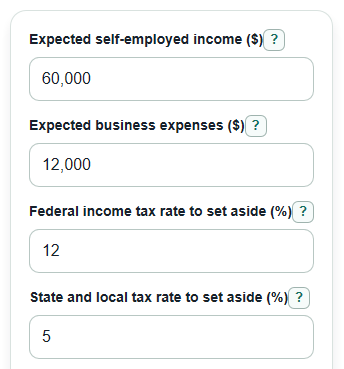
- Enter Expected self-employed income ($) before expenses and Expected business expenses ($) for the year.
- Enter the Federal income tax rate to set aside (%) and State and local tax rate to set aside (%). Use 0 for state and local tax only if you want no state or local amount included.
- Choose Show savings as to see the yearly total, quarterly amount, monthly amount, or amount to save per $1,000 of net profit.
- Open Advanced options if W-2 wages expected this year ($), Tax filing status, or Tax already saved or paid ($) affects your plan.
- Sanity-check the Percent of net profit to set aside and the Estimated yearly tax set-aside. If the percent looks too high or too low, recheck expenses, tax rates, and W-2 wages.
Definitions
Expected self-employed income ($): Money you expect to receive from freelance, contract, gig, or business work before subtracting expenses.
Expected business expenses ($): Business costs you expect to subtract from self-employed income.
Net profit: Expected self-employed income minus expected business expenses.
Self-employment tax: Social Security and Medicare tax for people who work for themselves.
W-2 wages expected this year ($): Pay from an employer job. These wages can use part of the Social Security wage base before self-employed earnings are counted.
Social Security wage base: The yearly maximum earnings amount subject to Social Security tax; the maximum is updated over time [1].
Half self-employment tax deduction estimate: An estimate of the employer-equivalent part of regular self-employment tax that can reduce the federal income tax estimate.
Common mistakes and quick fixes
Mistake: Entering take-home pay in Expected self-employed income ($).
Fix: Enter the total amount customers, platforms, or clients are expected to pay before business expenses.
Mistake: Putting personal bills in Expected business expenses ($).
Fix: Include only expected business costs you plan to treat as business expenses.
Mistake: Leaving Federal income tax rate to set aside (%) blank because the rate is unknown.
Fix: Enter a planning percent from 0 to 60, then adjust it when you have a better estimate.
Mistake: Forgetting W-2 wages expected this year ($) when you also have a job.
Fix: Enter W-2 wages in Advanced options so the Social Security wage cap effect is included.
Mistake: Reading Still to set aside after saved or paid as an extra tax bill.
Fix: Treat it as a savings target. A negative amount means Tax already saved or paid ($) is higher than this estimate.
Limitations & Key Assumptions / Boundary Conditions
- This is a planning estimate, not a filed tax return.
- The federal and state/local income tax amounts use the flat rates you enter. The calculator does not apply tax brackets, standard deductions, itemized deductions, credits, or state-specific rules.
- The 2026 Social Security wage base is built into the calculation. Review the wage base for future tax years.
- Business expenses are treated as a direct reduction of self-employed income. The calculator does not decide whether an expense is deductible.
- If expenses are higher than income, taxable profit is floored at $0 for this estimate, so tax amounts do not go below zero.
- W-2 wages are counted before self-employed earnings for the Social Security wage base in this simplified planning model.
- Quarterly and monthly results are savings targets. They do not replace IRS estimated tax safe-harbor rules, payment due dates, or state payment rules.
Methodology
Calculation steps
The calculator first finds net profit, then floors taxable profit at $0 so tax estimates cannot become negative.
net_profit = annual_1099_income - business_expenses
taxable_profit = max(0, net_profit)
If taxable profit is at least $400, the calculator multiplies it by 0.9235 to estimate net earnings from self-employment. If taxable profit is under $400, the self-employment tax base is $0.
se_base = taxable_profit >= 400 ? taxable_profit * 0.9235 : 0
The Social Security part uses the 12.4% rate only on the remaining wage base after W-2 wages. The 2026 wage base used here is $184,500.
ss_remaining = max(0, 184500 - w2_wages)
social_security_tax = min(se_base, ss_remaining) * 0.124
The regular Medicare part uses 2.9% of the self-employment tax base. Additional Medicare Tax uses 0.9% above the filing-status threshold after W-2 wages are counted.
medicare_tax = se_base * 0.029
additional_medicare_tax = max(0, se_base - max(0, filing_status_threshold - w2_wages)) * 0.009
self_employment_tax = social_security_tax + medicare_tax + additional_medicare_tax
The half self-employment tax deduction estimate includes the regular Social Security and Medicare parts only. Additional Medicare Tax is not included in this deduction estimate.
half_se_deduction = (social_security_tax + medicare_tax) * 0.5
Federal income tax uses the federal planning rate you enter after subtracting the half self-employment tax deduction estimate. State and local income tax uses the state and local rate directly on taxable profit.
federal_income_tax = max(0, taxable_profit - half_se_deduction) * (federal_income_tax_rate / 100)
state_local_tax = taxable_profit * (state_local_tax_rate / 100)
income_tax_estimate = federal_income_tax + state_local_tax
annual_total_set_aside = self_employment_tax + income_tax_estimate
The selected savings amount is the yearly estimate divided by the schedule you choose, or converted to a per-$1,000-of-net-profit target.
selected_set_aside = annual_total_set_aside, annual_total_set_aside / 4, annual_total_set_aside / 12, or annual_total_set_aside / taxable_profit * 1000
remaining_to_save = annual_total_set_aside - tax_saved_or_paid
Mini-example
With $60,000 of expected self-employed income, $12,000 of expenses, a 12% federal rate, a 5% state and local rate, no W-2 wages, and no tax already saved, net profit is $48,000. The self-employment tax estimate is $6,782.18, the income tax set-aside is $7,753.07, and the estimated yearly tax set-aside is $14,535.25. If Show savings as is Quarterly amount, the suggested set-aside is $3,633.81 per quarter.
Calculation choices
The filing-status thresholds used for Additional Medicare Tax are $200,000 for single and head of household, $250,000 for married filing jointly, and $125,000 for married filing separately. Percent outputs use taxable profit when possible; Percent of net profit to set aside shows N/A when taxable profit is $0.