
Compare your federal standard deduction with itemized deductions for 2025 or 2026 and see which choice gives the larger deduction.
Advanced options
Table of contents
How to use our Standard Deduction vs Itemized Deduction Calculator
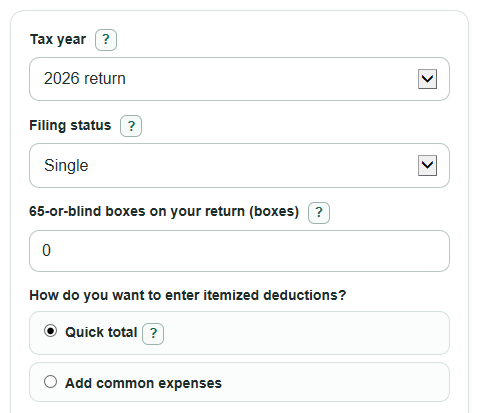
- Choose Tax year and Filing status, then enter the number of 65-or-blind boxes on your return.
- Choose How do you want to enter itemized deductions? Use Quick total if you already know your allowed Schedule A total, or Add common expenses if you want the calculator to apply common medical and state tax limits.
- Enter the money fields that are visible, such as Itemized deduction total, Adjusted gross income, Medical and dental expenses paid, and State and local taxes paid.
- Open Advanced options only if someone can claim you as a dependent, your married filing separately spouse itemizes, or you want an Estimated federal tax rate for the deduction gap.
- Check Better federal deduction choice first, then sanity-check Itemized minus standard and Rule note. If the gap is small, review your records and tax software before deciding.
Definitions
Standard deduction: A fixed federal deduction amount based on Tax year, Filing status, age, blindness, and dependent status.
Itemized deductions: Specific allowed expenses that may replace the standard deduction on a federal return, such as mortgage interest, charitable gifts, medical expenses above a floor, and state and local taxes within a cap.
Adjusted gross income: Income after certain adjustments. This calculator uses it to find the part of Medical and dental expenses paid that counts.
65-or-blind boxes: The count of age 65 or older and blindness boxes on the return. A person who is both age 65 or older and blind counts as 2 boxes.
State and local tax amount that counts: The part of State and local taxes paid that remains after the federal SALT cap and any high-income phase-down used by the calculator.
Itemized minus standard: Allowed itemized deduction total minus Standard deduction amount. Positive means itemizing is larger; negative means the standard deduction is larger.
Dependent earned income: Wages, tips, salaries, and similar earned income used to limit the standard deduction when someone can claim you as a dependent.
Common mistakes and quick fixes
Mistake: Entering total receipts in Itemized deduction total instead of the allowed Schedule A amount.
Fix: Use Itemized deduction total only for an already allowed itemized total, or switch How do you want to enter itemized deductions? to Add common expenses.
Mistake: Leaving Adjusted gross income blank while using Medical and dental expenses paid.
Fix: Enter Adjusted gross income so the calculator can apply the 7.5% medical floor.
Mistake: Putting all taxes paid into State and local taxes paid and expecting the full amount to count.
Fix: Enter the full State and local taxes paid, then read State and local tax amount that counts and Rule note for the federal cap result.
Mistake: Counting 65-or-blind boxes on your return as people instead of boxes.
Fix: Count each age 65 or older box and each blind box separately; one person can count as 2 boxes.
Mistake: Ignoring If married filing separately, does your spouse itemize? when filing separately.
Fix: Set If married filing separately, does your spouse itemize? to Yes if your spouse itemizes, because Better federal deduction choice may become forced itemized.
Mistake: Treating Estimated federal tax difference as your refund change.
Fix: Use Estimated federal tax difference only as a rough federal tax effect from the deduction gap, not a full tax bill or refund estimate.
Limitations & Key Assumptions / Boundary Conditions
- This is a federal deduction comparison for 2025 and 2026 only. It does not calculate state income tax deductions or state filing rules.
- Quick total mode assumes Itemized deduction total is already an allowed Schedule A total. It does not re-check medical, tax, charity, mortgage, or casualty-loss limits.
- Add common expenses mode applies the medical expense floor and the state and local tax cap, but it does not verify every Schedule A rule, receipt rule, mortgage debt limit, charity percentage limit, or casualty-loss rule.
- The separate 2025 to 2028 senior bonus deduction is not included because it may be available whether you itemize or take the standard deduction.
- Estimated federal tax difference uses one Estimated federal tax rate. Real tax changes can differ if the deduction gap crosses tax brackets or affects credits, phaseouts, or other tax items.
- If the result is close, small record changes can switch the Better federal deduction choice. Review your final tax forms or tax software before filing.
Methodology
How the comparison is made
The calculator first looks up the base standard deduction for the selected Tax year and Filing status. It then adds the extra amount for each 65-or-blind box on your return. If Can someone claim you as a dependent? is Yes, the base standard deduction is limited before the age or blindness extra amount is added.
dependent_base = min(base_standard, max(dependent_minimum, dependent_earned_income + 450))
standard_deduction = (dependent ? dependent_base : base_standard) + age_blind_count * per_box_extra
For 2025, the base standard deduction table uses $15,750 for single or married filing separately, $31,500 for married filing jointly or qualifying surviving spouse, and $23,625 for head of household. For 2026, it uses $16,100, $32,200, and $24,150 for those same groups. The extra age or blindness amount per box is $2,000 in 2025 and $2,050 in 2026 for single or head of household, and $1,600 in 2025 and $1,650 in 2026 for married filing statuses and qualifying surviving spouse.
How itemized deductions are counted
In Quick total mode, the calculator uses Itemized deduction total as an already allowed amount. In Add common expenses mode, it applies two common federal limits before adding the entered categories.
medical_allowed = max(0, medical_expenses - 0.075 * adjusted_gross_income)
salt_cap_after_phase = max(salt_floor, salt_base_cap - 0.30 * max(0, salt_income - salt_phase_threshold))
salt_allowed = min(state_local_taxes_paid, salt_cap_after_phase)
allowed_itemized_total = medical_allowed + salt_allowed + mortgage_interest_points + charitable_gifts + other_itemized
For the state and local tax cap, the calculator uses a 2025 base cap of $40,000, a floor of $10,000, and a phase-down threshold of $500,000. For 2026, it uses a base cap of $40,400, a floor of $10,000, and a phase-down threshold of $505,000. Married filing separately uses half of the cap, floor, and threshold amounts.
How the recommendation is chosen
The main gap is allowed itemized deductions minus the standard deduction. The calculator normally recommends itemizing only when that gap is positive. If Filing status is Married filing separately and If married filing separately, does your spouse itemize? is Yes, the result is forced itemized even if the itemized amount is smaller.
itemized_minus_standard = allowed_itemized_total - standard_deduction
recommended_method = forced_itemized ? forced_itemized : (allowed_itemized_total > standard_deduction ? itemized : standard)
deduction_amount_used = forced_itemized ? allowed_itemized_total : max(standard_deduction, allowed_itemized_total)
estimated_tax_difference = abs(itemized_minus_standard) * marginal_tax_rate / 100
amount_needed_to_itemize = allowed_itemized_total > standard_deduction ? 0 : standard_deduction - allowed_itemized_total + 0.01
Mini-example
Suppose a 2026 single filer has no 65-or-blind boxes and enters an Itemized deduction total of $18,000. The 2026 single standard deduction is $16,100, so Itemized minus standard is $1,900. At a 22% Estimated federal tax rate, the estimated federal tax difference is $418. The Better federal deduction choice is itemized because $18,000 is larger than $16,100.