
Estimate your 2026 federal bracket room for a Roth conversion and the tax on a planned conversion.
Table of contents
How to use our Roth Conversion Tax Bracket Calculator
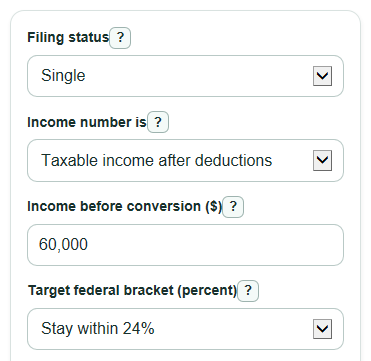
- Choose your Filing status for the 2026 federal tax year.
- Set Income number is before entering Income before conversion, because tax brackets use taxable income after deductions.
- Choose the Target federal bracket you want to stay within and enter your Planned Roth conversion.
- Open Advanced options only if you need to change Taxable part of conversion or add a Flat state tax rate.
- Check Taxable income used before conversion and Taxable room left after your planned conversion before relying on the estimate; a negative room value means the plan crosses your target bracket.
Definitions
Roth conversion: Moving money from a traditional pre-tax retirement account to a Roth account. The taxable part is generally added to income for the year.
Taxable income: Income after deductions. Federal tax brackets apply to taxable income, not gross income.
Income before conversion: Your income before adding the Roth conversion you are testing.
Income number is: The setting that tells the calculator whether your income entry is already taxable income or is income before the standard deduction.
Target federal bracket: The highest federal tax bracket you want the after-conversion taxable income to stay within.
Taxable part of conversion: The percent of the planned conversion that is added to taxable income. Use 100 percent when the whole conversion is pre-tax.
Taxable room left after your planned conversion: Dollars still left under the top of the chosen bracket. A negative number means the planned conversion crosses that bracket.
Average federal rate on the conversion: Federal tax on the conversion divided by the taxable part of the conversion.
Common mistakes and quick fixes
Mistake: Entering gross pay in Income before conversion while Income number is set to taxable income.
Fix: Change Income number is to income before the standard deduction, or enter the taxable income from your own estimate.
Mistake: Including the Planned Roth conversion inside Income before conversion.
Fix: Keep Income before conversion separate, then enter the conversion only in Planned Roth conversion.
Mistake: Reading Most you can convert and stay in the target bracket as taxable dollars when Taxable part of conversion is below 100 percent.
Fix: Treat Most you can convert and stay in the target bracket as total conversion dollars after the taxable percent adjustment.
Mistake: Ignoring Taxable room left after your planned conversion when it is negative.
Fix: A negative Taxable room left after your planned conversion means the plan goes over the Target federal bracket, even though the tax estimate is still calculated.
Mistake: Using Flat state tax rate as if it changes the federal bracket result.
Fix: Flat state tax rate only affects Optional state tax estimate and Estimated tax on your planned conversion, not federal bracket room.
Limitations & Key Assumptions / Boundary Conditions
- The calculator uses 2026 federal ordinary income tax brackets and 2026 standard deduction amounts.
- It estimates tax on the conversion only. It does not calculate your full federal tax return.
- The bracket math uses taxable income after deductions. If your actual deductions, filing status, or income change, the result can change.
- The optional state estimate uses one flat rate. It does not model state brackets, deductions, credits, exclusions, or local taxes.
- It does not model Social Security taxation, net investment income tax, Medicare IRMAA, ACA premium credits, AMT, tax credits, penalties, withholding, or estimated-tax rules.
- If a conversion is not fully taxable, you must know the taxable percent. The calculator does not compute IRA basis or pro-rata rules.
- The target bracket result is a planning estimate, not tax advice. Check the final plan with tax software or a qualified tax professional before converting.
Methodology
Tax year and brackets
The calculator uses 2026 federal ordinary income tax rates and bracket tops by filing status. It also uses the 2026 standard deduction values when Income number is set to income before the standard deduction [1].
Standard deduction amounts used are $16,100 for Single, $32,200 for Married filing jointly, $16,100 for Married filing separately, and $24,150 for Head of household.
Taxable income before conversion
If Income number is taxable income after deductions, the entered Income before conversion is used directly. If Income number is income before the standard deduction, the calculator subtracts the standard deduction for the selected Filing status and floors the result at $0.
base_taxable_income = income_before_conversion
base_taxable_income = max(0, income_before_conversion - standard_deduction)
Taxable part of the conversion
The taxable part is the planned conversion multiplied by Taxable part of conversion. This lets the estimate handle a conversion that is not fully taxable.
taxable_conversion_amount = planned_conversion_amount * taxable_part_percent / 100
Federal tax on the conversion
Federal income tax is computed in marginal layers. The calculator does not multiply all income by the highest bracket reached.
federal_tax(x) = sum over brackets of max(0, min(x, bracket_top) - bracket_bottom) * bracket_rate
Federal tax on the conversion is the difference between tax after the taxable conversion and tax before the conversion.
federal_tax_on_conversion = federal_tax(base_taxable_income + taxable_conversion_amount) - federal_tax(base_taxable_income)
Bracket room and total tax estimate
The top of the selected Target federal bracket is compared with taxable income before and after the planned conversion.
max_conversion_to_target = max(0, (target_bracket_top - base_taxable_income) / (taxable_part_percent / 100))
taxable_room_after_plan = target_bracket_top - (base_taxable_income + taxable_conversion_amount)
The optional state estimate is added after the federal tax estimate. It does not change the federal bracket room.
state_tax_on_conversion = taxable_conversion_amount * state_tax_rate_percent / 100
planned_conversion_total_tax = federal_tax_on_conversion + state_tax_on_conversion
average_federal_rate_percent = federal_tax_on_conversion / taxable_conversion_amount * 100
Worked mini-example
For a Single filer with $60,000 of taxable income before conversion, a $30,000 planned conversion, a 100 percent taxable conversion, and a 24 percent target bracket, the taxable conversion amount is $30,000 and after-conversion taxable income is $90,000. The 2026 Single 24 percent bracket top is $201,775, so the most that can be converted and stay in the target bracket is $141,775. The planned conversion stays below the target by $111,775. Because the full $30,000 falls in the 22 percent layer in this example, estimated federal tax on the conversion is $6,600 and the average federal rate is 22 percent.